You Get One Chance to Make It Look Easy
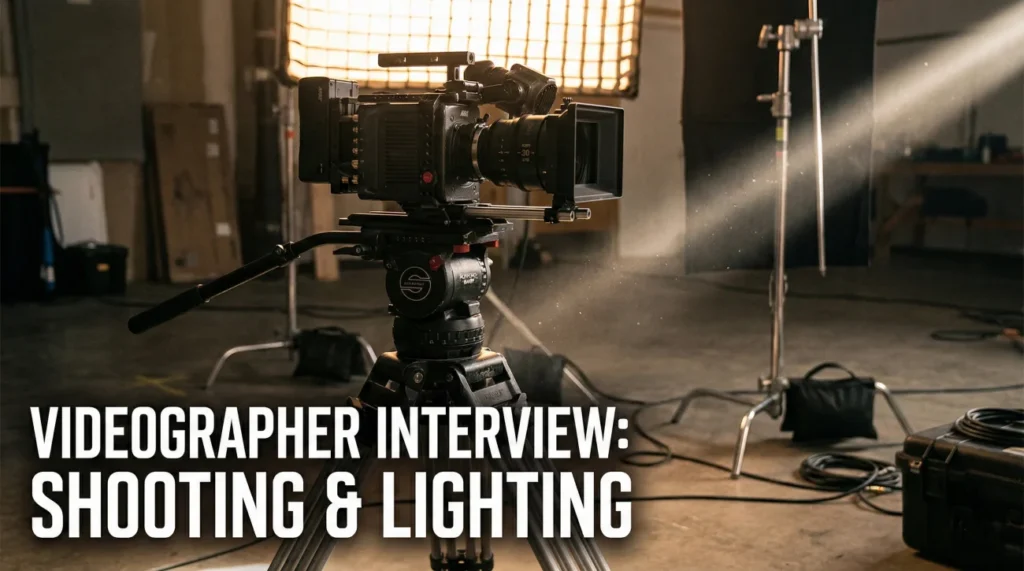
The conference room has overhead fluorescents, the CEO has 12 minutes, and the background is a wall of glass that wants to blow out. That is the reality hiding inside videographer interview questions. Hiring managers are not only looking for taste. They are looking for a person who can arrive, diagnose the room, and build a clean setup fast, without turning the shoot into chaos.
A great videographer is part technician, part director, and part therapist. You control exposure and color, but you also control nerves. You know how to get a subject comfortable, how to keep the audio safe, and how to capture enough coverage so the edit does not collapse later. When you answer, speak like someone who can deliver under time pressure and still protect quality.
This guide helps you prepare with practical priorities: exposure triangle decision-making, fast lighting setups that do not feel “studio,” and audio habits that keep the project usable even when the environment fights you.
Camera Technical Proficiency
Q: Walk me through your process for setting proper exposure.
I follow the hierarchy of the Exposure Triangle, usually prioritizing Shutter Speed first. For a cinematic look, I lock my shutter angle at 180 degrees (or double the frame rate, e.g., 1/50th for 24fps) to maintain natural motion blur.
Next, I set my Aperture (f-stop) based on the desired Depth of Field. If I want a blurry background for an interview, I open up to f/2.8. Finally, I adjust ISO to get the correct exposure level, keeping it as low as possible (Native ISO) to minimize noise. If it’s too bright outdoors, I use ND Filters to cut light rather than compromising my shutter speed or aperture choice.
Q: How do you choose the right focal length for a shot?
Focal length is an emotional choice, not just a magnification one. For an interview where I want the subject to feel flattering and separated from the background, I use an 85mm or 50mm lens. This compresses the features and avoids facial distortion.
For a dynamic, high-energy gym shoot or real estate walkthrough, I might use a 16mm or 24mm wide angle to exaggerate space and movement. I explain that wide lenses expand space, while telephoto lenses compress space, and I choose based on the story we are telling.
Q: Explain White Balance and why it matters.
White Balance is calibrating the camera to the color temperature of the light source so that white looks white, not orange or blue. It is measured in Kelvin.
I never leave it on Auto White Balance (AWB) for video because shifts in lighting during a shot can ruin the footage. I manually dial it in: 3200K for tungsten (indoor warm light) or 5600K for daylight. If I am in a mixed lighting situation, I find a middle ground or gel the lights to match the dominant source. Getting this right in camera saves hours of color correction later.
Q: What is the difference between shooting Log vs. Rec.709?
Rec.709 is the standard broadcast profile; it has contrast and saturation baked in. It is great for fast turnaround projects where there is no time for grading.
Log (Logarithmic) is a flat, desaturated profile that preserves the maximum Dynamic Range (highlights and shadows). I shoot Log for high-end projects where we want cinematic quality, as it gives us the most flexibility in post-production to recover blown-out windows or dark shadows. However, I always monitor with a LUT (Look Up Table) so I can see what the final image will roughly look like.
Lighting & Composition Techniques
Q: Explain standard 3-Point Lighting.
1. Key Light: The main source, usually placed 45 degrees to the subject, creating the primary exposure.
2. Fill Light: Placed on the opposite side to soften the shadows created by the Key. I often use a reflector instead of a light for a natural look.
3. Back/Hair Light: Placed behind the subject to create a rim of light, separating them from the background and adding depth.
Q: What is the difference between Hard Light and Soft Light?
Hard Light creates sharp, defined shadows (like the sun at noon). It creates drama and texture but can be unflattering on skin.
Soft Light wraps around the subject with gradual shadow transitions (like a cloudy day). It is universally flattering. I create soft light by using a large light source relative to the subject, usually by shooting through a softbox or diffusion silk.
Q: How do you use “Motivated Lighting”?
Motivated lighting looks natural because it mimics a source visible in the scene (a practical). If there is a window on the left, my Key light should come from the left.
If there is a lamp on a desk, I might dim the lamp but place a stronger light right outside the frame to mimic its glow. The goal is to make the lighting feel organic to the environment, not like a studio set.
Q: Explain the “Rule of Thirds” in composition.
The frame is divided into a 3×3 grid. I place important elements (like the subject’s eyes) along the intersection points or grid lines, rather than dead center.
For interviews, I frame the subject on one vertical third line and have them look across the “negative space” to the interviewer. This creates a balanced, dynamic composition that feels natural to the viewer.
Q: How do you create depth in a flat room?
I pull the subject away from the wall. Never shoot against a flat wall if you can avoid it. Distance creates separation.
I use lighting to create layers: a bright foreground, a correctly exposed midground (subject), and a darker background. I also use “leading lines” (like a table edge or hallway) to draw the eye into the frame, turning a 2D image into a 3D experience.
Q: What is “Negative Fill” and when do you use it?
Negative fill is the process of blocking light to create contrast. If a room has white walls, light bounces everywhere, making the image flat.
I bring in a black flag or “floppy” on the shadow side of the subject to absorb the bounce light. This deepens the shadows on the face, creating shape and drama (“modeling”) that makes the image look more professional and cinematic.
On-Set Scenarios & Problem Solving
You arrive at a location and the natural light is terrible (mixed color temps, harsh sun). What do you do?
I take control of the environment. If it’s mixed light (orange tungsten lamps vs. blue window light), I turn off the overhead lights and block the windows (blackout) to use my own lights, giving me 100% control.
If I must use the window, I match my lights to daylight (5600K). If the sun is harsh, I use a scrim or diffuser to soften it, or I move the subject into the shade. I never just “hope for the best”; I modify the light to suit the camera.
The interview subject is incredibly nervous and stiff.
I stop being a technician and start being a human. I step away from behind the camera. I talk to them about their day or their dog while I’m setting up to build rapport.
I tell them, “Don’t worry about the lens; just look at me/the interviewer. We can stop anytime.” I often roll camera without saying “Action” (just “Okay, let’s chat”) so they don’t freeze up. Making the tech invisible helps them shine.
You are shooting “Run and Gun” and audio is picking up wind noise.
I check my tools. Do I have a “Dead Cat” (windshield) on the shotgun mic? If not, I use my body to block the wind or move the subject to a sheltered area.
I get the mic closer. The signal-to-noise ratio improves drastically the closer the mic is to the mouth. I might switch to a lavalier hidden under a jacket which acts as a windbreaker. I monitor audio constantly with headphones; if I hear wind, I stop. Bad video is watchable; bad audio is unbearable.
Audio Mastery & Equipment
Q: What is the most important rule of capturing audio?
Get the mic close. No expensive microphone can fix the physics of distance. A $50 mic placed 6 inches from the mouth sounds better than a $1,000 mic placed 6 feet away.
I always boom from above whenever possible, aiming at the sternum, as this sounds natural and rejects background noise better than booming from below. I always record “Room Tone” for 30 seconds at the end of a shoot to help the editor patch gaps.
Q: When do you use a Lavalier (Lapel) mic vs. a Boom (Shotgun) mic?
I use a Boom for sit-down interviews because it sounds more natural and rich (“open” sound). It also doesn’t suffer from clothing rustle.
I use a Lavalier for wide shots where the boom would be in the frame, or for walking/moving subjects. Ideally, I record both on separate channels for redundancy. Having a backup audio source is non-negotiable professional practice.
Q: How do you handle RF interference (static) on a wireless mic?
I scan for clear frequencies before every shoot. If I hear static, I change the channel immediately. I ensure the transmitter (on the talent) and receiver (on the camera) have a clear line of sight.
If interference persists (e.g., in a crowded convention center), I switch to a wired lavalier or a hard-wired boom. I carry XLR cables of various lengths for exactly this reason. Wireless is a convenience; wired is a guarantee.
Q: Why do you want to be a Videographer?
I love the challenge of capturing reality and elevating it. I enjoy the technical puzzle of lighting and the emotional puzzle of composition. There is a specific thrill in being on set, solving problems in real-time, and knowing you just captured a moment that will move an audience. I want to use my technical skills to tell stories that matter.
Videography Competency Quiz
Take the 20-Question Challenge
1. The “180 Degree Shutter Rule” states that shutter speed should be:
- Equal to the frame rate
- Double the frame rate (e.g., 24fps = 1/48 or 1/50 sec)
- Four times the frame rate
- As fast as possible
2. “ISO” measures:
- Color temperature
- The camera sensor’s sensitivity to light
- Focus distance
- Lens length
3. Opening the aperture (e.g., f/2.8 to f/1.4) does what to Depth of Field?
- Makes it deeper (more in focus)
- Makes it shallower (more background blur/bokeh)
- Does not change it
- Makes the image black and white
4. “White Balance” is measured in:
- Lumens
- Kelvin (K)
- Watts
- Pixels
5. The standard color temperature for “Daylight” is roughly:
- 3200K
- 5600K
- 1000K
- 8000K
6. A “Key Light” is:
- A light for unlocking doors
- The primary/brightest light source illuminating the subject
- The light behind the subject
- The light filling in shadows
7. “ND Filter” stands for:
- No Darkness Filter
- Neutral Density Filter (sunglasses for the lens)
- New Digital Filter
- Night Day Filter
8. “B-Roll” refers to:
- Bad footage
- Supplemental footage used to visually support the main story (A-Roll)
- Audio recording
- The battery
9. A “Gimbal” is used for:
- Recording sound
- Stabilizing the camera during movement
- Lighting the scene
- Editing video
10. “Frame Rate” for standard cinematic look is:
- 30 fps
- 24 fps (or 23.976)
- 60 fps
- 120 fps
11. “Peaking” in camera assist tools helps with:
- Exposure
- Focus (highlighting in-focus edges)
- Audio volume
- Color balance
12. “Zebras” on a monitor indicate:
- Animals in the shot
- Overexposed areas (highlights clipping)
- Underexposed shadows
- Focus issues
13. A “Shotgun Mic” has what pickup pattern?
- Omnidirectional (all around)
- Directional/Cardioid (focused in front, rejecting sides)
- Stereo
- Random
14. “Gain” in audio refers to:
- The weight of the mic
- The input sensitivity/volume level
- The battery life
- The cable length
15. “Practical Lighting” means:
- Lights that are easy to carry
- Light sources that are visible within the frame (lamps, neon signs)
- Sunlight only
- Flashlights
16. “Leading Lines” are used to:
- Tie cables
- Guide the viewer’s eye toward the subject in the composition
- Measure focus
- Connect batteries
17. “Clipping” in audio means:
- Cutting the file
- The audio level is too high, causing distortion (hitting the red)
- Using a clip on mic
- Low volume
18. A “Prime Lens” has:
- Variable focal length (zoom)
- Fixed focal length (cannot zoom)
- Low quality glass
- Automatic focus only
19. “Room Tone” is:
- The color of the walls
- The sound of silence in a specific location, recorded for editing
- Background music
- The director’s voice
20. “Short Lighting” puts the shadow on:
- The side of the face furthest from the camera
- The side of the face closest to the camera (slimming effect)
- The background
- The floor
❓ FAQ
🎥 Should I tailor my reel to the role, or show everything?
Tailor it. A hiring manager wants proof you can deliver their style, not a museum of every genre you have tried. Lead with the closest match, then add one or two pieces that show range, like a fast event recap or a clean interview setup.
🎙️ What is the quickest way to show I care about audio?
Talk about redundancy and monitoring. Mention that you wear headphones, watch levels, and record a backup track when possible. You can also say you capture room tone and you do a short test before rolling on the main take.
💡 If I only have one light, what setup should I describe?
Describe a simple key-light plan. Place it 45 degrees off-axis, soften it with diffusion, and use practicals or ambient light to keep the background alive. The point is showing you can shape faces and avoid flat, harsh lighting without needing a truck of gear.
🧠 How do I answer questions about nervous on-camera subjects?
Explain your process. You build rapport before you press record, you give clear direction, and you keep the room calm. Strong answers include small tactics, like starting with easy warm-up questions and keeping the setup quiet and focused.
🧾 What is a smart way to talk about deliverables and timelines?
Be specific about scope. Mention how you confirm length, format, aspect ratios, and revision rounds up front. When you show that you manage expectations early, you sound like a professional clients and teams can trust.
Final Thoughts
When you answer videographer interview questions, aim to sound like the person who keeps a shoot stable. You notice problems early, you fix them quickly, and you keep your standards consistent from setup to export.
Close with one short example where you saved a project: bad lighting turned workable, noisy audio rescued through smart mic placement, or a tight schedule handled with a clean plan. That kind of calm problem solving is what gets you hired.
⚠️ Disclaimer: The interview strategies, sample answers, and negotiation tips provided in this guide are for educational purposes only. Hiring decisions are subjective and vary by company and industry. While these strategies are based on professional HR standards, they do not guarantee a specific job offer or result.