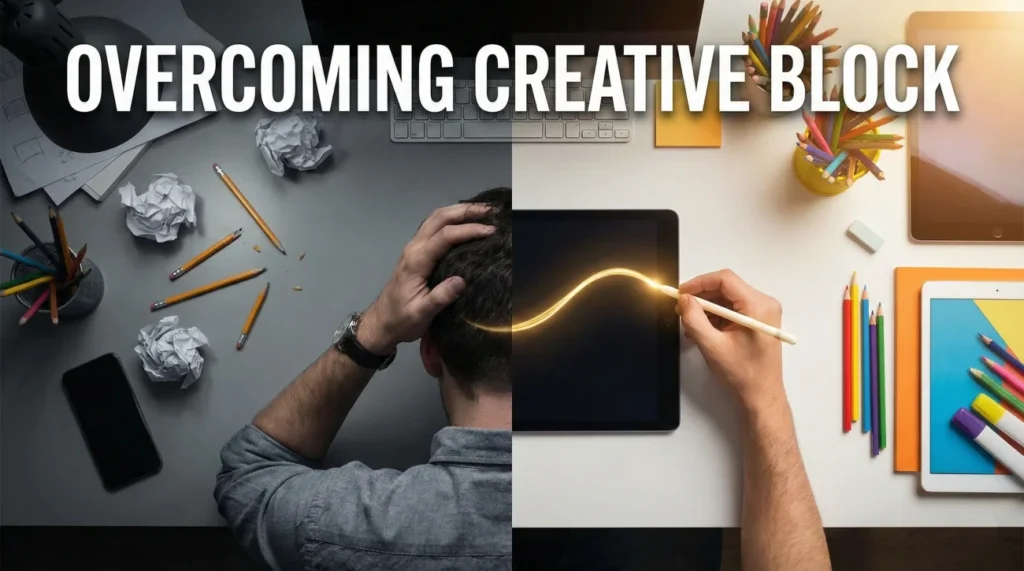
- Why it matters: Creative block can damage deadlines, client trust, and hiring evaluations because pros must deliver without waiting for inspiration.
- Root causes: Blocks usually come from perfectionism fear, burnout depletion, unclear direction, stale repetition, or pressure anxiety, and each needs a different fix.
- Fast restart tools: Generate many rough ideas first, switch mediums, add random constraints, seek fresh input, and time-box work to break paralysis.
- Environment fixes: Change location, time of day, and routine patterns to disrupt stuck loops and re-enter productive flow.
- Long game: Prevent repeat blocks with real recovery, project variety, and continuous learning so creativity stays reliable under pressure.
Why Creative Block Threatens Professional Designers
Understanding overcoming creative block proves essential for professional designers because unlike hobbyists who can wait for inspiration, working creatives face deadlines, client expectations, and career pressures that don’t pause for creative droughts. That blank page terror, the inability to generate ideas despite urgent need, or producing only derivative uninspired work under pressure affects every designer eventually regardless of talent level or experience depth.
Strong designers develop systematic approaches for restarting creativity when natural inspiration fails, recognizing that professional success requires producing quality work consistently rather than hoping for sporadic genius moments. During hiring evaluations, employers specifically assess your ability to deliver under pressure and manage creative challenges because reliability matters as much as occasional brilliance. The professionals who thrive build diverse techniques for unlocking stuck thinking, managing performance anxiety, and maintaining productive flow even when feeling creatively depleted.
Understanding Creative Block Root Causes
Effective creative block solutions begin with recognizing that different block types require different approaches, so diagnosing underlying causes helps select appropriate intervention strategies.
Perfectionism and Fear
Many blocks stem from perfectionism creating paralyzing fear that anything you create won’t meet impossibly high standards, so you never start. The blank page remains pristine because imperfect attempts feel like failures rather than necessary steps toward eventual solutions. This perfectionism intensifies under high-stakes pressure when project importance magnifies fear of producing inadequate work. Breaking this paralysis requires permission to create terrible first drafts, recognizing that iteration transforms rough concepts into polished solutions through progressive refinement rather than springing fully formed from initial inspiration.
| Block Type | Root Cause | Intervention Strategy |
|---|---|---|
| Perfectionism Paralysis | Fear of imperfect output prevents starting | Permission for terrible drafts, iterative refinement |
| Mental Exhaustion | Depleted cognitive resources, burnout | Rest, recovery, reduced workload temporarily |
| Unclear Direction | Ambiguous goals, insufficient constraints | Problem clarification, scope definition, constraints |
| Over-Familiarity | Stale thinking from repeated similar projects | New inputs, different media, cross-pollination |
| External Pressure | Anxiety about judgment, consequences, stakes | Pressure reframing, process focus, perspective shift |
Burnout and Depletion
Sometimes blocks simply signal genuine exhaustion requiring rest rather than pushing harder through depleted creative reserves. Continuous high-pressure work without recovery drains the mental resources creativity demands. If you’ve produced consistently for extended periods, struggle might indicate your creative well needs refilling through rest, new experiences, or reduced workload rather than different techniques for forcing output when you genuinely need recovery time.
Insufficient Constraints or Direction
Paradoxically, too much freedom sometimes creates blocks because infinite possibilities overwhelm decision-making. Clear constraints often unlock creativity by narrowing focus toward specific problems requiring solutions. When stuck, examine whether you truly understand the challenge, have defined success criteria, or need additional parameters creating productive boundaries for exploration. Sometimes asking better questions or establishing clearer objectives immediately breaks apparent creative paralysis.
Expert advice: The most productive creative block intervention involves diagnosing specific block type before applying techniques, recognizing that perfectionism paralysis requires different approaches than mental exhaustion or unclear direction.
Practical Techniques for Restarting Creativity
Strong design inspiration techniques provide concrete strategies for breaking through blocks when natural inspiration fails to arrive despite urgent need.
Emphasizing Quantity Over Quality Initially
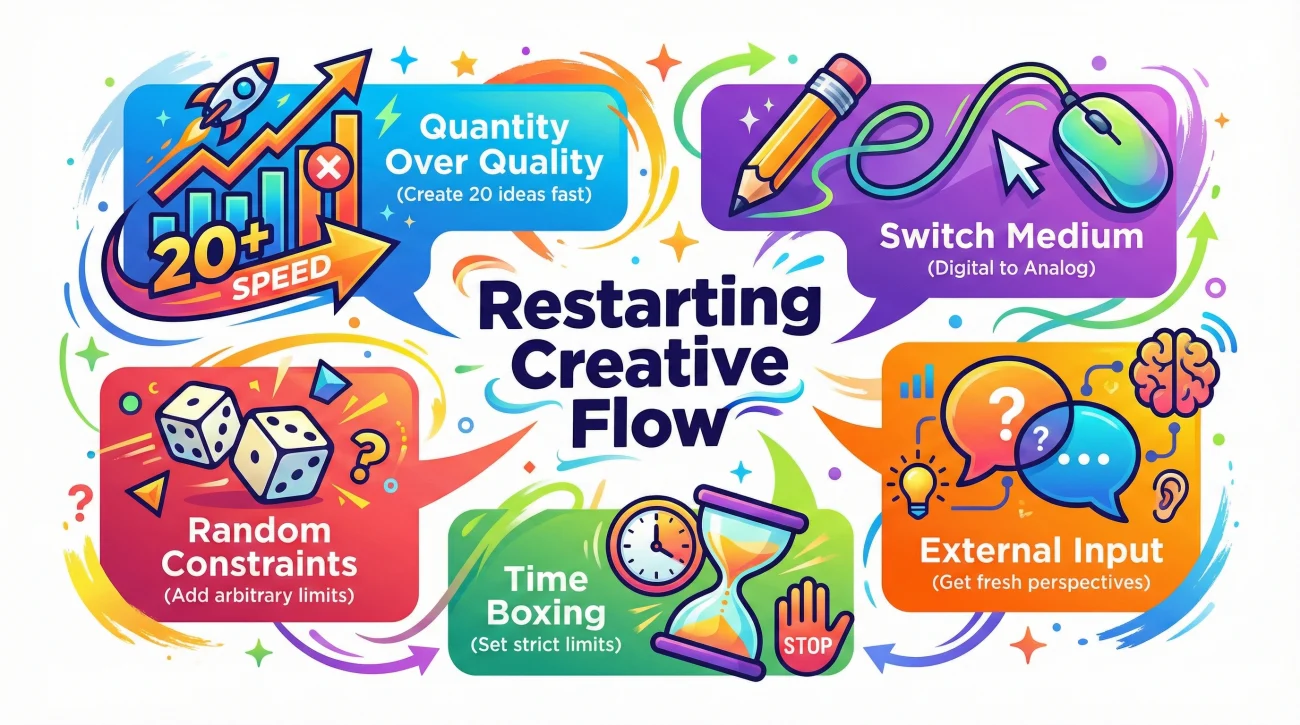
When stuck, commit to generating specific quantity of ideas regardless of quality rather than waiting for good concepts. “Create 20 rough sketches in 30 minutes” proves more productive than “develop the perfect concept.” This quantity focus removes perfectionism pressure while activating creative thinking through momentum. Later filtering separates promising directions from mediocre ideas, but initial generation phase prioritizes volume over refinement.
Switching Creative Medium Temporarily
If stuck designing digitally, sketch on paper. If struggling with visual concepts, write verbal descriptions. If paralyzed by color decisions, work in black and white. Changing medium often unlocks thinking by removing familiar tool constraints or habits that contribute to stuck feeling. This medium shift provides fresh perspective while maintaining progress on underlying problem even when primary approach feels blocked.
- 📊 Quantity generation: 20 ideas in 30 minutes, quality filtering later
- 🔄 Medium switching: Digital to paper, visual to verbal, color to monochrome
- 🎲 Random constraints: Arbitrary limitations sparking unexpected directions
- 👥 External input: Fresh perspectives breaking internal loops
- ⏰ Time boxing: Strict limits preventing endless refinement paralysis
Introducing Arbitrary Limitations
Add random constraints forcing unconventional approaches. “Design using only three colors,” “no text allowed,” “must incorporate circles,” or “solve in 15 minutes” create artificial boundaries that paradoxically expand thinking by preventing default solutions. These arbitrary limitations spark unexpected directions you wouldn’t explore with complete freedom, often revealing innovative approaches that survive constraint removal because they offer genuine improvements over conventional thinking.
💡 Pro tip: Keep “creative emergency kit” with inspirational images, interesting constraints, creative prompts, or exercises specifically for block moments; having prepared resources prevents additional decision paralysis about how to restart when already feeling stuck.
Environmental and Routine Adjustments
Effective creative productivity strategies include manipulating physical environment, schedule, and routines to support rather than hinder creative thinking.
Changing Physical Environment
Physical environment significantly impacts creative thinking. If stuck at your desk, move to different location like coffee shop, library, outdoor space, or even different room. Environmental change provides sensory stimulation, breaks habitual thinking patterns, and removes associations with previous struggles in familiar space. Some designers maintain multiple work locations specifically for fresh perspective when primary workspace feels creatively stagnant.
Disrupting Standard Routines
If you always design mornings, try evening sessions. If you work alone, collaborate temporarily. If you follow systematic process, embrace messier exploration. Routine disruption breaks automatic patterns that might contribute to stuck feeling while providing fresh neural pathways for problem engagement. However, balance disruption with maintaining some structure; complete chaos rarely helps creativity more than thoughtful variation from established patterns.
| Environmental Factor | Adjustment Strategy |
|---|---|
| Physical Location | Work from different spaces, outdoor sessions, café visits |
| Time of Day | Shift working hours, experiment with energy peaks/valleys |
| Social Context | Solo vs collaborative, silent vs music, isolation vs activity |
| Sensory Input | Different music, lighting changes, temperature variation |
| Work Duration | Shorter focused bursts vs longer sessions, strategic breaks |
Seeking New Creative Input
Creativity requires diverse input for recombination into novel outputs. When stuck, inject new stimuli through museum visits, reading outside your field, conversations with non-designers, nature exposure, or consuming media from different cultures or eras. This input diversification provides raw material for creative synthesis while preventing stale thinking that emerges from exclusively consuming work similar to your own repeatedly.
Managing Performance Pressure
Understanding designer mental blocks includes recognizing how anxiety about performance often creates or intensifies creative paralysis requiring specific pressure management strategies.
Reframing Project Stakes
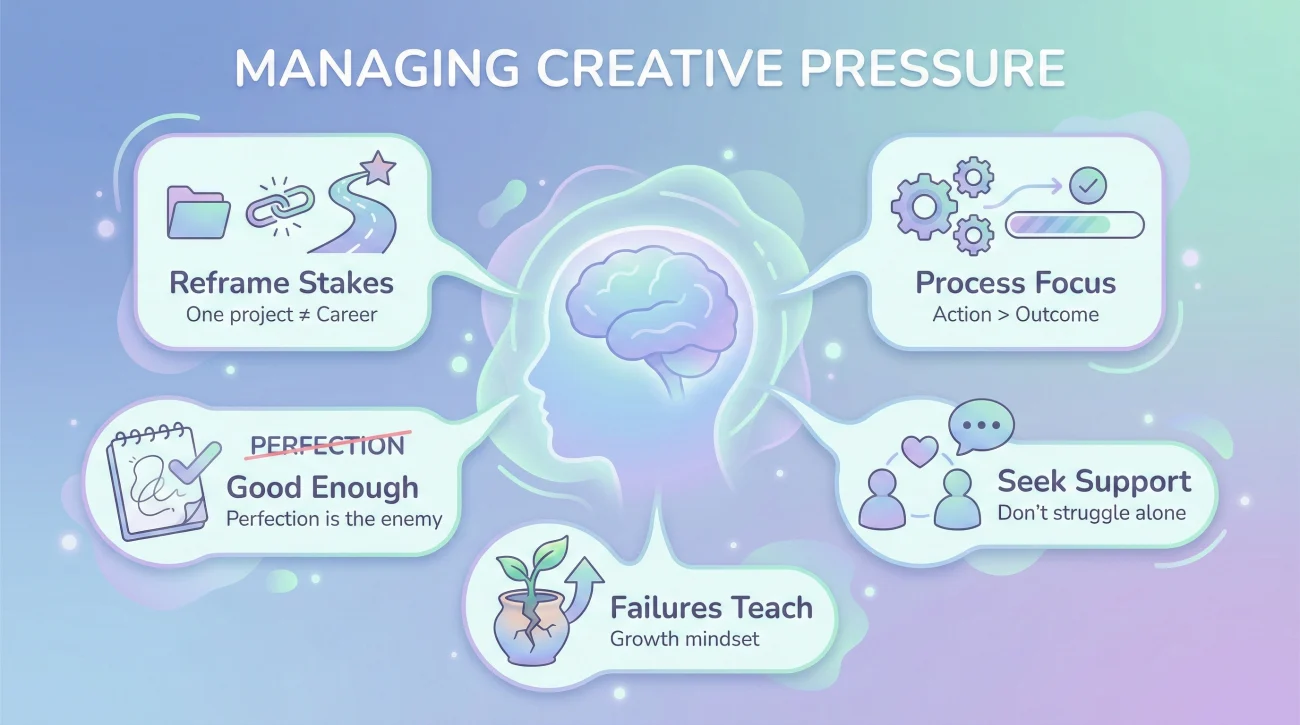
High-pressure projects magnify block severity because stakes feel enormous. Reframe perspective by remembering that even important projects represent single points in long careers, that imperfect solutions often suffice when perfect ones remain elusive, and that learning from struggles provides value beyond immediate outcomes. This reframing doesn’t eliminate responsibility but reduces paralyzing anxiety preventing productive work toward solutions even if they’re not ideal.
Focusing on Process Not Outcomes
When outcome pressure creates blocks, redirect attention toward process. “I’ll spend two hours exploring concepts” proves less paralyzing than “I must create the perfect solution.” Process focus provides achievable near-term objectives reducing anxiety while often producing outcomes as byproduct of sustained engagement. Trust that commitment to good process generally yields acceptable results even when you can’t guarantee brilliant solutions on demand.
- Remember failures teach as much as successes across career arcs
- Recognize that “good enough” often suffices when perfect remains unattainable
- Focus on controllable process rather than uncertain outcomes
- Break overwhelming projects into smaller achievable steps
- Seek support from colleagues rather than struggling alone silently
Never hide genuine creative struggles from collaborators or clients until deadlines pass; early communication about challenges enables support, timeline adjustments, or collaborative problem-solving that late crisis revelation prevents.
Building Sustainable Creative Practices
Long-term creative productivity requires preventing blocks through sustainable practices rather than only reacting once paralysis strikes.
Prioritizing Rest and Recovery
Creativity demands cognitive resources that deplete with continuous use requiring recovery through adequate sleep, strategic breaks, and periods of reduced intensity. Pushing relentlessly through exhaustion produces diminishing returns while increasing block frequency and severity. Build recovery into regular practice rather than treating rest as luxury or weakness. Your creative capacity depends on protecting the mental resources creativity demands.
Maintaining Project Variety
Working exclusively on similar projects breeds stale thinking increasing block probability. When possible, balance repetitive work with varied challenges engaging different skills or creative approaches. This variety keeps thinking fresh while preventing the over-familiarity that makes innovation difficult. Even small personal projects exploring unfamiliar territory can refresh perspective applied to primary work.
Continuous Learning and Growth
Learning new tools, techniques, or approaches provides fresh creative resources while preventing stagnation. When creativity feels blocked, sometimes you need new capabilities rather than just different mindset. Invest in skill development through courses, workshops, experimentation, or mentorship expanding your creative toolkit beyond familiar comfortable approaches that eventually limit rather than enable innovative thinking.
❓ FAQ
🎯 How do I overcome creative block with tight deadlines?
Focus on quantity over quality initially, generating many rough ideas quickly rather than waiting for perfect concepts. Use time-boxing to prevent paralysis, switch mediums temporarily, or introduce arbitrary constraints sparking unexpected directions. Accept that good enough often suffices when perfect remains unattainable under pressure.
💼 What if I experience creative block during interviews?
Talk through your thinking process aloud, ask clarifying questions about challenges, and explain how you’d normally approach blocks when not under interview pressure. Committees value seeing authentic problem-solving including acknowledging difficulty more than fake effortless brilliance suggesting you don’t understand realistic creative challenges.
⏰ How long should I struggle before trying different techniques?
If genuinely stuck for more than 30-60 minutes, try intervention rather than grinding indefinitely. Brief struggles can be productive, but extended paralysis wastes time better spent on different approaches. Switch techniques, change environment, or seek input rather than hoping breakthrough magically arrives.
📋 Should I tell clients when experiencing creative block?
Frame communication around process and timeline rather than “I’m blocked.” Say “I’m exploring several directions and will have concepts by [date]” not “I can’t think of anything.” Update clients proactively about progress rather than hiding struggles until deadlines pass preventing productive problem-solving.
✨ What if creative blocks happen frequently?
Frequent blocks suggest systemic issues like burnout, skill gaps, or unsustainable work patterns rather than temporary challenges. Assess whether you need rest, skill development, project variety, or workload reduction. Chronic blocks often signal deeper problems requiring substantial changes beyond quick-fix techniques.
Final Thoughts
Creative block affects every designer eventually because professional work demands consistent output under pressure rather than allowing luxury of waiting for inspiration. The designers who sustain long productive careers develop diverse techniques for restarting creativity when natural flow falters, recognizing that different block types require different intervention strategies and that preventing blocks through sustainable practices proves more effective than only reacting once paralysis strikes.
Mastering overcoming creative block requires building systematic approaches beyond hoping inspiration arrives magically when needed. Diagnose specific block causes before applying techniques, maintain diverse restart strategies for different situations, manage performance pressure that often intensifies paralysis, and invest in sustainable practices preventing chronic blocks through adequate recovery, project variety, and continuous skill development. This comprehensive approach transforms creative blocks from career-threatening crises into manageable challenges you navigate confidently using proven techniques that restart productive flow even when feeling genuinely stuck without obvious paths forward toward solutions.
⚠️ Disclaimer: The interview strategies, sample answers, and negotiation tips provided in this guide are for educational purposes only. Hiring decisions are subjective and vary by company and industry. While these strategies are based on professional HR standards, they do not guarantee a specific job offer or result.