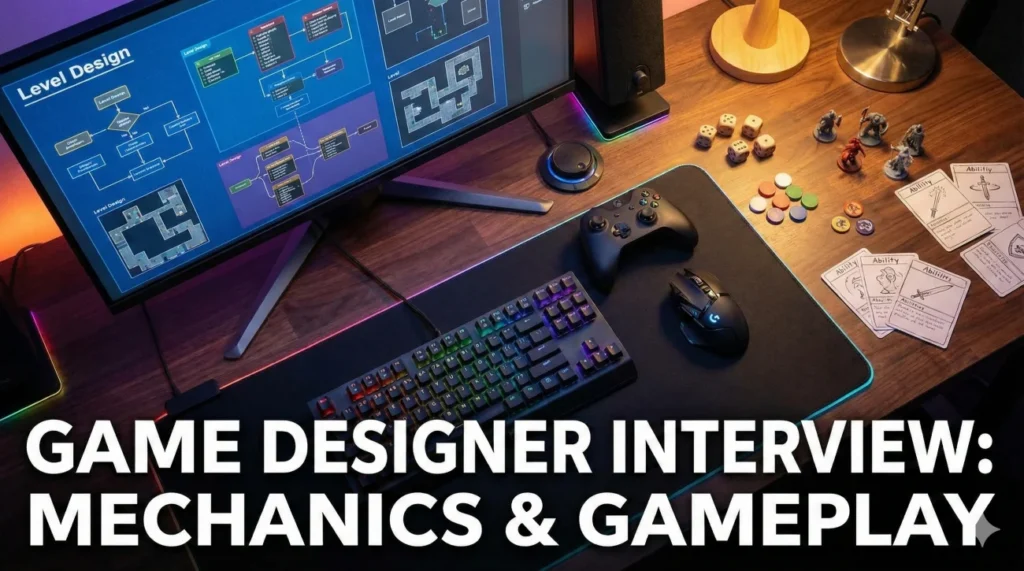
If It Is Not Playable, It Is Not Real
Game designer interview questions are rarely about having the coolest idea. They are about whether you can take a messy concept and turn it into something a team can build and a player can feel within minutes.
In a good interview, you will be pushed to explain tradeoffs. What do you cut first? How do you keep difficulty fair without making the game boring? How do you write a mechanic so clearly that engineering does not have to guess, and art does not have to reread your notes three times?
Think of your answers like a mini design doc you can say out loud: goal, constraints, player action, feedback, and what you would measure to know it is working. That mindset is what hiring teams want to hear.
Design Philosophy & Process
Q: What is the “Core Loop” of a game?
The Core Loop is the fundamental, repetitive action the player performs. For example, in an RPG, it might be: Kill Monster -> Get Loot -> Upgrade Gear -> Kill Bigger Monster.
I focus on making this loop satisfying (Game Feel). If the basic action of jumping or shooting doesn’t feel good within 30 seconds, the meta-game won’t save it. I design the core loop first and layer complexity on top.
Q: How do you approach “Prototyping” a new mechanic?
I follow the “Fail Fast” methodology. I start with paper prototyping if possible to test the logic. Then, I move to “Grey Boxing” in the engine (Unity/Unreal) using placeholder assets.
I focus on function over form. I want to test “Is this fun?” not “Does this look good?” I iterate rapidly based on team feedback, discarding ideas that are overly complex or don’t serve the core experience.
Q: Explain the difference between Game Design and Level Design.
Game Design focuses on the Rules: How high does the character jump? How much damage does the sword do? It creates the toolbox.
Level Design focuses on the Environment: Where does the player jump? Where are the enemies placed? It uses the tools to create a specific experience. I am comfortable doing both, but my strength lies in [choose one: System Design/World Building].
Q: How do you document your design (GDD)?
I believe a Game Design Document (GDD) should be a living wiki (Confluence/Notion), not a static 500-page PDF that no one reads. I write “Feature Specs” that are concise and visual.
I use flowcharts, mockups, and bullet points. I write for the consumer of the doc (the programmer or artist), focusing on the “acceptance criteria” – exactly what needs to be built to call the feature done.
Game Design Mechanics & Systems
Q: What is “Ludonarrative Dissonance”?
It creates a disconnect between the story (Narrative) and the gameplay (Ludology). Example: A cutscene shows the hero mourning a death, but gameplay requires killing 100 guards effortlessly.
I avoid this by aligning mechanics with themes. If the game is about survival, ammo should be scarce, and combat should be dangerous, reinforcing the narrative tension.
Q: Explain “Flow State” in gaming.
Flow is the zone where skill meets challenge. If the game is too hard, the player feels anxiety. If it’s too easy, they feel boredom.
I design for the “Flow Channel” by introducing difficulty curves. As the player masters a skill, I introduce a new challenge or twist to keep them engaged without overwhelming them.
Q: How do you design for different “Player Bartle Types”?
I ensure there is something for everyone: Achievers get leaderboards/badges. Explorers get hidden lore/Easter eggs.
Socializers get chat/guilds. Killers get PvP competition. A successful game balances these incentives so different player types can coexist and thrive in the same ecosystem.
Q: What is “Emergent Gameplay”?
Emergence happens when simple mechanics interact to create complex, unscripted scenarios (e.g., Breath of the Wild’s physics).
I design “Systems,” not just “Scripts.” Instead of scripting a fire to burn a specific door, I make wood flammable. This allows players to solve problems creatively in ways I didn’t explicitly plan.
Q: How do you handle “Power Creep” in a live game?
Power Creep happens when new content makes old content obsolete. I combat this with “Horizontal Progression” (new options/playstyles) rather than just “Vertical Progression” (bigger numbers).
I also use “seasons” or rotation formats to retire old meta gear, keeping the game fresh without forcing players into an endless stat spiral.
Q: Explain the concept of “Juice” or “Game Feel.”
“Juice” is the audio-visual feedback that makes an interaction satisfying. It’s screen shake, particle effects, sound crunches, and hit stops.
If a player hits an enemy, the game should confirm that hit loudly. Without juice, even a mechanically solid game feels flat and unresponsive. It bridges the gap between input and output.
Balancing & Player Experience
Players complain a weapon is “OP” (Overpowered). What do you do?
I look at the data, not just the forums. Does the weapon have a disproportionately high win rate or pick rate?
If the data confirms it, I nerf gently. I prefer to “buff the counters” (make other things stronger) rather than ruining the fun weapon. Or, I add a skill requirement (e.g., increase recoil) so it remains powerful but harder to use, rewarding mastery.
The tutorial drop-off rate is 50%. How do you fix it?
I simplify. Tutorials often fail because they front-load too much text. I adopt “Just-in-Time” learning.
I teach the mechanic when the player needs it, not all at once. I replace text boxes with visual cues or level design that forces the behavior (e.g., a high ledge that requires a jump). I watch playtests to see exactly where they get stuck or bored.
You need to monetize a Free-to-Play game without making it “Pay-to-Win.”
I focus on “Time vs. Money” or “Cosmetics.” Players can pay to speed up progress (convenience) or look cool (skins), but not to gain a statistical advantage in combat.
I design “Battle Passes” that reward engagement. Monetization should feel like a “thank you” to the developers, not a toll booth. If players feel exploited, the community becomes toxic.
Tools & Industry Trends
Q: Do you need to know how to code (C#/C++)?
I am not a gameplay programmer, but I know enough scripting (C# for Unity or Blueprints for Unreal) to prototype my own ideas. This makes me self-sufficient.
I can tweak variables (speed, damage) without bothering an engineer. Speaking the language of code allows me to write better specs and understand the technical cost of my design requests.
Q: How do you use Analytics in game design?
I treat analytics as the “silent playtester.” I look at heat maps to see where players die most often. I check retention curves.
If players are quitting at Level 3, I investigate Level 3. Is there a difficulty spike? Is the objective unclear? Data points to the problem; design provides the solution.
Q: Why do you want to be a Game Designer?
I love games because they are the only medium where the audience is an active participant, not a passive observer. I enjoy the psychological puzzle of motivating players. I get satisfaction from crafting a system that creates joy, frustration, and triumph. I want to build worlds that players want to live in.
Game Design Competency Quiz
Take the 20-Question Challenge
1. “NPC” stands for:
- New Player Character
- Non-Player Character
- No Point Contact
- Null Position Code
2. A “Whale” in monetization refers to:
- A large boss enemy
- A high-spending player (top 1% of revenue)
- A slow server
- A bug
3. “Hitbox” is:
- The box the game comes in
- The invisible geometry used to detect collisions/damage
- A punch animation
- The health bar
4. “Nerf” means to:
- Make something stronger
- Weaken a mechanic or item to improve balance
- Delete a character
- Add foam physics
5. “Buff” means to:
- Polish the graphics
- Strengthen a mechanic or item
- Remove a bug
- Slow down the game
6. “GDD” stands for:
- Graphics Display Driver
- Game Design Document
- Global Data Distribution
- Game Developer Day
7. “PvE” stands for:
- Player vs Everything
- Player vs Environment (AI)
- Player vs Enemy
- Points vs Energy
8. “HUD” (Heads-Up Display) shows:
- The game credits
- Vital info like health, ammo, and maps on the screen
- The character’s face only
- The pause menu
9. “Rubber Banding” in AI racing games:
- Connects cars with a rope
- Adjusts AI speed to keep them close to the player (fairness/tension)
- Makes the cars bounce
- Is a graphical glitch
10. “Procedural Generation” uses:
- Manual placement only
- Algorithms to create content (levels/items) automatically
- Legal procedures
- Slow loading
11. A “Mechanic” is:
- Someone who fixes the server
- A rule or method of interaction (e.g., jumping, crafting)
- The story
- The graphics engine
12. “Onboarding” refers to:
- Getting on a boat level
- The initial phase where players learn how to play (Tutorial)
- Loading the game
- Buying the game
13. “MVP” in development means:
- Most Valuable Player
- Minimum Viable Product (playable version with core features)
- Maximum Visual Polish
- Main Villian Plot
14. “QTE” stands for:
- Quest Time Event
- Quick Time Event (timed button press)
- Quality Test Engine
- Quit To Exit
15. “F2P” games monetize through:
- Upfront purchase
- Microtransactions (IAP) or Ads
- Subscriptions only
- Donations
16. A “Sprite” is:
- A 3D model
- A 2D bitmap image used in games
- A sound file
- A line of code
17. “Collision Detection” checks:
- If the game crashed
- If two in-game objects touch or overlap
- The internet connection
- The color palette
18. “Permadeath” means:
- The game is deleted
- If the character dies, progress is lost and they cannot respawn
- Infinite lives
- A glitch
19. “Fog of War” hides:
- The menu
- Unexplored areas of the map
- The graphics settings
- The enemy health bar
20. “AOE” stands for:
- Attack On Enemy
- Area of Effect (damage/healing within a radius)
- Age of Empires
- All Over Environment
❓ FAQ
🧪 What is the easiest way to prove I can design, not just talk?
Bring one small playable thing. It can be a tiny prototype, a mod, or even a paper game. Then explain what you changed after testing and why. Iteration is the proof.
📄 What should my design documentation look like?
Readable and buildable. Use clear rules, edge cases, and acceptance criteria. A great doc helps a programmer implement without guessing and helps QA know what “correct” means.
📊 How do I talk about balancing without sounding theoretical?
Talk in levers. Damage, cooldowns, economy rates, spawn rules, and reward timing. Then mention how you test changes, small adjustments, isolated experiments, and clear success criteria.
🧍 Do I need to be good at coding?
Not always, but you should be comfortable with tools. The most credible answer is that you can prototype enough to test ideas quickly and that you understand technical constraints when you write specs.
🗣️ How do I handle feedback like “this is not fun”?
I ask what the player expected, where the experience broke, and what feeling the game should create instead. Then I propose one focused change, test it, and compare results rather than debating opinions.
Final Thoughts
To win the offer, your answers to game designer interview questions should show three things: you can ship a playable core, you can explain it clearly, and you can improve it after real feedback.
Keep your close simple. Name one prototype you built, one decision you changed after testing, and one lesson you would apply next time. That combination sounds like a designer a studio can trust.
⚠️ Disclaimer: The interview strategies, sample answers, and negotiation tips provided in this guide are for educational purposes only. Hiring decisions are subjective and vary by company and industry. While these strategies are based on professional HR standards, they do not guarantee a specific job offer or result.