Beautiful Is Not the Hard Part
A client points at your rendering and says, “I love it.” Then the contractor walks the site and says, “We cannot build it like that.” That gap is where real design lives, and it is why interior designer interview questions are never only about taste.
Hiring teams want to hear how you think when reality pushes back. How you protect flow when the room is smaller than the photos. How you keep the concept intact while updating the plan to meet code, budget, lead times, and what the trades can actually execute. They are listening for decision-making, not just inspiration.
In this guide, you will learn to answer with a clear spine: purpose of the space, constraints you respect, and the specific steps you take to move from concept to construction without surprises. We cover space planning, client communication, and on-site coordination that keeps a project moving.
Design Process & Philosophy
Q: Walk me through your design process from initial consultation to installation.
I follow a structured path: Programming (Client Brief), Schematic Design (Concepts), Design Development (Refining), Construction Documents (Tech Specs), and Contract Administration (Build). I start by asking deep questions to understand the client’s lifestyle, not just their style.
I move to bubble diagrams for flow, then floor plans. Once the layout works, I layer on the aesthetics (materials, furniture). I get sign-off at each stage to prevent costly revisions later. My process ensures the design is beautiful and buildable.
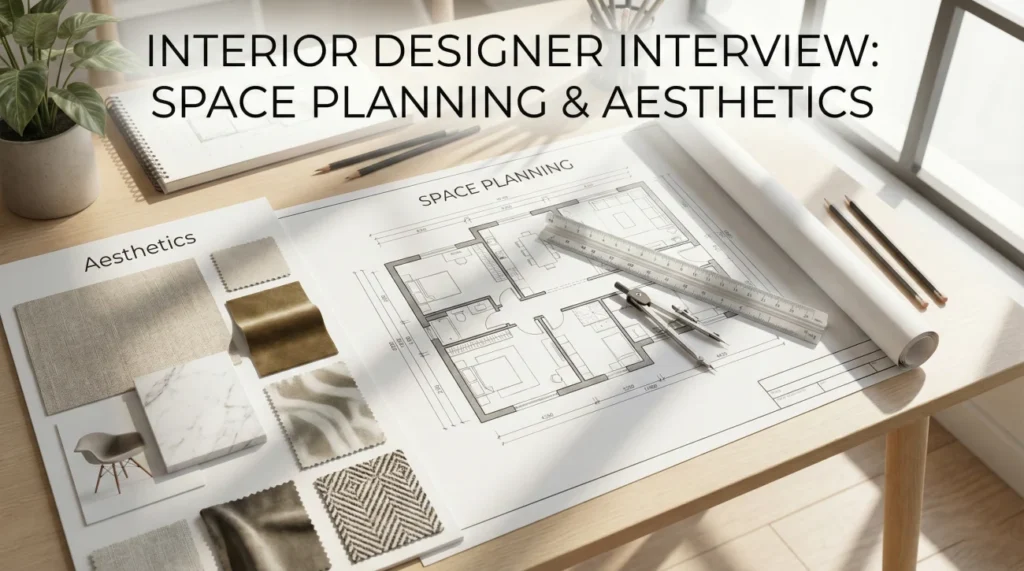
Q: How do you approach “Space Planning”?
I prioritize Function and Flow. I analyze traffic patterns to ensure clear pathways (e.g., 36 inches minimum for corridors). I place furniture to encourage conversation or focus, depending on the room’s purpose.
I consider “Adjacencies” – the kitchen should be near the dining room, but the bathroom shouldn’t open directly into the living room. I use blocking diagrams to test multiple layouts before committing to one. A pretty room that doesn’t flow is a failure.
Q: What is the difference between an Interior Designer and an Interior Decorator?
An Interior Decorator focuses on surface aesthetics: paint, fabric, and furniture. An Interior Designer deals with the volume of the space: moving walls, electrical layouts, and safety codes.
Designers are often accredited (NCIDQ) and work with architects/contractors. While I love decoration, my value lies in my ability to reshape the architecture of the interior to improve the user’s quality of life.
Q: How do you incorporate “Sustainability” into your designs?
I look at the full lifecycle. I specify materials with low VOCs (Volatile Organic Compounds) for indoor air quality. I source locally to reduce the carbon footprint of shipping.
I choose durable materials (like quartz or wool) that won’t need replacing in 5 years. I also look for certifications like LEED or Cradle-to-Cradle. Sustainability isn’t an add-on; it’s a responsible baseline for modern design.
Technical Skills & Tools
Q: AutoCAD vs. Revit: Which do you prefer and why?
I use AutoCAD for precise 2D detailing and millwork drawings. It is the industry standard for accuracy.
I use Revit (BIM) for 3D modeling and collaboration with architects. Revit allows me to see immediate clashes (e.g., a duct hitting a light fixture) and generates elevations automatically. I am proficient in both because different firms have different workflows.
Q: How do you create a “Mood Board” that sells the vision?
I create a sensory experience. I include physical samples (fabric, tile, wood) so the client can touch the texture.
I pair these with “Inspirational Images” that capture the feeling (lighting, vibe) rather than specific furniture pieces. I organize the board to show the relationship between elements (e.g., placing the rug sample under the sofa fabric) to help the client visualize the cohesion.
Q: What is your knowledge of ADA (Americans with Disabilities Act) guidelines?
I design for “Universal Design.” I know the turning radius for a wheelchair (60 inches). I ensure counters are at accessible heights or adaptable.
I check door widths (32 inches clear). ADA is not just a code requirement; it is an ethical obligation to ensure everyone can use the space with dignity.
Q: How do you create a “Lighting Plan”?
I layer light: Ambient (General), Task (Reading/Cooking), and Accent (Art/Drama).
I consider color temperature (2700K for cozy, 4000K for office). I place switches logically at entry points. I specify dimmers everywhere to give the client control over the mood. Lighting can make or break a design.
Q: Explain “FF&E” (Furniture, Fixtures, and Equipment).
FF&E refers to moveable furniture, window treatments, lighting, and accessories that are not permanently attached to the building.
I create detailed “Spec Sheets” for every item, listing the manufacturer, finish, dimensions, and lead time. This specification document is the bible for purchasing and installation.
Q: How do you handle “Millwork” detailing?
I draw custom cabinetry in CAD. I specify the “Reveal” (gaps), the hardware placement, and the material direction (grain).
I communicate closely with the cabinet maker. A good millwork drawing leaves nothing to interpretation; it shows sections and details so the built product matches the design intent perfectly.
Client Management & Budget
A client falls in love with a sofa that is way over budget.
I validate their taste (“It is stunning”). Then I present the reality: “Buying this would eat up 50% of the living room budget.”
I offer options: 1. Increase the budget. 2. Cut elsewhere (cheaper rug/lamps). 3. Find a “Look for Less” alternative that captures the style. I let them choose the trade-off. I am the financial advisor of their renovation; I present the math, they make the decision.
The contractor says your design is “impossible to build.”
I don’t get defensive. I ask, “What specific part is the issue? Is it structural or cost?” I go to the site.
Often, “impossible” means “difficult” or “I haven’t done it before.” I work with them to find a solution that maintains the design intent but simplifies the construction. I respect their expertise in building, and I ask them to respect my expertise in design.
A client hates the mood board you spent weeks on.
I treat it as data. “Tell me what isn’t working. Is it too dark? Too modern?” I detach my ego.
I realize I may have misinterpreted the brief. I ask them to show me images of what they do like again. I pivot quickly. “No problem, this was just Concept A. Based on your feedback, Concept B will focus more on [X].” I thank them for the clarity.
Aesthetics & Materials
Q: How do you stay updated on design trends?
I attend trade shows like High Point Market or NeoCon. I read publications like Architectural Digest and specialized trade journals.
However, I filter trends through “Timelessness.” I don’t specify a trendy tile just because it’s on Instagram if it will look dated in 2 years. I help clients invest in classic bones and use trends for easily swappable items like pillows or paint.
Q: How do you select materials for a high-traffic commercial space?
Durability is key. I look at the “Double Rub” count for fabrics (needs to be 50,000+ for commercial). I choose flooring like LVT (Luxury Vinyl Tile) or Porcelain that can handle wear and cleaning.
I check fire codes (Class A ratings). Aesthetics matter, but if the chair fabric rips in a month, the design failed. I balance beauty with the brutality of public use.
Q: Why do you want to be an Interior Designer?
I believe that our environment shapes our behavior and mood. A well-designed hospital room can aid healing; a well-designed office can boost productivity. I love the puzzle of fitting all the functional requirements into a beautiful package. I enjoy the tactile nature of materials and the satisfaction of walking into a finished space that started as a sketch in my notebook.
Interior Design Competency Quiz
Take the 20-Question Challenge
1. “FF&E” stands for:
- Furniture, Fabrics, and Electricity
- Furniture, Fixtures, and Equipment
- Floors, Finishes, and Entryways
- Fast, Fun, and Easy
2. The standard height for a kitchen counter is:
- 30 inches
- 36 inches
- 42 inches (Bar height)
- 24 inches
3. “NCIDQ” is:
- A design software
- The professional certification exam for interior designers
- A fabric rating
- A building code
4. A “Reflected Ceiling Plan” (RCP) shows:
- The floor pattern
- Lighting, HVAC, and ceiling details as if looking down at a mirror on the floor
- Reflections in windows
- The roof structure
5. “Elevation” drawings show:
- The view from above (Plan)
- The vertical view of a wall (straight on)
- 3D perspective
- The foundation
6. “Double Rubs” measure:
- Carpet thickness
- Fabric abrasion resistance (durability)
- Paint layers
- Cleaning frequency
7. “Biophilic Design” incorporates:
- Bio-hazard materials
- Nature elements (plants, natural light, wood) into the built environment
- Plastic furniture
- Dark colors only
8. The “Golden Triangle” in a kitchen connects:
- Table, Chair, Window
- Sink, Refrigerator, and Range (Stove)
- Microwave, Toaster, Coffee Maker
- Floor, Ceiling, Wall
9. “BIM” stands for:
- Basic Interior Modeling
- Building Information Modeling (e.g., Revit)
- Blue Ink Marker
- Building Inspection Mode
10. “Kelvin” (K) measures:
- Light brightness (Lumens)
- Light Color Temperature (Warm/Cool)
- Electricity usage (Watts)
- Fabric weight
11. A “Section” drawing cuts through:
- The budget
- The building/object vertically to show internal structure
- The timeline
- The contract
12. “VOCs” are:
- Very Old Chairs
- Volatile Organic Compounds (harmful chemicals in paint/glue)
- Visual Object Codes
- Value Of Construction
13. “Casegoods” refers to:
- Suitcases
- Furniture made of hard materials (wood/metal) like dressers, tables, chests
- Upholstered sofas
- Curtains
14. To make a small room feel larger, you should use:
- Dark colors and heavy drapes
- Light colors, mirrors, and legs on furniture (visibility)
- Large, bulky furniture
- Many small patterns
15. “Lead Time” is:
- The weight of the item
- The time between ordering an item and its delivery
- The time to design
- The metal content
16. “PO” stands for:
- Post Office
- Purchase Order
- Plan Option
- Project Owner
17. “Wayfinding” design helps people:
- Lose weight
- Navigate through a space (signage, color coding)
- Find furniture
- Buy online
18. “Scale” refers to:
- The weight of the furniture
- The size of an object relative to the space or other objects
- A measuring tool only
- The cost
19. A “Punch List” is created:
- At the start of the project
- At the end, detailing minor tasks/repairs needed to finish construction
- To order lunch
- To fight the contractor
20. “COM” means:
- Computer On Monitor
- Customer’s Own Material (fabric provided by designer to manufacturer)
- Commercial Only Model
- Cash On Monday
❓ FAQ
🧭 What is the biggest difference between school projects and real projects?
Real projects have constraints that do not negotiate, like budget ceilings, lead times, trades, and code. In interviews, the strongest answer is showing you can keep a concept strong while adapting details so the build stays realistic.
📐 Do I need to know building codes and accessibility basics?
For many roles, yes. You do not need to quote every rule from memory, but you should show that you design with clearances, safe egress, and accessibility in mind. The key is proving you check standards early, not at the end.
🗂️ What should a portfolio include besides pretty renders?
Show your thinking. Include plans, elevations, details, and a short explanation of constraints and decisions. Hiring managers want evidence you can document work so it can be built, not only admired.
🧱 How do I answer when a contractor pushes back on my design?
Stay collaborative. Ask what is impossible and why, then offer alternatives that preserve intent, like adjusting materials, changing dimensions, or revising the detail. The best answer sounds like you solve problems without ego.
🧾 How should I talk about budget with clients?
Talk about tradeoffs early and keep numbers visible. I help clients decide where to spend and where to simplify, and I document scope so surprises are limited. Clear budget communication is part of good design, not a separate task.
Final Thoughts
To earn the role, your answers to interior designer interview questions should show you can carry a project from idea to install. Great designers do not just pick finishes. They organize decisions, protect function, and keep the build aligned with the promise you sold in the presentation.
Close your interview with one crisp example where you handled constraints well, like saving a layout with smarter circulation, keeping a concept intact after a value-engineering cut, or resolving a site issue without delaying the schedule. That is the kind of confidence firms hire.
⚠️ Disclaimer: The interview strategies, sample answers, and negotiation tips provided in this guide are for educational purposes only. Hiring decisions are subjective and vary by company and industry. While these strategies are based on professional HR standards, they do not guarantee a specific job offer or result.