Read the Script Like It Is a Budget
A production designer is hired to make the story visible, but also to make it possible. That balance is why production designer interview questions can feel tough. The interviewer is listening for vision and practicality in the same sentence.
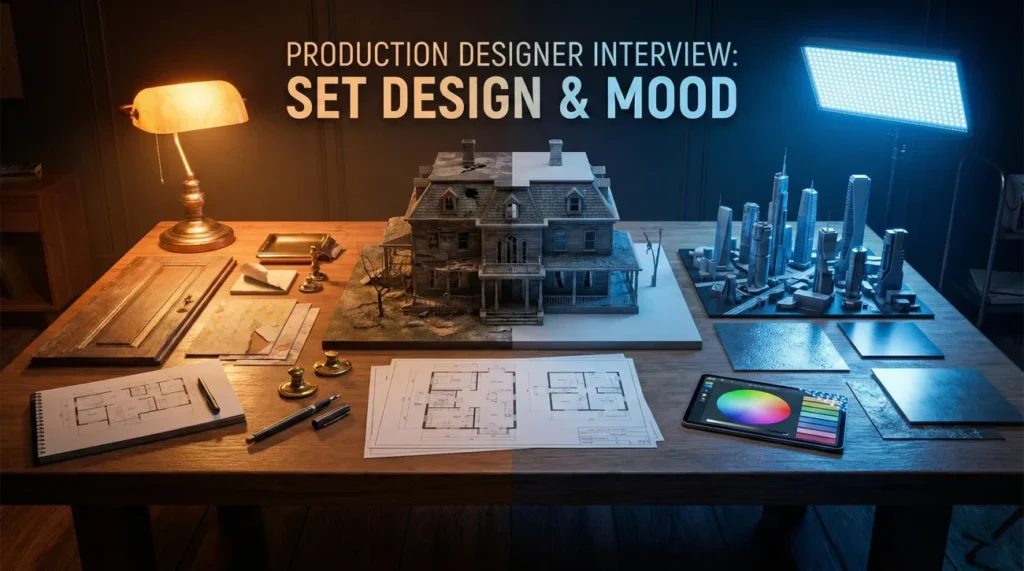
Great production design is not decoration. It is storytelling through architecture, texture, color, and space, all under time and money pressure. You have to sell a world to the director, protect it for the DP, and still give your crew something they can build safely.
As you prepare, practice explaining decisions: how a palette supports character, how you prioritize hero sets, how you pivot when locations fail, and how you keep the art department aligned when the schedule starts slipping.
Design Process & Visual Storytelling
Q: Walk me through your process from receiving the script to the first day of shooting.
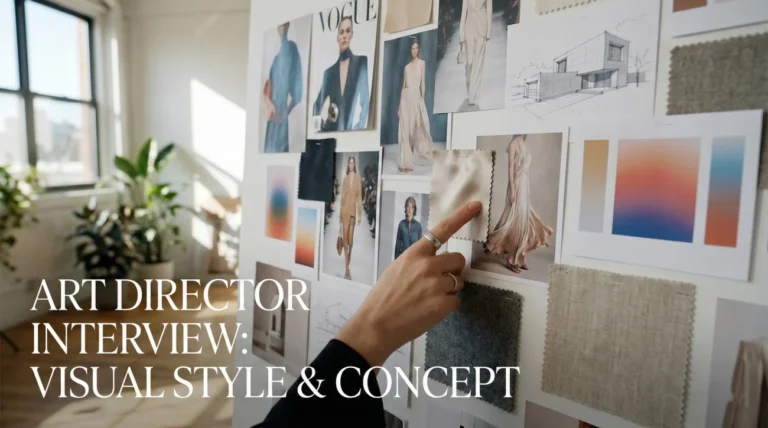
I start with a “Gut Read” of the script, noting my emotional reactions. Then I do a technical “Script Breakdown,” listing every location, prop, and vehicle needed. I create a “Look Book” or Mood Board to align with the Director on the visual tone.
Once the concept is approved, I move to scouting locations or drafting blueprints (white models) for stage builds. I hire my key crew (Art Director, Set Decorator). We then move into the “Pre-Production” phase of construction, dressing, and rigging, ensuring everything is camera-ready by Day 1. My process moves from the abstract (mood) to the concrete (nails and paint).
Q: How do you use color theory to support the narrative?
I create a “Color Script” for the film. I assign specific palettes to characters, locations, or timelines. For example, the hero’s world might be warm and saturated, while the villain’s world is desaturated and cool.
I also use color to track character arcs. As a character becomes corrupt, their environment might slowly introduce more toxic greens or bruised purples. I ensure these choices are subtle but subconscious for the audience, reinforcing the emotional beats of the script.
Q: What is the difference between a Production Designer and an Art Director?
The Production Designer is the “Head of Department” responsible for the overall creative vision and high-level management. I answer to the Director and Producer.
The Art Director is my “Chief of Staff” or project manager. They handle the logistics, budget tracking, crew scheduling, and technical drawings to execute my vision. I dream it; they ensure it gets built safely and on budget.
Q: How do you approach designing for a period piece vs. sci-fi?
For a Period Piece, I am an archaeologist. I dive into archives, paintings, and photographs to ensure historical accuracy in architecture and props, while finding the specific “texture” of that era.
For Sci-Fi, I am an inventor. I have to create a logic for the world. “How does gravity work here? What creates power?” The design must feel functional and grounded in its own reality, even if it is completely made up. Consistency is key in both genres.
Technical Skills & Budgeting
Q: How do you create an Art Department budget?
I break the script down into “Sets.” I estimate costs for Construction (materials/labor), Set Dressing (rentals/purchases), Props, and Locations fees.
I add a 10-15% contingency for last-minute director requests. I track “Actuals” vs. “Estimated” weekly. If one set goes over, I must find savings in another set to balance the bottom line.
Q: What is a “White Model” and why is it useful?
A White Model is a physical foam-core scale model of the set (usually 1/4 inch scale). It allows the Director and DP (Director of Photography) to visualize the space.
They can use a lipstick camera or phone to plan shots and blocking (“Lens the set”) before we spend money building it. It is a cheap way to catch design flaws early.
Q: How do you handle “Wild Walls”?
Wild Walls are movable sections of a set (on jacks or sliders) that can be pulled out to allow the camera to get a wider shot in a small room.
I design them into the blueprints from the start, ensuring they are lightweight enough to move quickly but sturdy enough not to wobble. This facilitates complex camera movements in tight spaces.
Q: What software do you use for drafting and visualization?
I use SketchUp or Rhino for quick 3D visualization and concepting. For technical construction drawings, I use Vectorworks or AutoCAD.
I use Photoshop/Illustrator for creating graphic props and mood boards. I am also learning Unreal Engine to collaborate better on virtual production stages.
Q: How do you manage “Clearances” (Copyright)?
Every piece of art, brand logo, or distinctive wallpaper on set must be legally cleared (“Greeked” or licensed). I work with the Clearance Coordinator.
If we can’t clear a painting, I have my scenic artists create an original piece that evokes the same mood. Avoiding lawsuits is a critical part of the job.
Q: Explain “Aging and Weathering” (Patina).
A new set looks fake. I use “Scenic Painting” techniques to add age: washes of dirt, scuff marks on floors, coffee stains on tables.
I think about the history of the room – where would hands touch the doorframe? Where would rain leak in? Adding layers of grime and wear makes the world feel lived-in and authentic.
Collaboration & Director’s Vision
The Director hates the location you scouted, but it’s the only one in budget.
I listen to why they hate it. Is it the color? The layout? I propose modifications. “We can repaint the walls, change the lighting fixtures, or build a false wall to hide that ugly kitchen.”
I show them reference photos of how we can transform the space (“The Magic”). If they still refuse, I explain the trade-off: “To afford a better location, we would have to cut the car crash scene.” I let them prioritize.
The Cinematographer (DP) complains there isn’t enough space for lights.
I collaborate with the DP early in the design phase. I integrate “Practicals” (lamps, neon signs) that actually light the scene.
I design “Fly-away” ceilings or windows that can be removed for rigging. I ensure there are “hides” for lights behind furniture. A beautiful set is useless if it can’t be lit, so I treat the DP as my creative partner, not an obstacle.
You have to design a set that reflects a character’s mental state.
I use “Environmental Psychology.” If the character is chaotic, the room is cluttered, with mismatched textures and jarring angles.
If they are lonely, I design a large, empty space with sparse, uncomfortable furniture placed far apart. I use the set as an external manifestation of their internal world. The audience should know who the character is just by looking at their bedroom.
Logistics & Crew Management
Q: How do you manage a large Art Department crew?
I hire strong department heads (Set Dec, Props Master, Construction Coordinator) and trust them. I hold daily “Stand-up” meetings to sync on the schedule.
I am clear about the vision but flexible on the execution. I protect my crew from last-minute changes by filtering requests from production. I ensure they have the resources and food they need. A happy crew builds better sets.
Q: How do you handle “Continuity” in set dressing?
I rely on the On-Set Dresser and the Script Supervisor. We take “Safety Photos” of the set before every take and at the end of the day.
If a scene is shot over two days, every book and coffee cup must be in the exact same inch-perfect spot. We use tape markers (“T-marks”) for movable props. Continuity errors break the immersion, so we are meticulous.
Q: What is your strategy for “Strike” (tearing down)?
I plan the Strike as carefully as the Build. I determine what is rented (must be returned), what is an asset (stored for sequels/reshoots), and what is trash.
I aim for sustainability – donating materials to Habitat for Humanity or other schools rather than filling a dumpster. I ensure the location is returned to its original state (or better) to protect the production’s reputation.
Q: Why do you want to be a Production Designer?
I love the total immersion of world-building. I enjoy the challenge of creating a reality that exists for the sole purpose of telling a story. I get satisfaction from the tangible nature of the job – walking onto a soundstage and seeing a sketch turned into a physical room. I want to create environments that help actors find their truth and audiences lose themselves in the narrative.
Production Design Competency Quiz
Take the 20-Question Challenge
1. A “Look Book” is used to:
- Order costumes
- Visually communicate the mood, tone, and aesthetic to the Director
- Track the budget
- Schedule actors
2. “Set Dressing” refers to:
- The walls and floor
- Items placed in the set to create detail (furniture, rugs, books) not handled by actors
- Items actors touch
- The actors’ clothes
3. A “Prop” (Property) is:
- A wall
- Any object handled or used by an actor during a scene
- A lamp in the background
- The camera
4. “Practical Lighting” sources are:
- Easy to carry
- Working light fixtures visible on screen (e.g., a desk lamp)
- The sun
- Studio lights
5. A “Wild Wall” is:
- A wall painted with graffiti
- A movable wall section that can be removed for camera access
- A wall built outdoors
- A soundproof wall
6. “Greeking” means:
- Eating Greek food
- Obscuring or replacing brand names/logos to avoid copyright issues
- Speaking Greek
- Building columns
7. The “Green Department” handles:
- Money
- Plants, trees, landscaping, and flowers on set
- Recycling
- Green screens
8. A “Swing Gang” crew member:
- Dances on set
- Moves set dressing and props onto and off the set (often overnight)
- Builds the walls
- Paints the set
9. “Concept Art” is created to:
- Sell the movie poster
- Visualize key scenes or environments before they are built
- Test colors
- Make the director happy
10. “Location Scouting” involves:
- Camping
- Finding real-world places that match the script’s requirements
- Building sets
- Drawing maps
11. A “Backlot” is:
- A parking lot
- An outdoor area of a studio containing permanent exterior sets (streets, facades)
- The back of the camera
- A storage room
12. “Atmospherics” include:
- Air conditioning
- Fog, smoke, rain, or dust added to a scene for mood
- Background actors
- Music
13. The “Art Director” typically reports to:
- The Producer
- The Production Designer
- The Director
- The Set Decorator
14. “Flat” usually refers to:
- A boring scene
- A lightweight, movable wooden frame covered in canvas/plywood used as a wall
- A type of paint
- A rug
15. “Translight” or “Backing” is:
- A heavy light
- A large photograph/painting placed outside a window to simulate a view
- A mirror
- A green screen
16. “Scenic Painting” focuses on:
- Painting landscapes on canvas
- Faux finishing surfaces to look like wood, marble, stone, or aged materials
- Painting faces
- Painting cars
17. “On-Set Dresser” (Standby) ensures:
- The actors are dressed
- Set continuity is maintained and adjustments are made between takes
- The set is built
- The food is ready
18. “Clearance” is needed for:
- Tall actors
- Using trademarked logos, artwork, or products on screen
- Moving furniture
- Cleaning the set
19. A “Soundstage” is:
- A concert venue
- A large, soundproof warehouse used for building interior sets
- A microphone
- A rehearsal room
20. The “Gold Room” or “Prop Room” stores:
- Gold bars
- Valuable small props (watches, jewelry, guns)
- Paint
- Lumber
❓ FAQ
📚 What should I bring to a production design interview?
Bring proof of process. Look books, reference pulls, sketches, floor plans, and a few final frames. Hiring teams want to see how you go from theme to build, not only the prettiest final image.
🧱 How do I show I understand construction realities?
Talk about materials, safety, and collaboration. Mention how you design wild walls, fly-away ceilings, and practical rig points, and how you loop in the art director and construction coordinator early so you do not redesign on the stage.
🖥️ How should I discuss virtual production without overhyping it?
Frame it as integration. You design foreground sets that blend with LED content, you coordinate with VFX and the volume team, and you make choices that still read on camera. The point is smooth collaboration, not software flexing.
🧾 What is a smart way to talk about budget?
Explain prioritization. Identify what must be built, what can be cheated, what can be rented, and where you can reuse assets. Show that you track tradeoffs and protect the story beats that matter most.
🧠 How do I answer questions about leadership and crew culture?
Be specific about communication. Daily check-ins, clear boards, realistic deadlines, and shielding the crew from chaos when possible. Strong candidates respect craft and keep the department steady under pressure.
Final Thoughts
To stand out in production designer interview questions, speak like a builder of worlds and a manager of reality. You translate theme into space, then protect that space through budget, schedule, and last-minute change.
For more prompts to rehearse, use the full interview questions library and practice answering with one example per story: the constraint, the choice, and what ended up on screen.
⚠️ Disclaimer: The interview strategies, sample answers, and negotiation tips provided in this guide are for educational purposes only. Hiring decisions are subjective and vary by company and industry. While these strategies are based on professional HR standards, they do not guarantee a specific job offer or result.