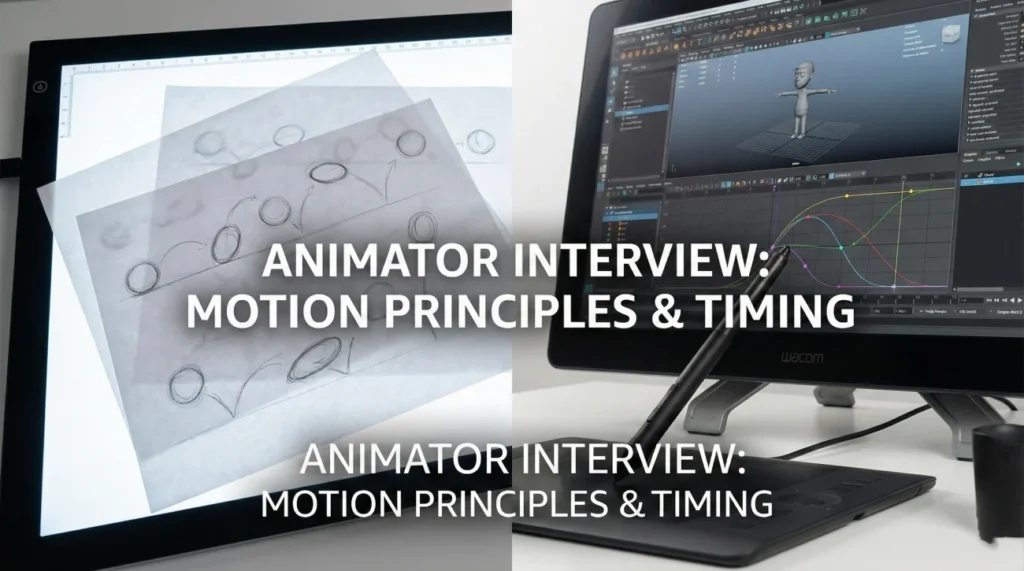
Make the Motion Feel Inevitable
Animation is not “moving a rig.” It is making an audience believe a thought happened, then a body followed. That is what Animator interview questions are really trying to measure: can you create intention, weight, and timing that reads instantly.
Studios do not hire the person who can recite theory. They hire the person who can take feedback like “it feels floaty” or “the pose is unclear” and turn it into a cleaner silhouette, stronger contacts, better spacing, and a performance that lands emotionally. The work is technical, but the goal is always acting.
Use this guide to frame your answers around how you think: reference, blocking choices, polish decisions in the graph editor, and how you collaborate with rigging and layout so the shot stays stable from first pass to final.
The 12 Principles of Animation
Q: Explain “Squash and Stretch” and its purpose.
Squash and Stretch gives weight and flexibility to an object. It defines the rigidity of the material.
A bouncing ball squashes when it hits the ground (impact) and stretches when it is in the air (velocity). The key rule is Volume Preservation: if it gets flatter, it must get wider. Without it, animation looks stiff and robotic.
Q: What is “Anticipation” and why is it critical?
Anticipation is the preparation for an action. It tells the audience what is about to happen so they don’t miss it.
Before a character jumps, they must crouch down. Before a punch, they pull back. It builds energy and realism. Without anticipation, actions feel sudden and weightless (“pop”).
Q: Differentiate between “Timing” and “Spacing.”
Timing is when something happens (the number of frames an action takes). It defines the speed.
Spacing is how it happens (the distance between frames). It defines the acceleration/deceleration (Ease In/Out). Uniform spacing looks mechanical; varied spacing creates natural, organic movement.
Q: Explain “Follow Through” and “Overlapping Action.”
This principle dictates that nothing stops all at once. When a character stops running, their hair or coat continues to move forward (Follow Through).
Overlapping Action means different body parts move at different rates. The arm might move after the shoulder. This “drag” adds realism and fluidity, preventing the “mannequin” effect.
Q: What is “Staging” in animation?
Staging is the presentation of an idea so it is unmistakably clear. It involves camera angle, lighting, and composition.
I use strong silhouettes to ensure the pose is readable instantly. If a character is sad, the staging should isolate them. Good staging directs the viewer’s eye to the most important part of the scene.
Q: Explain “Exaggeration” in a realistic style.
Even in realism, literal motion can look dull. Exaggeration pushes the essence of the action to make it read clearly.
If a character is sad, I make them very slumped. If they are fast, I push the blur. It is not about distortion (like cartoons), but about emphasizing the emotional truth of the movement so the audience feels it.
Creative Process & Acting
How do you approach a dialogue shot (Lip Sync & Acting)?
I listen to the audio track hundreds of times to find the inflection points and breaths. I record video reference of myself acting out the line to find natural gestures.
I animate the body first (body language), then the head, and finally the mouth. Lip sync is not just opening/closing; it’s about the jaw and the eyes. The emotion comes from the eyes (upper face), not the mouth shape.
Your animation feels “floaty” or weightless. How do you fix it?
I check the spacing on the contact frames. Floaty animation usually has even spacing on landings.
I sharpen the impact. I make the contact frame hit hard (larger spacing gap) and then settle. I also check the arcs; gravity creates parabolas. If the motion path is too linear, it looks unnatural. I ensure there is a clear sense of gravity pulling the object down.
You have to animate a quadruped (dog/horse) but have never done it.
I study reference footage frame-by-frame (Muybridge is the bible). I identify the gait pattern: Walk (4 beats), Trot (2 beats), Canter (3 beats), Gallop (4 beats).
I focus on the spine mechanics. In quadrupeds, the spine is a suspension bridge that flexes and extends. If the spine is stiff, the animal looks like a table. I block out the hips and shoulders first before worrying about the paws.
Technical Skills & Workflow
Q: Pose-to-Pose vs. Straight Ahead: Which do you use and why?
I use Pose-to-Pose for character acting and dialogue because it allows me to plan the key storytelling beats (Golden Poses) and timing first. It ensures structure.
I use Straight Ahead for fluid elements like fire, water, or hair, where the physics of the previous frame dictates the next. Often, I combine them: blocking in Pose-to-Pose, then refining with Straight Ahead spontaneity.
Q: How do you use the Graph Editor (Curve Editor)?
The Graph Editor is where the polish happens. I use it to clean up messy keys and refine spacing. I look for smooth arcs (“f-curves”).
I use tangent handles to adjust the Ease In/Out. If I want a sharp impact, I break the tangent to create a V-shape. If I want a smooth drift, I flatten the curve. Mastering the graph editor separates beginners from pros.
Q: Explain “Rigging” from an animator’s perspective.
I am not a rigger, but I understand how a rig works so I can communicate with the TD (Technical Director). I know the difference between FK (Forward Kinematics) and IK (Inverse Kinematics).
I use IK for legs/arms contacting a surface (planting) and FK for swinging motions (walking arms). If a rig is breaking (deforming badly), I can take a screenshot and explain “The weight painting on the shoulder is shearing” rather than just saying “It’s broken.”
Q: Why do you want to be an Animator?
I love the magic of creating life from nothing. There is a specific moment when you press play and the character suddenly thinks and feels – that is addictive. I enjoy the blend of technical precision and pure acting. I want to tell stories that resonate emotionally, using movement as my language.
Animation Competency Quiz
Take the 20-Question Challenge
1. “Squash and Stretch” preserves:
- Color
- Volume (Mass)
- Time
- Lighting
2. “Anticipation” prepares the audience for:
- The credits
- An upcoming action
- A flashback
- Silence
3. “Staging” is primarily about:
- Building a stage
- Clarity of the idea/action (Silhouette)
- Color correction
- Rendering speed
4. “Straight Ahead” animation is drawn:
- Backwards
- Frame by frame from start to finish linearly
- Only keyframes first
- Using a ruler
5. “Pose to Pose” involves drawing:
- Only the background
- Key poses first, then filling in the in-betweens
- Random frames
- The end first
6. “Follow Through” refers to:
- Following instructions
- Parts of the body continuing to move after the main body stops
- Walking through a door
- Finishing the project
7. “Slow In and Slow Out” (Ease) mimics:
- Robots
- Physics (inertia/acceleration/deceleration)
- Teleportation
- Freezing
8. “Arcs” are important because:
- They are easy to draw
- Most natural movement follows an arched trajectory (not straight lines)
- They look cool
- Computers prefer them
9. “Secondary Action”:
- Distracts from the main action
- Supports the main action to add dimension (e.g., a sad person wiping a tear while walking)
- Happens second
- Is optional
10. “Timing” refers to:
- The time of day
- The number of frames (speed) of an action
- The stopwatch
- The deadline
11. “Exaggeration” is used to:
- Lie
- Make the action clearer and more appealing (pushing reality)
- Scare the audience
- Hide mistakes
12. “Solid Drawing” means:
- Using a thick pen
- Understanding 3D space, volume, and weight in a drawing
- Drawing rocks
- Drawing without erasing
13. “Appeal” in animation is equivalent to:
- Being pretty
- Charisma (making the character interesting to look at)
- Begging
- Being funny
14. “IK” (Inverse Kinematics) moves the arm by:
- Rotating the shoulder
- Moving the hand (the chain follows the end effector)
- Moving the head
- Using magic
15. “FK” (Forward Kinematics) moves the arm by:
- Moving the hand
- Rotating the shoulder, then elbow, then wrist (parent drives child)
- Moving the hips
- Telepathy
16. A “Walk Cycle” typically loops every:
- 2 frames
- 2 steps (Left, Right, back to Left)
- 100 frames
- 1 step
17. “Lip Sync” focuses primarily on:
- Every single letter
- Vowel shapes and key consonants (M, B, P)
- Tongue movement
- Breathing
18. The “Graph Editor” visualizes:
- The stock market
- Interpolation curves (value vs. time) of keyframes
- The script
- Color palette
19. “Breakdown” drawings are:
- Drawings of broken items
- The drawings between keyframes that define how the character moves
- Final polish
- Backgrounds
20. “Twinning” (a mistake) happens when:
- Two characters look alike
- Both sides of the body move symmetrically at the same time (looks robotic)
- The animation is too fast
- The render fails
❓ FAQ
🎬 What should be in a strong demo reel?
Only your best work, and only what matches the job. Open with your strongest shot, keep the reel short, and include a clean breakdown of what you animated. Hiring teams want clarity, not volume.
🧩 How do I talk about feedback without sounding defensive?
Frame feedback as iteration. I ask what the note is trying to improve, then I propose a change that targets it, like stronger anticipation, a clearer pose, or tighter spacing on impacts. The goal is alignment, not arguing.
🧠 Do I need to memorize the 12 principles for interviews?
Knowing the language helps, but proof matters more. If you can explain why a motion looks weightless and how you would fix it with contacts, arcs, and spacing, you already sound like a working animator.
🪞 How much reference should I use?
As much as it takes to remove guessing. I pull real-world reference for mechanics, then I push it where the shot needs readability. Reference keeps the physics honest, and your choices turn it into performance.
🕹️ Is game animation different from film animation?
Yes. Film is shot-based, game work is system-based. In games, cycles and transitions must blend, read from multiple angles, and support gameplay. In film, you can tailor choices to one camera and one cut. Saying you understand that difference is a quick credibility boost.
Final Thoughts
A great interview answer sounds like a shot plan: what the character wants, what the key poses communicate, where the contacts land, and how you will polish timing and spacing until it feels real. That is how you stand out in Animator interview questions.
If you want extra practice prompts, jump into the interview questions hub and rehearse short, specific stories: a note you received, the exact change you made, and why it fixed the problem.
⚠️ Disclaimer: The interview strategies, sample answers, and negotiation tips provided in this guide are for educational purposes only. Hiring decisions are subjective and vary by company and industry. While these strategies are based on professional HR standards, they do not guarantee a specific job offer or result.