Owning the Front Door
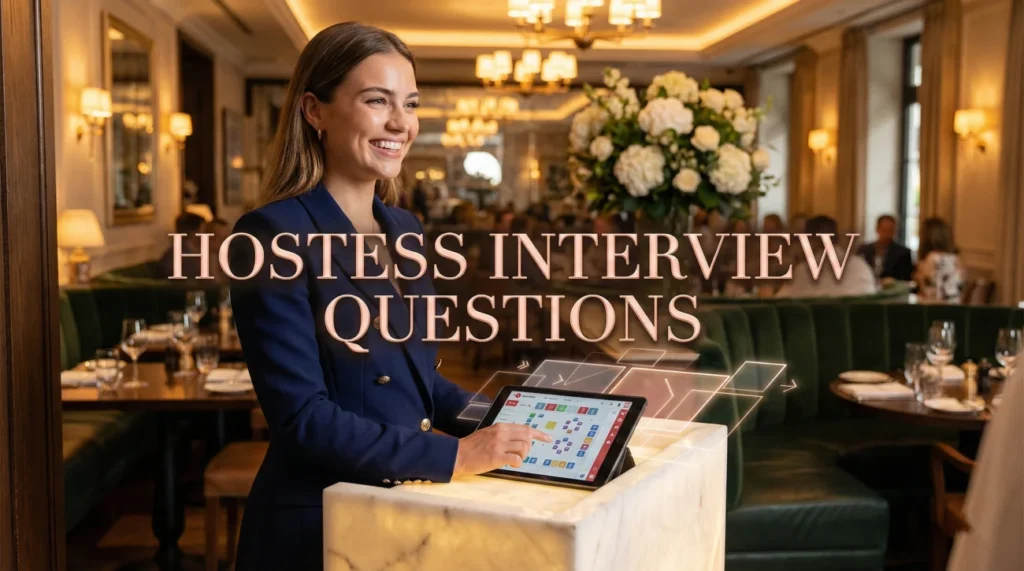
Hostess interview questions are about control, not just friendliness. The host stand is where expectations are set, wait times are negotiated, and the whole room stays in rhythm. One shaky decision at the podium can domino into angry guests, slammed servers, and a stressed kitchen.
Interviewers will push on your judgment: how you quote waits, manage walk-ins, handle reservations that arrive early, and keep your tone steady when the lobby gets loud. Your goal is to prove you can be warm and firm at the same time, because that is the job.
The Art of the Greeting & Brand Ambassadorship
The podium is the face of the brand. Interviewers want to see that you understand the weight of being the first and last person a guest interacts with.
Q: Describe the perfect guest greeting in your own words.
Answer: The perfect greeting is immediate, warm, and professional. Even if I am on the phone or checking the iPad, I must make eye contact and give a friendly nod to the new arrivals so they feel seen. A standard script might be: “Good evening! Welcome to [Restaurant Name]. Do you have a reservation with us tonight?” I maintain an open posture and ensure my grooming reflects the establishment’s standards. I treat every guest as if they are entering my own home.
Q: How do you handle a guest who enters while you are in the middle of a phone call?
Answer: I prioritize the physical guest while remaining polite to the caller. I make immediate eye contact with the guest and give a “one moment” gesture with a smile. I then politely ask the caller: “Do you mind holding for just one moment while I check a guest in?” Once they agree, I quickly check the guest’s name or party size. If the check-in is complex, I ask for the guest’s name and tell them: “I’ll be with you in just a second to show you to your table.” I never ignore a person standing in front of me for a phone call.
Q: What is the most important part of the “Farewell” (the exit)?
Answer: The farewell is the last memory the guest takes home. I never let a guest leave without a sincere “Thank you for joining us, hope to see you again soon!” If I notice they have leftovers, I offer a bag or help with their coat. If they had a specific celebration, I mention it: “Hope you had a wonderful birthday!” This personalized touch turns a transaction into a relationship, which is the core of hospitality.
Q: How do you represent the “Brand Voice” at the podium?
Answer: I adapt my energy to the venue. If it is a high-energy bistro, I am upbeat and fast-paced. If it is a quiet fine-dining room, I am more reserved and formal. I use the specific language the brand prefers (e.g., “Certainly” instead of “Sure”). I view myself as a diplomat; I must stay on-brand even when guests are difficult, ensuring the reputation of the restaurant remains intact.
Seating Strategy & Station Rotation
Seating is a math problem. If you seat too many people at once, you crash the kitchen. If you seat the wrong station, you upset the servers. These questions test your tactical thinking.
Q: What is “Station Rotation” and why is it vital for the restaurant?
The Strategy: Fairness and Flow.
Answer: Station rotation is the practice of distributing guests evenly among the servers’ assigned sections. It is vital for two reasons: First, it ensures no single server gets “slammed” (triple-seated) while another is bored, which maintains service quality. Second, it prevents the kitchen from receiving 10 orders at the exact same minute. I keep a mental or digital tally of “covers” per server to ensure everyone earns a fair amount of tips while keeping the pace manageable.
Q: A guest demands a booth, but all booths are reserved for larger parties later.
The Strategy: The “Yes, but” Technique.
Answer: I try to accommodate them without compromising the night’s flow. I say: “I would love to give you a booth, but those are currently held for reservations. However, I have a beautiful corner table with a great view available right now. Would you prefer that, or would you mind waiting about 20 minutes for the next booth to open?” Often, offering a specific alternative makes them feel like they have a choice rather than just being told “No.”
Q: How do you handle “Double Seating” a server?
The Strategy: Communication Loop.
Answer: I avoid it if possible, but on busy nights, it happens. If I must seat two tables in one section back-to-back, I tell the server immediately: “I just sat 21 and 24 for you; I’ll grab water for 24 to give you a head start.” I also alert the manager so they can help with the initial greeting. Communication prevents the server from feeling blind-sided and ensures the second table doesn’t sit there for 5 minutes without being acknowledged.
Q: How do you estimate “Wait Times” accurately?
The Strategy: Under-promise, Over-deliver.
Answer: I look at the “state of the table” in the dining room. Are they on desserts? Did they just get mains? I check the average turn time (e.g., 90 mins for dinner). If I think a table will be ready in 15 minutes, I tell the guest “20-25 minutes.” It is much better to seat someone 5 minutes early than 5 minutes late. I also monitor the “Waitlist” on my iPad to see how many parties are ahead of them.
Q: What is your process for managing a large “Incomplete Party”?
The Strategy: Policy Enforcement with Empathy.
Answer: House policy usually dictates that we don’t seat until at least 50% or 100% of the party is present to avoid tying up a large table. I say: “We would be happy to seat you as soon as the rest of your party arrives. In the meantime, would you like to grab a drink at the bar? I will come find you the second everyone is here.” This keeps the table open for full parties who are ready to order, maximizing revenue.
Q: How do you handle a “VIP” or regular who walks in without a reservation?
The Strategy: Recognition and Creativity.
Answer: I greet them by name if I know it. I immediately alert the manager: “Mr. Jones is here.” I look for “hidden” space – perhaps a table that isn’t reserved for another hour, or I check if the bar has an opening. I never just say “We’re full” to a regular. I try to find a solution, even if it is just a complimentary drink at the bar while I “work my magic” on the floor plan. Recognition is the best form of service.
Technology & Reservation Systems
The modern hostess stand is a digital hub. You need to be proficient with software to manage the inventory of tables.
Q: Which reservation platforms have you used (OpenTable, Resy, Yelp)?
Answer: I am highly proficient with both OpenTable and Resy. I am comfortable with the “Floor View” to track table status (Seated, Appetizer, Paid), managing the “Book” to maximize covers, and adding detailed guest notes (allergies, anniversaries). I also know how to use the automated waitlist feature to text guests when their table is ready, which reduces crowding at the front door. If you use a different proprietary system, I am very tech-savvy and can learn the interface in a single shift.
Q: How do you use the iPad to “Maximize the Book”?
Answer: I look for “gaps” in the schedule. If I have a 2-top reservation at 6:00 and another at 8:00 on the same table, I know I can squeeze in a walk-in at 7:00 if they promise to be quick. I also look at “Table Combinations” – knowing when to push two 2-tops together for a 4-top vs. keeping them separate. I proactively move reservations around the floor plan to keep large tables open for bigger parties. Efficiency on the iPad translates to higher sales for the restaurant.
Q: How do you handle a “Technical Glitch” where a reservation is lost?
Answer: I never blame the guest or the software. I apologize sincerely: “It seems there was a hiccup in our system, and I don’t see your name here. I am so sorry for the confusion.” I immediately check with the manager to see how we can squeeze them in. I prioritize them as the next available table and perhaps offer a complimentary appetizer or round of drinks for the inconvenience. The goal is to make them feel like we are solving the problem, not debating it.
Q: Why is “Guest Notes” or “Tags” important in the system?
Answer: Data is the key to personalized service. If a guest is tagged as “Likes quiet corner” or “Severe Nut Allergy,” I can ensure the server is briefed before they even say hello. In my last role, I made it a point to check for “First Time Guest” tags so I could give them a special welcome. This information helps the entire team provide a higher level of hospitality that feels custom-made for the individual.
Situational & Conflict Resolution
The hostess stand is where guests vent their frustration about wait times. You must be the “calm in the storm.”
A guest is yelling because their table isn’t ready 10 minutes after their reservation time.
The Strategy: Validate and Reassure.
Answer: I stay calm and lower my voice. “I completely understand your frustration, and I apologize for the delay. We are waiting on a specific table to finish their check, and it is taking a few minutes longer than expected.” I offer a concrete update: “It should be just another 5 minutes. Can I walk you to the bar and have the first round of drinks sent over on us while you wait?” Most people stop yelling when they feel heard and compensated for their time.
A server comes to the podium and complains that you are “burying” them with too many tables.
The Strategy: Teamwork over Ego.
Answer: I don’t get defensive. I listen to their concern: “I hear you, you’re slammed.” I check the floor plan. If I did make a mistake in rotation, I apologize and promise to skip them for the next two turns. If the whole restaurant is just that busy, I say: “I’m sorry, everyone is on a wait right now. I’ll ask the manager to send the runner to help you with water and bread so you can catch up.” I view the servers as my internal customers; if they fail, the guest experience fails.
How do you handle a “Walk-out” (guest leaves while on the waitlist)?
The Strategy: List Hygiene.
Answer: I try to prevent it by “touching” the waitlist guests every 10 minutes. “Thanks for your patience, you’re #2 on the list now!” If they do leave without telling me, I remove them from the system immediately once they don’t answer the text/page so the list stays accurate for the remaining guests. I always apologize to the next party: “Thanks for waiting, I have a table opening right now!” and keep the energy positive.
The “Pivot” and Team Collaboration
You are the communication bridge between the kitchen, the servers, and the guests. This section explores your ability to multitask.
Q: How do you communicate with the kitchen (Chef) regarding pacing?
Answer: I don’t talk to the Chef directly about cooking, but I give them “Heads Up” warnings. If I see a party of 12 walking in, I alert the Expo or Chef: “Large party of 12 just seated.” If we are on a 1-hour wait, I tell them: “We have 40 people on the waitlist, expect a heavy push for the next two hours.” This allows the kitchen to prep extra or pace themselves. I am the “scout” for the kitchen brigade.
Q: What do you do when the dining room is slow?
Answer: I practice “ABC” (Always Be Cleaning). I sanitize the menus, organize the coat check, and clean the glass on the front doors. I also check the restrooms to ensure they are stocked and tidy. I might also help the servers by running water or bread if they are tied up with a complex order. I never just stand behind the podium looking at my phone; there is always something to do to improve the guest experience.
Q: Describe your relationship with the “Busser” team.
Answer: The bussers are my best friends. If they don’t clear tables, I can’t seat guests. I communicate with them constantly: “I need Table 42 reset ASAP for a reservation.” I treat them with respect and thank them when they flip a table quickly. Sometimes, if they are buried, I will physically help them clear a table or reset the silverware so I can get my guests seated faster. We are one team with one goal.
Hostess & Seating Management Quiz
Test Your Podium IQ
1. “Covers” in a restaurant refers to:
- Tablecloths
- The number of individual guests served
- Lids for food
- The manager’s salary
2. A “Deuce” is restaurant slang for:
- A bathroom break
- A table for two people
- A $2 tip
- A second course
3. “Triple Seating” a server is considered:
- A great way to make them rich
- A mistake that can crash their service quality
- Required during lunch
- Illegal
4. What does “Flipping a Table” mean?
- An angry guest throwing the table
- Cleaning and resetting a table for the next party
- Changing the menu
- Rotating the dining room
5. A “No-Show” is a guest who:
- Doesn’t have a reservation
- Has a reservation but doesn’t arrive or call to cancel
- Leaves without paying
- Is invisible
6. “Waitlist Pacing” ensures:
- The guests walk faster
- The kitchen and servers aren’t overwhelmed by too many orders at once
- The host gets a break
- The music is loud
7. “OpenTable” and “Resy” are examples of:
- Types of food
- Reservation and table management systems
- Cleaning supplies
- Uniform brands
8. If a guest has a “Special Occasion” tag, you should:
- Ignore it
- Acknowledge it during greeting and alert the server/manager
- Charge them extra
- Give them a free meal immediately
9. “Walk-in” refers to:
- A thief
- A guest who arrives without a prior reservation
- A refrigerator
- An outdoor table
10. The primary goal of “Station Rotation” is:
- To make the host’s job easier
- To distribute workload and tip potential fairly among servers
- To move the furniture
- To confuse the guests
11. A “Runner” usually delivers:
- Food and drinks from the kitchen/bar to the table
- The check
- The guest’s coat
12. “Pre-shift” is a meeting held:
- After the shift
- Before service begins to discuss specials and goals
- During the lunch break
- Once a month
13. What is a “Communal Table”?
- A table for the staff
- A large table where separate parties sit together
- A table in the kitchen
- A free table
14. If a guest asks for a “Quiet Table,” you should avoid:
- Corner tables
- Tables near the kitchen door or bar area
- Window tables
- Booths
15. “Guest Retention” means:
- Locking the doors
- The ability to turn first-time guests into repeat customers
- Keeping the guest’s credit card
- Forgetting the guest
16. A “Floor Plan” is:
- The menu
- A map of the restaurant’s tables and server sections
- A cleaning schedule
- The recipe book
17. “Side Work” for a host might include:
- Cooking steak
- Polishing menus and organizing the podium
- Doing the laundry
- Accounting
18. “Incomplete Party” policy helps:
- Annoy guests
- Ensure high-demand tables aren’t held empty for too long
- Save money on water
- Close the restaurant early
19. “Maitre d'” is classically:
- A type of sauce
- The head of the dining room/host team
- A dishwasher
- A regular guest
20. When seating a guest, you should walk:
- As fast as possible
- At a pace that is comfortable for the guest, glancing back to ensure they are following
- Behind the guest
- Directly to the kitchen
❓ FAQ
👗 What should I wear to a hostess interview?
Match the restaurant’s level. Aim for clean, polished, and simple: neat hair, minimal accessories, and shoes you can stand in. When in doubt, dress one step more professional than the floor staff, but still practical.
🙂 Do I have to be super outgoing to do well?
You need confidence and composure more than a big personality. A great host can be calm, observant, and direct. The key is making guests feel acknowledged quickly, even when you are busy.
📲 How much does reservation software experience matter?
It matters a lot. Even if you have not used their exact system, knowing platforms like OpenTable or Resy signals you understand pacing, notes, sections, and waitlists. Mention how you learn new tools fast and stay accurate under pressure.
🧍 Is hostess work physically tiring?
Yes. You stand for long stretches, move constantly, and often handle the busiest moments of the night. Comfortable posture, supportive shoes, and staying organized make a big difference.
🧭 Can this role lead to serving or management?
Absolutely. Hosting teaches you the floor plan, guest flow, and communication habits that good servers and managers need. Tell the interviewer you are eager to learn more, and you will often get cross-trained faster.
Final Thoughts
The best hostess interview questions reveal one thing: can you manage the room’s pace while keeping guests calm? Speak in specifics about wait quotes, section balance, and how you communicate with servers and managers when things shift.
End with your signature: organization, quick recognition, and steady hospitality. When you can keep the door flowing without letting stress leak into your voice, you are already ahead.
⚠️ Disclaimer: The interview strategies, sample answers, and negotiation tips provided in this guide are for educational purposes only. Hiring decisions are subjective and vary by company and industry. While these strategies are based on professional HR standards, they do not guarantee a specific job offer or result.