Your Health Is Your Business
You don’t owe employers details about your medical history. This isn’t a suggestion or a polite convention. It’s a fundamental principle that should guide every answer you give about health-related career gaps.
When learning how to explain a health gap in an interview, start from this foundation: you have a legal and ethical right to privacy regarding your medical information. Interviewers in most jurisdictions cannot legally require medical disclosure during hiring. You need only confirm two things: whatever happened is resolved, and you’re fully capable of performing the job they’re discussing with you.
Many candidates over-explain health gaps out of nervousness, guilt, or a misguided belief that full transparency is required. It isn’t. Protecting your privacy isn’t deception. It’s appropriate boundary-setting in a professional context where your medical history is simply not relevant to your qualifications.
What Disclosure Actually Requires
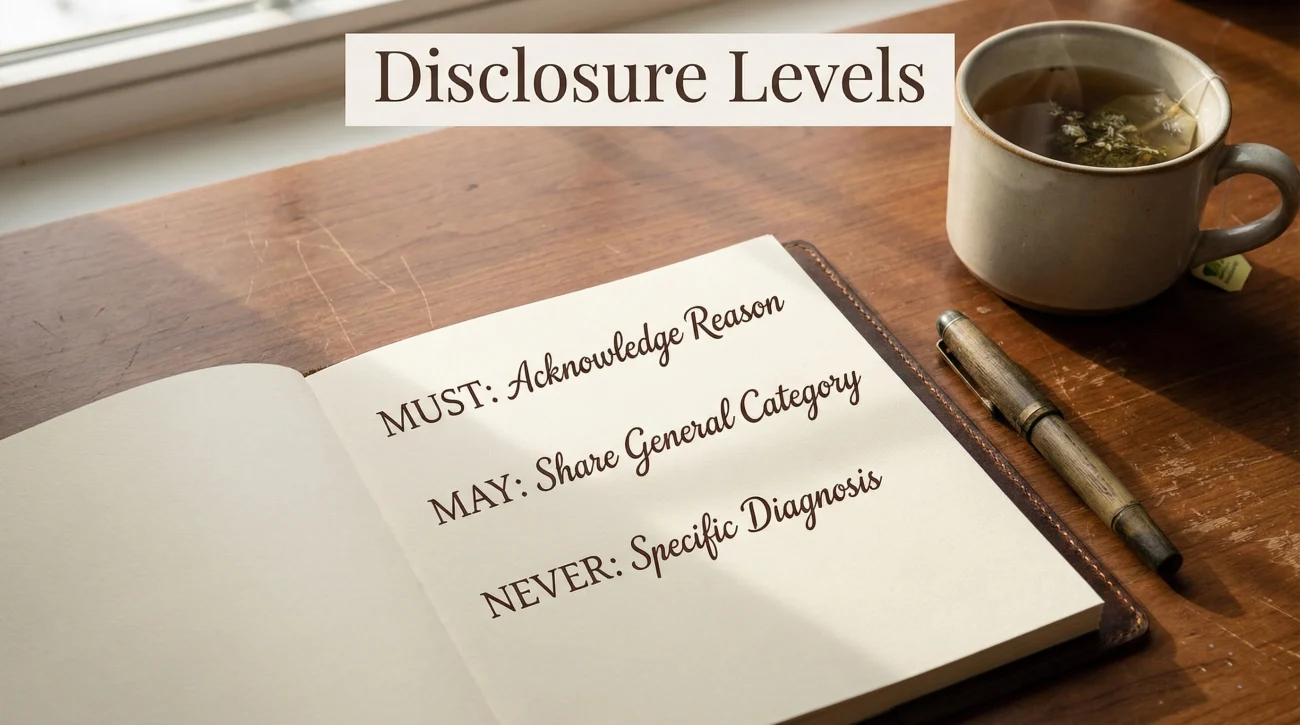
Let’s be concrete about what you must, may, and should never disclose about health-related gaps.
What You Must Acknowledge
If directly asked why you have a gap on your resume, you need to provide some answer. Complete silence or obvious evasion creates more concern than a simple, general response. Acknowledge that health was the reason without providing specifics.
What You May Choose to Share
The level of detail is entirely your choice. Some people feel comfortable naming general categories: “I had surgery and needed recovery time” or “I dealt with a chronic condition that’s now well-managed.” Others prefer complete generality: “I addressed a health matter.” Both approaches are valid. Choose based on your comfort level, not on what you think the interviewer wants to hear.
What You Should Never Feel Obligated to Share
Specific diagnoses, symptoms, treatments, medications, prognosis details, or anything that feels too personal. You’re not applying to be the interviewer’s patient. You’re applying to be their colleague. Medical details don’t belong in that conversation unless you freely choose to share them.
| Too Vague | Appropriate | Too Detailed |
|---|---|---|
| “I had some stuff going on.” | “I dealt with a health matter that required my attention.” | “I was diagnosed with Stage 2 lymphoma and underwent six rounds of chemotherapy…” |
| “Personal reasons.” | “I had surgery and needed time to recover fully.” | “I had a herniated disc at L4-L5 that was compressing my sciatic nerve…” |
| “Things happened.” | “I addressed a medical situation that’s now completely resolved.” | “I struggled with severe depression and was hospitalized twice…” |
The middle column gives enough information to explain the gap while maintaining appropriate professional boundaries. Practice responses at this level until they feel natural.
Proving Current Readiness
After briefly acknowledging the gap, immediately pivot to confirming your current capability. This is what employers actually need to know, and it’s where you should spend most of your answer time.
Elements of a Strong Readiness Statement
- ✅ The health issue is resolved or fully managed
- ✅ You’re at complete capacity for work demands
- ✅ No ongoing limitations affect your ability to perform this role
- ✅ You’re committed, available, and energized to work
- ✅ If applicable, you’ve taken steps to ensure current skills
“The situation required about eight months to fully address. I’m completely recovered now and have been cleared by my medical team for full-time work without restrictions. I’m ready to commit my complete energy to the right opportunity, and there are no ongoing issues that would affect my performance in this role.”
This statement does several things well. It provides a timeframe without excessive detail. It confirms resolution definitively. It addresses the unspoken concern about whether the issue might recur or limit your work. And it projects forward momentum rather than dwelling on the past.
Addressing Skill Currency
For longer health gaps, interviewers may wonder whether your skills have degraded. Address this proactively by mentioning any professional development you pursued during or after your recovery.
“During my recovery, I completed two online certifications to ensure my technical skills stayed current. I also did some light consulting work in the final months as I was getting back to full strength. I’m confident my capabilities are sharp and ready to apply.”
Handling Inappropriate Questions
Some interviewers push for more detail than appropriate. They may do this out of curiosity, poor training, or genuine concern that crosses professional boundaries. You can redirect without being hostile or damaging the interview.
The Capability Redirect
“I prefer not to discuss the medical specifics, but I’m happy to confirm that I’m fully able to meet all requirements of this role. Is there something specific about the position’s demands I can address for you?”
This response is polite but firm. It sets a boundary while offering to address the underlying concern. Most interviewers will accept this redirect and move on.
The General Confirmation
“It was a personal health situation that’s now completely behind me. I’ve been cleared by my doctors and am fully ready to return to demanding professional work. I’d rather focus on what I can contribute to this role going forward.”
This version acknowledges the question, confirms resolution, and redirects to professional discussion. The phrase “I’d rather focus on” is a soft but clear signal that you’re done discussing this topic.
The Direct Boundary
“I appreciate your concern, but I prefer to keep medical details private. What I can tell you is that I’m fully prepared to perform this job without any limitations. Shall we discuss the role requirements?”
Use this more direct approach if softer redirects aren’t working. It’s still professional but leaves no ambiguity about your boundary.
Recognizing Illegal Questions
In many jurisdictions, employers cannot ask about specific medical conditions, disabilities, or health history during interviews. They can ask whether you can perform essential job functions. If an interviewer asks directly about your diagnosis or medical details, they may be crossing legal lines. You can decline to answer while noting that you’re able to perform the job requirements.
For broader guidance on presenting your professional background, visit our self-introduction framework.
When Accommodation Is Needed
If you have an ongoing condition that requires workplace accommodation, the situation becomes more complex. You’ll eventually need to disclose enough information to request appropriate accommodation, but timing and approach matter.
Timing of Disclosure
In most cases, accommodation discussions happen after an offer has been extended, not during initial interviews. During interviews, focus on your ability to perform the essential functions of the role. Once you have an offer, you can discuss specific accommodations needed.
This timing protects you from discrimination during the selection process while still ensuring you’ll get necessary support if hired. It’s both legally sound and practically wise.
Essential Functions Focus
During interviews, you may be asked whether you can perform specific job functions. Answer honestly about your capabilities. If you can perform the essential functions with reasonable accommodation, you can generally answer “yes” to capability questions and discuss accommodation details later.
Never misrepresent capabilities you don’t have. If a role has physical requirements you cannot meet even with accommodation, address that honestly rather than accepting a position you can’t perform. Dishonesty helps no one and creates problems for everyone.
Visible Conditions
If your condition is visible, you may choose to address it briefly and directly rather than leaving it as an unspoken topic. “You may notice I use a mobility aid. It doesn’t affect my ability to do this work, and I wanted to acknowledge it directly so we can focus on my qualifications.” This approach takes control of the narrative and demonstrates confidence.
Mental Health Considerations
Mental health conditions carry additional stigma that makes disclosure decisions particularly sensitive. The same privacy principles apply, but candidates often feel more vulnerable discussing psychological health than physical health.
Same Privacy Rights
Mental health conditions have exactly the same privacy protections as physical conditions. You can explain a gap as “a health matter” without specifying whether it was mental or physical. No interviewer has the right to demand this distinction.
Navigating Stigma
Unfortunately, mental health stigma still exists in many workplaces. While this is changing, candidates should make disclosure decisions with awareness of potential bias. General language like “health situation” or “medical matter” provides explanation without inviting prejudice.
Demonstrating Current Stability
For any health condition, employers want assurance of current stability. For mental health specifically, this might include mentioning that you have effective management strategies in place, that you’re working with healthcare providers, or that you’ve built sustainable practices to maintain your wellbeing. You can communicate stability without disclosing diagnosis.
❓ FAQ
🎯 Can employers legally ask about my medical history?
In most jurisdictions, employers cannot ask about medical history, specific conditions, or disabilities during interviews. They can ask if you can perform specific job functions. If asked inappropriate medical questions, you can decline to answer while confirming your capability for the role.
💼 Should I disclose mental health conditions?
Only if you choose to. Mental health conditions have the same privacy protections as physical ones. You can explain a gap as a “health matter” without specifying whether it was mental or physical. Disclose only what you’re genuinely comfortable sharing, understanding that stigma unfortunately still exists.
⏰ What if my condition might recur?
You’re not required to speculate about future health possibilities. Focus on current readiness. Many conditions have recurrence potential but are well-managed. If a condition does recur, you’ll address it then. Don’t disqualify yourself based on possibilities that may never materialize.
📋 Will background checks reveal my health history?
Standard employment background checks do not include medical records. Your health history is protected information under privacy laws. Employers verify employment dates, education, and criminal records, not medical history. Your health information is yours to share or not share as you choose.
✨ How do I explain a visible disability?
You can address it directly and confidently if you choose. “I have a mobility limitation that doesn’t affect my ability to perform this work” acknowledges the visible while focusing on capability. You control how much additional detail to share. Confidence in your own abilities is the most important signal.
Private History, Present Capability
Mastering how to explain a health gap in an interview means protecting your legitimate privacy while clearly confirming your readiness to perform. Acknowledge the gap briefly using appropriately general language. State clearly and confidently that the issue is resolved. Confirm without reservation your full capability for the role’s demands. Redirect probing questions firmly but professionally to your ability to contribute. Your medical history belongs to you. What employers actually need is confidence that you’ll show up and deliver excellent work. Give them that confidence without sacrificing your right to privacy about matters that are none of their business.
⚠️ Disclaimer: The interview strategies, sample answers, and negotiation tips provided in this guide are for educational purposes only. Hiring decisions are subjective and vary by company and industry. While these strategies are based on professional HR standards, they do not guarantee a specific job offer or result.