The Bridge to Academic Life
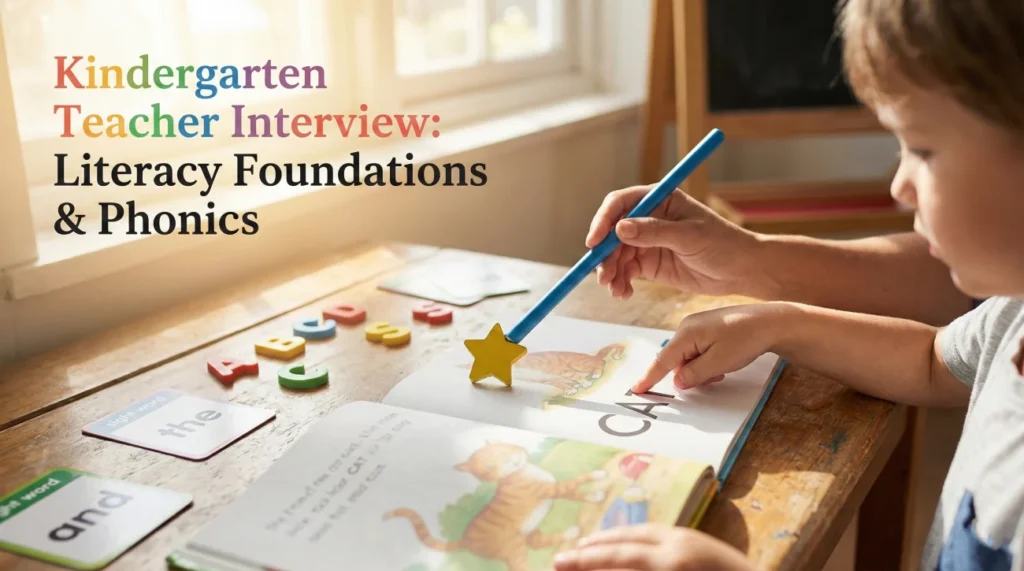
Kindergarten teacher interview questions focus on the pivotal transition from play-based preschool to the structured world of elementary school. For many children, kindergarten is their first exposure to formal education. Hiring managers are looking for educators who can balance the warmth of a caregiver with the academic rigor required to meet state standards in reading and math.
You will be tested on your knowledge of the “Science of Reading” (Phonics/Phonemic Awareness), your ability to manage a room full of 5-year-olds who are still learning how to sit in a chair, and your strategy for identifying learning disabilities early. Can you explain how you teach a child to decode CVC words? How do you handle a student who cries at drop-off for a month? How do you explain “number sense” to a parent?
This guide dives deep into the pedagogy of the kindergarten classroom. We explore the critical debate between Phonics and Balanced Literacy, the use of manipulatives for concrete math understanding, and the soft skills required to partner with parents who are often just as nervous as their children. These answers will help you prove you are ready to build the foundation upon which all future learning rests.
Early Literacy & Phonics
Q: What is your approach to teaching reading? (Science of Reading vs. Balanced Literacy)
This is the most critical question in 2025. I align my instruction with the Science of Reading. Research shows that explicit, systematic phonics instruction is non-negotiable. I don’t just rely on “three-cueing” (guessing based on pictures); I teach decoding.
My literacy block includes: 1) Phonemic Awareness: Oral practice (rhyming, blending sounds) without text. 2) Phonics: Connecting sounds to letters (graphemes). I use a scope and sequence to introduce letter sounds, then digraphs (sh, ch), then blends. 3) Vocabulary/Comprehension: Read-alouds of complex texts to build background knowledge that exceeds their decoding ability. I believe every child has a right to crack the code, not just guess.
Q: How do you teach “Sight Words” (High Frequency Words)?
I move away from pure rote memorization of flashcards. I use the “Heart Word” method. I explicitly teach the parts of the word that follow phonics rules (e.g., in “said,” the ‘s’ and ‘d’ are regular). Then I highlight the irregular part (the ‘ai’ making the /e/ sound) and put a heart over it, explaining “this is the part we must learn by heart.” This connects sight words back to phonics, rather than treating them as random shapes to memorize.
Q: Describe a “Writer’s Workshop” in Kindergarten.
Writing in kindergarten starts with drawing. I value the picture as much as the text. My workshop follows a predictable structure: Mini-Lesson (5-7 mins) where I model a skill (e.g., “stretching out a word” to hear sounds). Independent Writing (15-20 mins) where students draw and label. I confer with individual students, acting as a scribe for their oral stories if needed.
Sharing (5 mins) where a student sits in the “Author’s Chair.” I encourage “inventive spelling” (e.g., “kat” for cat) because it proves they are applying phonics knowledge. I don’t correct every spelling error; I celebrate the communication.
Q: How do you support a student who enters Kindergarten not knowing any letters?
I start with a baseline assessment (like DIBELS or a letter ID checklist) to find their starting point. I use Multi-Sensory approaches. We don’t just look at ‘A’; we trace ‘A’ in sand, we build ‘A’ with playdough, and we find ‘A’ in our names. I implement intense small-group intervention (Tier 2) daily, focusing on the letters in their own name first, as that has the highest personal relevance. I also send home “letter bags” for parents to practice in a low-stress way.
Math & Cognitive Development
Q: Concrete-Representational-Abstract (CRA)
Kindergarten math must start with the Concrete. To teach addition (2+3), we physically move 2 red bears and 3 blue bears together. Once mastered, we move to Representational (drawing circles or tally marks). Only at the end do we touch the Abstract (writing “2 + 3 = 5”). Skipping to abstract symbols too early causes confusion and math anxiety.
Q: Number Sense vs. Rote Counting
Rote counting is just memorizing a song (“1, 2, 3…”). Number Sense is understanding quantity. Can the student look at a group of 4 dots and know it’s “4” without counting (Subitizing)? Do they understand that “5” is one more than “4”? I teach number sense using ten-frames, dice games, and “Number Talks” where we discuss different ways to see a quantity.
Q: Calendar Time: Yes or No?
This is controversial. Traditional calendar time (yesterday was, tomorrow will be) is abstract for 5-year-olds. I keep it brief and focused on Patterning (Red, Blue, Red, Blue) and counting the days of school (Place Value). I focus more on the “Daily Schedule” (first we do math, then lunch) because that builds a temporal understanding relevant to their immediate life.
Q: Sorting & Classifying
Sorting is the precursor to data analysis and algebra. I provide “Loose Parts” (buttons, shells, keys) and ask students to sort them. The critical part is asking, “What is your rule?” (Color? Size? Number of holes?). This forces them to articulate attributes and logic. We then graph the results to introduce data visualization.
Q: STEM in Kindergarten
STEM isn’t just for high school. In Kindergarten, it’s about Inquiry. “Can you build a bridge for the Gingerbread Man that holds 10 pennies?” I provide materials (blocks, tape, cardboard) and let them fail and iterate. I celebrate the “Engineering Design Process” (Ask, Imagine, Plan, Create, Improve) more than the final product.
Q: Teaching 1-to-1 Correspondence
This is the skill of matching one number word to one object. Many kids count “1-2-3-4-5” while pointing to only three blocks. I teach them to “Touch and Move.” They must physically slide the object across a line as they say the number. This physical action syncs their brain and hand, cementing the concept that the last number said represents the total quantity (Cardinality).
Classroom Management & Culture
It’s the first week of school. Half the class is crying, and the other half is running around. How do you gain control?
The first week is about Procedure, not Content. I stop trying to teach curriculum. I focus entirely on “How to do school.” I use “Call and Response” (e.g., “Holy Moly!” -> “Guacamole!”) to get attention without yelling.
I model everything. “Watch how I push in my chair.” “Watch how I walk to the rug.” Then we practice it. We practice lining up 10 times if needed. I use visual timers so they know when a transition is coming. I keep a calm, low voice because if I escalate, they escalate. Routine creates safety, and safety stops the tears.
A student consistently hits others when frustrated. Time-outs aren’t working.
Hitting is a lack of vocabulary or impulse control. I stop the behavior immediately (“Hands down. Hitting hurts.”) and separate the child to a “Cool Down Spot” (not a punishment chair, but a regulation zone with stress balls).
Once calm, I do a “Replay.” I ask, “You wanted the truck. Instead of hitting, what could you say?” I make them practice saying, “Can I have a turn?” I also create a Behavior Chart for that specific student, catching them being good (“You kept your hands to yourself!”) to reinforce the positive alternative. Consistency is key.
A parent complains that their child is “bored” because they already know how to read.
I celebrate the child’s advanced skill: “It’s wonderful that [Name] is reading!” Then I educate the parent on the breadth of Kindergarten. “While they are advanced in decoding, we are also working on comprehension, retelling, and writing stamina.”
I explain differentiation: “During reading groups, [Name] reads chapter books and answers higher-level inference questions.” I also highlight the social curriculum: “Kindergarten is also about learning to work in a group, share, and navigate conflict, which are skills [Name] is still developing.” I assure them their child will be challenged, just maybe not in the way they expected.
Assessment & Readiness
Q: How do you assess “School Readiness”?
School readiness is holistic. It’s not just “knowing ABCs.” I assess: Social-Emotional (Can they separate from parents? Can they take turns? Can they follow multi-step directions?), Physical (Can they hold a pencil? Can they manage bathroom needs?), and Academic (Letter sounds, counting). I use a balanced scorecard approach because a child who can read but can’t sit still or handle frustration will struggle more than a non-reader with strong executive function.
Q: Describe your system for anecdotal records.
I carry a clipboard or use an app (like Seesaw) constantly. I capture “moments in time.” Instead of writing “Good at math,” I write “10/12: Built a pattern ABBA with blocks.” “10/14: Recognized the letter ‘M’ on a cereal box.” These specific data points allow me to see growth over time and provide concrete examples during parent-teacher conferences. It turns assessment into a narrative of the child’s journey.
Q: How do you prepare students for standardized testing (if applicable)?
I protect them from the stress. I call it a “Quiz Show” or “Brain Game.” I teach the mechanics (bubbling in, clicking the mouse) as a separate skill so the format doesn’t trip them up. I ensure they are well-fed and rested. I emphasize effort over score. “Just show what you know.” I refuse to let test prep cannibalize play time or social-emotional learning, as stress shuts down the kindergarten brain.
Q: What role does “differentiation” play in homework?
I generally believe homework in Kindergarten should be minimal (read with parents, play outside). However, if required, I differentiate. I send home “Family Activity Jars” rather than worksheets. One family might count forks for dinner (Math); another might look for letters on street signs. For advanced students, I might send a challenge journal. The goal is connection and extension, not drill and kill.
Kindergarten Teacher Knowledge Check
Test Your K-5 IQ
1. “Phonemic Awareness” is the ability to:
- Identify letters on a page
- Hear, identify, and manipulate individual sounds (phonemes) in spoken words
- Read fast
- Write sentences
2. Which grip is developmentally appropriate for a mid-year Kindergartner?
- Fisted Grip (Palmar)
- Tripod Grip (using thumb and index/middle fingers)
- No grip
- Two-handed grip
3. “Subitizing” means:
- Counting by ones
- Instantly recognizing a small quantity (like dots on a dice) without counting
- Subtracting numbers
- Writing numbers backward
4. A “Decodable Text” contains:
- Random words the student has to guess
- Words that follow the specific phonics patterns the student has already been taught
- Pictures only
- Advanced vocabulary
5. “Morning Meeting” is primarily used to:
- Take attendance efficiently
- Build community, practice social skills, and set the tone for the day
- Lecture on math
- Discipline students
6. If a child writes “I LUV MI MOM,” this is an example of:
- Laziness
- Invented (or Phonetic) Spelling, showing phonemic awareness
- Dyslexia
- Copying
7. The “Pincer Grasp” involves:
- The whole hand
- The thumb and pointer finger (critical for writing)
- The toes
- The elbow
8. “Centers” or “Stations” allow for:
- The teacher to take a nap
- Small group instruction and independent practice/exploration
- Chaos
- Testing only
9. A “Ten-Frame” is a visual tool to help students see:
- Pictures
- Numbers in relation to 5 and 10 (Place Value foundation)
- The alphabet
- Colors
10. “Digraphs” are:
- Two letters making two sounds (bl)
- Two letters making one new sound (sh, ch, th)
- Silent letters
- Capital letters
11. Which is a “Gross Motor” activity?
- Threading beads
- Skipping or hopping on one foot
- Writing name
- Cutting with scissors
12. “Elkonin Boxes” are used to:
- Store crayons
- Segment words into individual sounds (phonemes) visually
- Build blocks
- Pack lunch
13. A “Running Record” is:
- A list of students running in the hall
- A method of assessing reading accuracy and fluency by listening to a child read
- A music album
- A stopwatch time
14. “Shared Reading” involves:
- Students reading silently
- The teacher and students reading a large text together to model fluency and concepts of print
- Students sharing books
- Teacher reading a chapter book
15. To teach “Concepts of Print,” you might ask a student to:
- Spell their name
- Point to the front of the book, the title, and where to start reading
- Draw a picture
- Count the pages
16. “Positional Words” include:
- Red, Blue, Green
- Above, Below, Beside, Between
- One, Two, Three
- A, B, C
17. “Executive Function” skills in Kindergarten include:
- Knowing the presidents
- Self-regulation, working memory, and cognitive flexibility (shifting tasks)
- Writing in cursive
- Tying shoes
18. The “gradual release of responsibility” model is:
- Letting kids do whatever they want
- I do (Model), We do (Guided), You do (Independent)
- You do, I check
- I do everything
19. A “Social Story” helps students:
- Learn history
- Understand social cues and appropriate behaviors in specific situations (e.g., how to ask to play)
- Write fiction
- Read faster
20. “Manipulatives” in math should be used:
- Only on Fridays
- Daily to build concrete understanding before abstract notation
- Never, they are toys
- Only for struggling students
❓ FAQ
📜 Is Kindergarten mandatory?
In many states/countries, yes. Even where it isn’t, it is the de facto entry point for public schooling. Administrators treat it as the essential year for leveling the playing field before 1st grade.
🧪 How much testing is there?
More than before. Expect to administer DIBELS, MAP, or state readiness assessments 3 times a year. You must be comfortable collecting data while keeping the atmosphere light and playful for the kids.
🤧 How do you handle hygiene?
You teach it. You explicitly teach how to sneeze into an elbow (“Vampire Sneeze”), how to use one pump of soap, and how to wipe a nose. You will deal with germs. Build a routine of handwashing before and after everything.
👟 What should I wear to the interview?
Professional but practical. Wear clothes you can move in (you might be asked to sit on the floor during a demo lesson). Avoid high heels or restrictive suits. Show that you are ready to be active.
🍎 Why teach Kindergarten?
It is the year of exploding growth. You see non-readers become readers. You see shy kids become friends. The progress is tangible and massive. If you love building foundations and receiving unconditional hugs, this is the grade.
Planting the Seeds
To succeed with kindergarten teacher interview questions, you must prove you are a master of balance. You balance the academic pressure of standards with the developmental need for play. You balance the structure of school with the chaos of 5-year-olds.
Focus on your literacy knowledge (“I know how to teach a child to read”). Highlight your classroom management (“I know how to keep them safe and organized”). And show your heart (“I know how to make them love school”). The Principal wants to know that you are the teacher they would want their own 5-year-old to have.
⚠️ Disclaimer: The interview strategies, sample answers, and negotiation tips provided in this guide are for educational purposes only. Hiring decisions are subjective and vary by company and industry. While these strategies are based on professional HR standards, they do not guarantee a specific job offer or result.