What Medical Billing and Coding Interviews Test
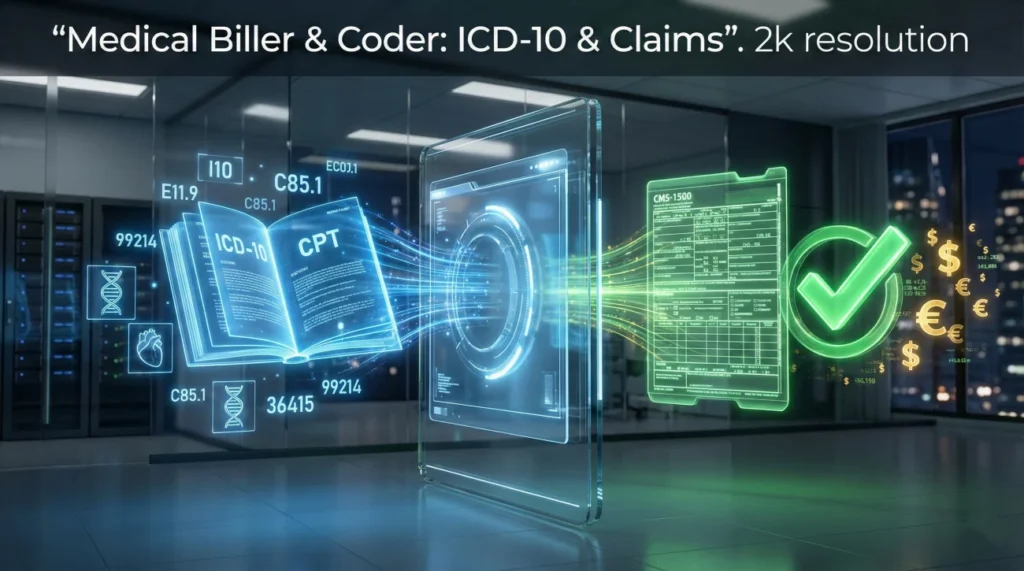
Medical biller and coder interview questions evaluate coding system proficiency including ICD-10-CM for diagnoses, CPT for procedures, and HCPCS Level II for supplies and equipment. Interviewers assess claims processing knowledge covering documentation review, code assignment accuracy, modifier usage, and claim submission. Questions test denial management through root cause analysis, appeals process, and resubmission strategies. Compliance understanding includes HIPAA privacy requirements, coding guidelines adherence, fraud prevention, and audit preparation while demonstrating attention to detail, medical terminology knowledge, and ability to query providers for clarification ensuring accurate reimbursement.
This guide covers coding systems mastery, claims processing workflow, denial and appeals management, compliance and accuracy, and professional development. Review more interview strategies at healthcare career preparation resources.
Coding Systems Mastery
Q: Explain the difference between ICD-10-CM and CPT codes.
Understanding code systems fundamental to billing accuracy. ICD-10-CM (International Classification of Diseases, 10th Revision, Clinical Modification) classifies diagnoses, symptoms, and conditions using alphanumeric codes, with additional characters adding specificity when the documentation supports it. Example: E11.65 represents type 2 diabetes mellitus with hyperglycemia where E11 is type 2 diabetes and .65 specifies hyperglycemia complication.
CPT (Current Procedural Terminology) describes medical procedures and services using five-digit numeric codes maintained by the American Medical Association, grouped into sections such as Evaluation and Management, Anesthesia, Surgery, Radiology, Pathology/Laboratory, and Medicine. Example: 99213 represents established patient office visit of moderate complexity. Purpose differs where ICD-10-CM establishes medical necessity justifying why service needed while CPT specifies what service performed determining reimbursement amount.
Q: What is HCPCS Level II and when do you use it?
HCPCS (Healthcare Common Procedure Coding System) has two levels. Level I identical to CPT codes covering physician services. HCPCS Level II uses alphanumeric codes (letter followed by four digits) for products, supplies, and services not included in CPT such as durable medical equipment (DME) like wheelchairs or walkers, prosthetics and orthotics, ambulance services, and temporary procedures awaiting CPT code assignment.
Common categories include A codes for transportation and medical supplies, E codes for DME like E0130 for walker, J codes for drugs administered other than oral route like J1644 for heparin injection, and L codes for orthotics and prosthetics. Use HCPCS Level II when CPT code doesn’t exist for item or service, billing Medicare or Medicaid requiring these codes, and documenting non-physician services. Payers vary in acceptance where Medicare mandates HCPCS Level II, private insurers may accept CPT equivalents, and some services require both codes for complete claim.
Q: Describe how you assign diagnosis codes for complex cases.
Complex coding requires systematic approach following guidelines. Review documentation thoroughly reading entire medical record not just diagnosis field, identifying all documented conditions, and noting any uncertainty or rule-out diagnoses. Apply coding conventions using official ICD-10-CM guidelines, following code first/use additional code instructions, and coding to highest specificity available typically 4-7 characters avoiding unspecified codes when details exist.
⚠️ Avoid coding unconfirmed “rule-out” diagnoses in many outpatient settings: Instead, code the documented signs/symptoms and follow your facility’s coding rules and payer guidance.
Sequence properly listing principal diagnosis first (reason for encounter), followed by secondary diagnoses affecting treatment or management, excluding resolved conditions or incidental findings not requiring resources. Query provider when documentation unclear or incomplete using compliant query language with clinical indicators, offering multiple choice options including “unable to determine,” and never suggesting specific diagnosis. Document rationale maintaining coding worksheets, noting assumptions made when documentation ambiguous, and tracking provider responses to queries supporting code selection during audits.
Q: How do you use modifiers correctly?
Modifiers provide additional information about procedure. Common CPT modifiers include 25 for significant separately identifiable E/M service same day as procedure, 59 for distinct procedural service indicating separate encounter or different site, 51 for multiple procedures reporting add-on procedures, and 76/77 for repeat procedures by same or different physician. Anatomical modifiers specify location like LT/RT for left/right side, E1-E4 for eyelid positions, and F1-F9/FA/T1-T9/TA for fingers and toes.
Application rules follow payer requirements checking NCCI edits (National Correct Coding Initiative) for allowable combinations, using appropriate modifier to bypass edits when clinically appropriate, and never modifier 25 stacking or using modifiers to avoid bundling incorrectly. Example: Patient receives office visit for new problem plus previously scheduled wart removal uses 99213-25 for E/M and 17110 for wart destruction where modifier 25 indicates E/M was separate from minor procedure. Avoid common errors including modifier overuse when not supported by documentation, wrong modifier selection like 59 instead of more specific X modifier, and missing modifier when required causing claim denial.
Claims Processing and Submission
Q: Walk through your claims submission process.
Systematic workflow ensures clean claims. Patient registration verifies demographics and insurance information including subscriber ID, group number, and effective dates, obtains necessary authorizations for procedures requiring prior approval, and confirms coverage and benefits checking copay, deductible, and coinsurance amounts. Documentation review examines medical record ensuring services documented, diagnosis supports medical necessity, and physician signature present. Code assignment selects appropriate ICD-10-CM codes reflecting documented diagnoses, assigns CPT/HCPCS codes for procedures performed, and applies modifiers when appropriate indicating special circumstances.
Claim preparation enters patient and provider information accurately, links diagnosis codes to procedures establishing medical necessity, and calculates charges based on fee schedule. Quality check runs edits through billing software identifying coding errors or missing information, verifies NCCI edits for bundling issues, and confirms claim completeness before submission. Submit electronically transmitting via clearinghouse checking for real-time errors or sending paper claim for non-electronic payers. Track submission maintaining claim log monitoring status and follow up on outstanding claims ensuring timely follow-up and payment within the payer’s timely filing window.
Q: How do you ensure coding accuracy?
Accuracy requires multiple verification steps. Reference materials include current code books updated annually for ICD-10-CM and CPT, encoder software providing code descriptions and guidelines, and specialty-specific coding resources addressing unique scenarios. Documentation support ensures sufficient detail reviewing operative reports for surgical coding, reading complete progress notes not just assessment/plan, and obtaining missing information through provider queries never assuming or guessing codes.
Double-check work verifying diagnosis codes match documentation reviewing each character for accuracy, confirming procedure codes appropriate cross-referencing with operative report or procedure note, and ensuring modifiers properly applied and necessary. Continuous learning includes staying current on coding updates attending webinars and reading coding newsletters, understanding payer policies reviewing LCD (Local Coverage Determination) and NCD (National Coverage Determination), and learning from denials analyzing rejection patterns identifying recurring issues. Audit readiness maintains coding worksheets documenting rationale for complex cases, keeps query log tracking provider clarifications, and participates in internal audits identifying improvement opportunities maintaining consistently high coding accuracy.
Q: Describe handling NCCI edits.
NCCI (National Correct Coding Initiative) prevents inappropriate payment for mutually exclusive or bundled procedures. Understand edit types including Column 1/Column 2 edits where Column 2 code bundled into Column 1, mutually exclusive edits where procedures wouldn’t reasonably be performed together, and medically unlikely edits (MUE) limiting units per day. Check edits using encoder software flagging potential bundling issues, NCCI edit tables published by CMS and updated regularly, and clearinghouse rejections catching errors before claim reaches payer.
Respond appropriately by accepting bundle when procedures part of same service not billing separately, using modifier to bypass when documentation supports separate service adding modifier 59 or XE/XS/XP/XU with clear justification, or correcting code selection choosing different more specific code not subject to edit. Document override providing detailed rationale in claim notes, attaching operative report when procedures performed at different sites, and maintaining audit trail protecting against audit findings. Never bypass edits routinely without clinical justification avoiding upcoding allegations, using modifier 59 as default requiring specific circumstances, or ignoring edit warnings risking claim denial or compliance violation.
Q: How do you verify medical necessity?
Medical necessity links diagnosis to treatment justifying reimbursement. Review coverage policies checking LCD for Medicare coverage criteria, reading payer medical policy bulletins for commercial insurers, and understanding diagnosis code requirements for specific procedures. Match diagnosis to procedure selecting ICD-10-CM code supporting service performed, sequencing diagnosis codes appropriately with primary reason first, and ensuring specificity meets payer requirements avoiding unspecified codes when details available.
Common scenarios include screening versus diagnostic services using different diagnosis codes like Z12.11 for screening colonoscopy versus K63.5 for diagnostic, preventive services requiring specific diagnosis codes like Z00.00 for annual wellness visit, and procedure-specific requirements like certain diagnoses required for injections or imaging. Flag concerns identifying services likely to deny for lack of medical necessity, communicating with provider about documentation needs requesting additional clinical information, and offering alternatives suggesting covered service when requested procedure not covered. Protect revenue through proper coding maintaining compliance while maximizing appropriate reimbursement, patient education explaining when service not covered, and ABN (Advance Beneficiary Notice) usage having Medicare patients sign when service may not be covered shifting liability to patient.
Denial and Appeals Management
Describe your process for handling denied claims.
Systematic denial management maximizes revenue recovery. Review denial notice reading EOB (Explanation of Benefits) or ERA (Electronic Remittance Advice) carefully identifying specific denial reason and remark codes, categorizing denial type as front-end denial for registration/eligibility issues or back-end denial for coding/medical necessity, and assessing timeliness by checking the payer’s appeal deadline for that claim. Research root cause pulling original claim and documentation comparing to denial reason, reviewing payer policy understanding coverage requirements, and identifying error source determining if coding, documentation, or technical issue.
Corrective action includes fixing and resubmitting correcting coding error and resubmitting as corrected claim, appealing with additional information writing appeal letter with supporting documentation when original claim appropriate, or patient billing transferring balance to patient if service not covered after exhausting appeals. Track outcomes maintaining denial log categorizing by reason and payer, calculating denial rate by category identifying systemic issues, and implementing process improvements preventing future denials through staff education or workflow changes. Target quick turnaround by reviewing denials promptly, prioritizing high-dollar claims focusing on largest revenue impact, and meeting deadlines preventing claim write-off due to late appeals.
How do you write an effective appeal?
Effective appeals provide compelling case for payment. Structure includes header with claim information (patient name, ID, date of service, claim number), clear opening statement “This is a first-level appeal for claim [number] denied on [date] for [reason],” factual argument addressing specific denial reason citing payer policy showing service meets criteria, and supporting documentation attaching relevant records including medical notes, test results, or literature. Professional tone maintains respectful language avoiding accusatory statements, uses objective facts not emotional appeals, and requests specific action “Please reconsider this claim for payment.”
Common scenarios include medical necessity appeals providing clinical rationale explaining why service appropriate, quoting LCD/NCD sections demonstrating compliance with coverage criteria, and including physician letter when helpful especially for experimental or unusual services. Coding clarification corrects misunderstood code providing CPT/ICD-10-CM code descriptions, explains modifier usage when payer questioned appropriateness, and references coding guidelines citing official coding advice. Timely filing disputes provides proof of original submission including claim confirmation or screenshot, explains delay if applicable like patient provided wrong insurance, and requests exception citing extenuating circumstances. Follow up tracking appeal status checking with payer after 30-45 days, escalating to supervisor or external review if denied again, and documenting all communications maintaining appeal history for reference.
What’s your approach to reducing denial rates?
Prevention better than correction reducing rework and accelerating payment. Analyze patterns reviewing denial reports monthly identifying top denial reasons, trending by payer recognizing payer-specific issues, and calculating financial impact prioritizing high-cost problems. Root cause analysis using fishbone diagrams or 5 Whys methodology, identifying systemic versus one-off issues, and engaging stakeholders involving registration, coding, and clinical staff in solutions. Implement solutions through staff education conducting training on common errors, process improvements revising workflow to prevent issues like real-time eligibility checking, and technology enhancements implementing claim scrubbing software catching errors pre-submission.
Monitor effectiveness tracking denial rate overall and by category measuring improvement, setting targets and driving the denial rate down over time, and celebrating successes recognizing team when goals achieved. Specific initiatives include registration accuracy training front desk on insurance verification reducing eligibility denials, coding compliance establishing coding review process catching errors before submission, and authorization management improving prior authorization obtaining process preventing denial for unauthorized services. Continuous improvement requires ongoing monitoring never considering process “fixed,” regular meetings discussing denial trends and solutions, and benchmarking comparing performance to industry standards identifying areas for improvement demonstrating commitment to revenue cycle excellence.
Compliance and Professional Development
Q: How do you ensure HIPAA compliance in billing?
Privacy protection essential in medical billing. Access control limits information to minimum necessary for job function using role-based access in billing software, logging off when away from workstation preventing unauthorized viewing, and never sharing passwords maintaining individual accountability. Secure handling includes locking physical files when not in use, shredding documents before disposal, encrypting electronic transmissions especially when emailing PHI, and using secure fax cover sheets marking “Confidential.”
Communication safeguards involve verifying identity before discussing account information asking identifying questions before phone disclosure, using private areas for sensitive conversations avoiding public discussion of patient information, and proper disposal destroying outdated records according to retention policy. Incident reporting includes recognizing breaches like unauthorized access or lost laptop containing PHI, reporting immediately to supervisor and compliance officer, and documenting incident completing required forms and corrective actions. Ongoing training participates in annual HIPAA education required for all healthcare staff, stays current on policy updates, and signs confidentiality agreement annually acknowledging responsibilities maintaining patient trust and helping the organization avoid costly violations and protect patient trust.
Q: Describe your experience with coding audits.
Audits verify coding accuracy and compliance. Preparation involves organizing documentation ensuring complete medical records available, reviewing coding guidelines refreshing knowledge before audit, and maintaining calm knowing audits identify improvement opportunities not punishment. Audit process includes chart selection reviewing random sample or targeted high-risk cases, code comparison auditor assigns codes comparing to biller’s codes, and variance analysis calculating accuracy rate identifying patterns in errors.
Common findings include specificity issues using unspecified codes when details documented, unbundling billing components separately when bundled, missing modifiers not appending required modifiers, and medical necessity diagnosis doesn’t support procedure. Response to findings accepts feedback acknowledging errors without defensiveness, seeks education asking auditor to explain errors for learning, and implements corrections revising future coding practices. Post-audit actions create improvement plan addressing identified weaknesses, additional training attending focused education on problem areas, and re-audit demonstrating improvement through follow-up audit showing progress. Maintain documentation keeping audit reports and action plans, tracking trends monitoring improvement over time, and demonstrating commitment to accuracy using audits as learning tool advancing professional competency.
Q: How do you stay current with coding changes?
Continuous learning mandatory in evolving field. Annual updates include reviewing annual code-set updates and making sure you’re ready before they take effect, reviewing update summaries published by AAPC or AHIMA highlighting major changes, and practicing new codes before effective date testing scenarios building confidence. Professional development maintains certification through CPC, CCS, or similar credential requiring continuing education, joins professional organizations accessing AAPC or AHIMA resources and networking, and attends conferences participating in annual coding conferences for intensive education.
Daily resources subscribe to coding newsletters receiving timely updates on policy changes, use online forums participating in coding discussion groups solving challenging cases collaboratively, and access reference tools using encoder software with embedded guidelines and frequent updates. Payer-specific updates reviews Medicare transmittables monitoring CMS updates and LCDs, reads commercial payer bulletins understanding policy changes, and checks payer websites accessing most current requirements. Document learning maintains CE certificate file tracking continuing education hours, creates personal reference guide compiling frequently used codes and tricky scenarios, and shares knowledge with team presenting at staff meetings or creating tip sheets demonstrating commitment to professional growth and coding excellence throughout career.
Q: What coding credentials do you hold?
Certification demonstrates competency and commitment. Common credentials include CPC (Certified Professional Coder) through AAPC for physician-based outpatient coding, CCS (Certified Coding Specialist) through AHIMA for hospital inpatient/outpatient coding, CPC-H for hospital outpatient coding, and specialty certifications like COC (outpatient facility) or CIC (interventional coding). Requirements involve passing a certification exam covering anatomy, terminology, and coding guidelines, meeting prerequisites many require coding experience or education, and maintaining your credential through ongoing continuing education and renewal requirements.
Value of certification includes credibility demonstrating mastery to employers and peers, earning potential where certified coders often earn more than non-certified peers, and career advancement opening doors to senior positions, auditing roles, or education opportunities. Preparation strategies study systematically using exam study guides and practice exams, join study group collaborating with peers for motivation and knowledge sharing, and focus on weak areas identifying gaps through practice tests targeting improvement. Continuing education maintains active status completing required CEUs through webinars, conferences, or online courses, stays current keeping skills sharp in changing environment, and demonstrates professionalism showing commitment to excellence in medical coding profession.
Medical Coding Knowledge Check
20 Practice Questions
1. ICD-10-CM codes are used for?
- Diagnoses and conditions
- Procedures only
- Equipment and supplies
- Physician services only
2. CPT 99213 represents?
- New patient visit
- Established patient office visit moderate complexity
- Hospital admission
- Surgical procedure
3. Modifier 25 indicates?
- Significant separately identifiable E/M service same day
- Multiple procedures
- Bilateral procedure
- Repeat procedure
4. HCPCS Level II codes cover?
- Physician services only
- DME, supplies, drugs, ambulance services
- Diagnoses
- Hospital procedures
5. NCCI edits prevent?
- Inappropriate bundling or unbundling
- All denials
- Medical necessity issues
- Registration errors
6. Medical necessity requires?
- Any diagnosis code
- Diagnosis supporting procedure performed
- Physician preference
- No documentation
7. Rule-out diagnoses in outpatient?
- Code as confirmed
- Code signs/symptoms instead
- Don’t code anything
- Use unspecified code
8. Appeals should be filed:
- whenever you have time
- within the payer’s stated appeal timeframe
- only after a second denial
- there are no deadlines
9. HIPAA requires?
- Minimum necessary access, secure PHI
- Sharing all patient info freely
- No password protection
- Public discussion of cases
10. Coding systems are updated:
- only when a payer requests it
- on a regular schedule (often annually)
- every week
- never
11. Maintaining certification usually requires:
- ongoing continuing education and renewal requirements
- one-time exam only
- no ongoing education
- a medical degree
12. Clean claim submission needs?
- Diagnosis only
- Complete demographics, correct codes, medical necessity
- Just procedure code
- No documentation
13. Provider query should?
- Suggest specific diagnosis
- Present clinical indicators with multiple choices
- Lead to higher payment code
- Never be done
14. Upcoding means?
- Billing higher level than documented
- Correct coding
- Using latest codes
- Billing multiple procedures
15. EOB stands for?
- Electronic Office Billing
- Explanation of Benefits
- End of Billing
- Estimated Online Balance
16. A strong coding program aims for:
- about 70% accuracy
- consistently high accuracy with continuous improvement
- around 50% accuracy
- no standard
17. LCD stands for?
- Local Coverage Determination
- Licensed Coding Database
- Low Cost Diagnosis
- Latest Code Directory
18. Timely filing limits:
- are always 30 days
- vary by payer and plan
- are always 5 years
- don’t exist
19. A healthy denial management goal is to:
- accept denials as normal
- reduce preventable denials over time and learn from patterns
- focus only on high-dollar claims
- ignore low-volume denial types
20. Code to highest specificity means?
- Use 3-character codes
- Use all available characters (4-7) when documented
- Always use unspecified
- Use shortest code
❓ FAQ
🎯 Do I need certification to work as medical coder?
While not always legally required, CPC or CCS certification strongly preferred by most employers demonstrating competency and often increasing earning potential. Entry-level positions may accept on-the-job training, but career advancement typically requires certification. Many employers provide study time or reimbursement for certification exam showing commitment to professional development.
🚀 How do I demonstrate coding accuracy without years of experience?
Highlight education including coding courses and clinical externship experience, certification showing passed rigorous exam demonstrating knowledge, and practice scenarios discussing how you approach complex coding cases using systematic methodology. Emphasize attention to detail, use of reference materials, and commitment to ongoing learning. Employers value trainability and accuracy over speed for entry-level coders.
💼 What software should I be familiar with?
Mention experience with encoder/encoder-like tools for code lookup and edits, common practice management or EHR systems for billing workflow, and clearinghouses or payer portals for claim submission (for example, Availity or similar platforms). Even if unfamiliar with specific software employer uses, emphasize quick learning ability and general understanding of billing workflow transferable across systems.
📚 How do I prepare for coding scenarios in interview?
Review common procedures in employer’s specialty knowing typical CPT codes, practice ICD-10-CM coding using sample cases, and understand modifier usage especially 25, 59, and anatomical modifiers. Bring code books or ask if allowed referencing during test demonstrating how you work in real world. Talk through your reasoning showing systematic approach to code selection even if final code isn’t perfect, proving thinking process solid.
🌐 Should I discuss specific denial rate or accuracy metrics?
Yes, absolutely – quantify achievements when possible like “maintained 98% coding accuracy” or “reduced denial rate from 12% to 6%”. If entry-level without metrics, discuss school project results or externship performance. Employers appreciate data-driven mindset. If asked about goals, talk about maintaining high accuracy, reducing preventable denials, and continuously improving through audits and feedback.
Final Thoughts
Success with medical biller and coder interview questions requires demonstrating coding system mastery across ICD-10-CM, CPT, and HCPCS, claims processing proficiency through accurate code assignment and submission, denial management capability analyzing and appealing rejected claims, compliance knowledge including HIPAA and coding guidelines, and professional development through certification and continuous education. Focus on systematic approach to coding, attention to detail, and understanding payer requirements.
Employers value coders who balance accuracy with productivity, stay current with annual updates, communicate effectively with providers for clarification, and demonstrate ethical coding practices avoiding fraud. Prepare by reviewing code books, practicing coding scenarios, organizing metrics quantifying accuracy and performance, and researching employer’s specialty understanding common procedures. For additional career guidance, explore interview preparation tips demonstrating genuine interest in contributing coding expertise, meticulous accuracy, compliance commitment, and dedication to revenue cycle optimization.
⚠️ Disclaimer: The interview strategies, sample answers, and negotiation tips provided in this guide are for educational purposes only. Hiring decisions are subjective and vary by company and industry. While these strategies are based on professional HR standards, they do not guarantee a specific job offer or result.