The Job Is Small Tasks, Done Like They Matter
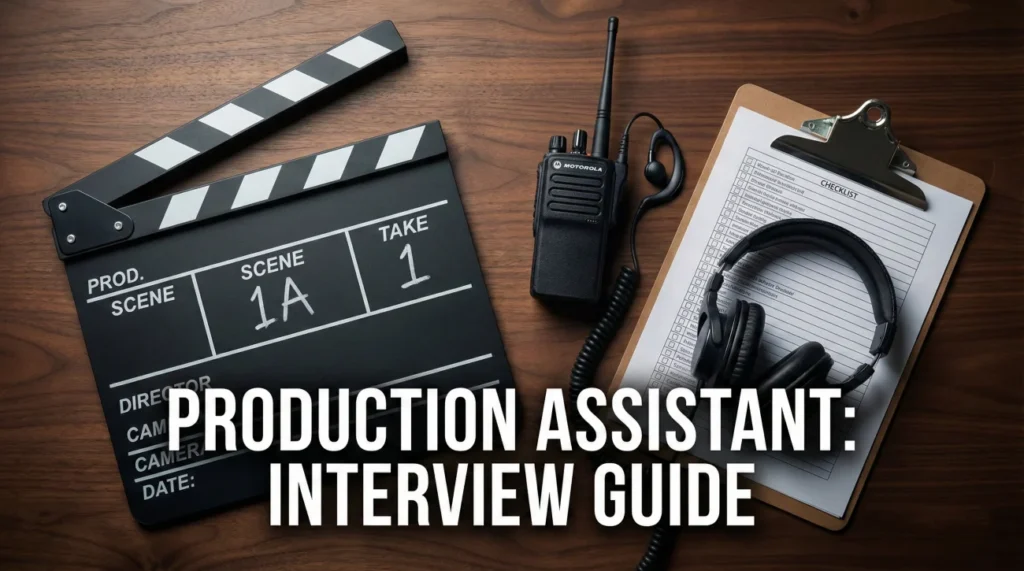
You get a call sheet, a walkie, and a list of errands that never ends. Nobody is asking you for your artistic opinion yet. They are watching whether you show up early, stay sharp, and keep the day from wobbling. That is what production assistant interview questions are really measuring.
A strong Production Assistant is reliable before anything else. You protect set rhythm, you respect chain of command, and you handle boring work with the same seriousness as urgent work. If you can explain how you stay organized, communicate cleanly, and hold boundaries with the public without escalating, you will sound hireable fast.
Use this guide to speak in real habits, not hype: radio discipline, set etiquette, and the quiet professionalism that makes the AD team trust you.
The PA Mindset & Work Ethic
Q: Why do you want to be a Production Assistant, knowing the hours and pay?
I view the PA role as a paid masterclass in filmmaking. I am not here for the glamour; I am here for the education. I want to learn how a set breathes, how the departments interact, and how problems are solved in real-time.
I understand the hours are long and the work is physically demanding (taking out trash, moving gear), but I thrive in high-energy environments. My goal is to be the most reliable person on set so that I can eventually move up to [Target Role, e.g., Producer or AD], but I know I must earn my stripes first.
Q: How do you handle a mistake you made on set?
I own it immediately. On a film set, time is money (literally thousands of dollars a minute). If I forget to print the sides or grab the wrong coffee, I tell my Key PA or AD immediately: “I made a mistake, here is what happened, and here is how I am fixing it right now.”
I do not hide it or blame others, as that delays the solution. I learn from it and ensure it never happens twice. Accountability is the only way to build trust in this industry.
Q: Describe your organizational system for a busy shoot day.
I live by my notebook and my “Hot Bricks” (walkie-talkie). I write everything down because memory fails under stress. I prioritize tasks by urgency: Safety issues first, rolling camera needs second, crew comfort third.
I carry a “PA Kit” (Sharpies, multi-tool, tape, gum, external battery) so I am a walking resource. I check in with my department head constantly to ensure I am anticipating the next move, not just reacting to the last one.
Q: How do you handle “Hurry Up and Wait”?
I stay active. If the camera is resetting and the crew is waiting, I don’t sit down on an apple box and check my phone. That is the quickest way to get fired.
I look for work. I tidy up the crafty table, check if the trash needs emptying, or ask the ADs if they need water. I stay within earshot of the walkie. Being “present” means being ready to sprint the moment “We’re back in!” is called.
On-Set Scenarios & Problem Solving
You are guarding a door (“Lock Up”) and a VIP producer wants to enter during a take.
I hold the lock-up firmly but politely. I whisper, “We are rolling sound right now. As soon as they cut, I will open the door for you immediately.”
I do not let them in, even if they are important, because ruining a take costs more than their momentary patience. Most producers will respect a PA who does their job correctly. If they insist and barge in, I log it mentally but do not physically fight them; I did my duty by warning them.
You are sent on a coffee run for the director, but the order is sold out.
I communicate before I decide. I text or call the Key PA or the person who sent me immediately. “Starbucks is out of oat milk. Do they prefer almond or soy, or should I go to the other cafe down the street?”
I never just guess or come back empty-handed. I offer a solution (the alternative cafe) along with the problem. I treat the coffee run with the same seriousness as a gear run because morale runs on caffeine.
A crowd of bystanders is gathering and interfering with the shot.
I use my “Voice of Authority” but remain polite. I approach them and say, “Hi everyone, we are filming a movie here! We need to keep this sidewalk clear for the actors.”
I direct them to a designated viewing area out of the frame. If they are heckling or refusing to move, I call for the Key PA or Site Rep. I never touch a bystander. I act as a buffer between the public and the lens.
Office PA & Pre-Production Duties
Q: What is the difference between an Office PA and a Set PA?
A Set PA is the boots on the ground: lock-ups, gear moving, talentwrangling. An Office PA is the logistical brain: distributing scripts, managing petty cash, booking travel, and organizing lunch orders for the production office.
While the Office PA is less physical, it requires extreme attention to detail and computer literacy. I am comfortable doing both, but I understand that the Office PA keeps the machine running so the Set PAs can function.
Q: How do you handle sensitive documents (Scripts, Call Sheets)?
I treat them as confidential intellectual property. I watermark scripts if required. I never leave a call sheet lying around where the public could see actor phone numbers or locations.
If I am distributing them digitally, I double-check the email list. A leaked script or location can ruin a production, so I am meticulous about security and shredding old documents.
Q: How do you manage lunch orders for a crew of 20 people in the office?
I use a spreadsheet. I collect orders by a specific deadline (“Orders in by 11 AM or I order for you”). I categorize by restaurant to minimize delivery fees.
I label every box clearly with the person’s name and contents upon arrival. I always grab extra napkins and utensils. Getting lunch right is a massive morale booster; getting it wrong (forgetting the vegan option) causes “hangry” tension that slows down work.
Q: What software are you proficient in?
I am proficient in Google Suite (Sheets/Docs) and Microsoft Excel. I know how to do mail merges for labels. I am familiar with production software like Scenechronize or script breakdown tools.
I am also tech-savvy enough to troubleshoot the office printer, which is practically a PA job requirement. I can format a call sheet so it fits on a single page, which is a small detail that ADs appreciate.
Set Etiquette & Terminology
Q: What does “Points!” mean?
It is a safety warning. It means I am carrying something large/sharp (like a C-stand leg or a ladder) through a doorway or around a corner.
I shout it loudly to ensure people clear the way so I don’t accidentally stab or hit anyone. Safety communication must be loud and clear.
Q: Explain “Flashing” on a walkie-talkie.
“Flashing” is pressing the talk button for a split second without speaking. It is used to signal “I heard you” or “I’m busy but listening” when you can’t speak (e.g., during a take).
It keeps the channel clear. Proper radio discipline is vital; I keep chatter brief (“Go for [Name]”, “10-4”, “What’s your 20?”).
Q: What is a “Hot Brick”?
It refers to a fully charged walkie-talkie battery. “My walkie is dying, I need a hot brick.”
As a PA, part of my job is often “Battery Management” – ensuring there is a rotation of hot bricks on the charger station so the ADs and Crew never lose communication capability.
Q: What does “Back to One” mean?
It means the actors, background, and camera should return to their starting positions for the beginning of the scene.
When the 1st AD calls this, my job as a PA is to help herd the background actors (Extras) back to their original spots quickly so we can reset and roll again without delay.
Q: Who is the “Key PA”?
The Key PA is the head of the PAs, usually reporting directly to the 2nd AD. They assign tasks to the other PAs (who is on lock-up, who is on talent).
If I have a question or a problem, I go to the Key PA first, not the Director or the 1st AD. Respecting the chain of command prevents the leaders from being overwhelmed.
Q: What is “Crafty”?
Craft Services. It is the snack/beverage station for the crew. It is different from Catering (hot meals).
As a PA, I often help keep Crafty tidy. I know not to let the actors eat the “noisy snacks” right before a take. I also know that a well-stocked Crafty table keeps the crew happy, so I refill the coffee before it runs out.
Logistics & Talent Management
Q: How do you handle “Talent Wrangling”?
I treat the actors with respect but firmness. I am their shadow. I ensure they are in hair/makeup on time and on set when the AD calls.
I anticipate their needs (water, coat) but I do not “fanboy” or ask for autographs. I protect them from distractions. If they are late coming out of the trailer, I knock politely but persistently (“We are waiting on you”) and communicate the delay to the AD immediately via headset.
Q: How do you organize Appearance Releases for a crowd?
I carry a clipboard with a stack of releases and pens. I approach background actors before we shoot. I explain clearly: “We need your permission to use your image in the film.”
I check that they sign legibly and take a photo of them holding their release (photo ID) if required. I organize them alphabetically. Getting releases signed after the shoot is a nightmare, so I am aggressive about getting them done during downtime.
Q: How do you handle a “Company Move” (moving locations)?
It is organized chaos. I help pack up the “Circus” (base camp). I ensure no trash is left behind (Leave No Trace).
I might be assigned to put up directional signs (arrows) to the new location for the crew trucks. I get to the new location early to secure parking or set up holding areas. I communicate the ETA to the ADs so they know when the convoy has arrived.
Q: Why should we hire you over an experienced PA?
Because I have no bad habits and unlimited energy. I am not jaded. I am eager to learn your way of doing things. I have researched your production company and admire your work on [Project Name]. I am willing to be the first one in and the last one out, and I will do it with a smile because I genuinely want to be here.
Production Assistant Competency Quiz
Take the 20-Question Challenge
1. “Call Time” refers to:
- Time to make phone calls
- The specific time you are required to be on set and ready to work
- When the director yells “Action”
- Lunch time
2. A “C-Stand” is used primarily by:
- The Catering department
- The Grip and Electric departments (G&E) to hold lights/flags
- The Wardrobe department
- The Script Supervisor
3. “10-1” on a walkie-talkie means:
- I am coming back
- I am going to the restroom (short break)
- I am eating
- I am leaving for the day
4. The “Martini Shot” is:
- A drink at lunch
- The very last shot of the day
- A shot involving glass
- The first shot of the day (Abby Singer)
5. “Crossing” is said when:
- Crossing the street
- Walking in front of the camera lens (only when not rolling)
- Crossing your arms
- Crossing out a line in the script
6. A “Hot Set” means:
- The temperature is high
- The set is dressed and props are placed; DO NOT TOUCH anything
- The actors are attractive
- The lights are on
7. “Sides” are:
- Side dishes at lunch
- Small, printed pages of the script being shot that day
- The walls of the set
- The actors’ assistants
8. The “Gaffer” is the head of:
- The Camera Department
- The Lighting/Electric Department
- The Grip Department
- The Sound Department
9. “Striking” is yelled when:
- Someone is fighting
- Turning on a bright light (to warn eyes)
- Leaving the set
- Starting a union strike
10. “Room Tone” is:
- The mood of the room
- Silence recorded for sound editing to capture the ambient noise
- The color of the walls
- Music played on set
11. A “Stinger” is:
- A bee on set
- A single extension cord (usually black)
- A rude director
- A post-credits scene
12. “Video Village” is where:
- The PAs sleep
- The director, producers, and clients watch the monitors
- The extras wait
- The camera equipment is stored
13. “Last Looks” means:
- Look at the script one last time
- Final chance for Hair/Makeup/Wardrobe to touch up actors before rolling
- The last shot of the day
- Everyone look at the camera
14. “Turning Around” means:
- The actors spin
- The camera is moving to shoot the reverse angle
- Going home
- Changing the script
15. “Craft Services” provides:
- Arts and crafts supplies
- Snacks and drinks for the crew throughout the day
- Costume repairs
- Set construction
16. The “Boom Operator” holds:
- The camera
- The microphone pole
- The lights
- The explosive effects
17. “Flying in” means:
- Arriving by plane
- Bringing an object/person to set immediately (“I’m flying in a sandbag”)
- Throwing an object
- A bird in the shot
18. “NDB” refers to:
- No Director Business
- Non-Deductible Breakfast (Meal penalty avoidance)
- New Digital Beta
- No Dogs Barking
19. If someone says “We are going again,” it means:
- We are leaving
- We are doing another take of the same shot immediately
- We are repeating lunch
- We are moving locations
20. The “Abby Singer” shot is:
- The first shot
- The second to last shot of the day
- A shot of Abby Singer
- A singing scene
❓ FAQ
🪪 Do I need a film degree to start as a PA?
No. A degree can help with theory and connections, but PA work is logistics, stamina, and professionalism. If you can follow direction, stay useful, and communicate clearly, you can earn trust on set.
👕 What should I wear on set for a PA interview or first day?
Dress for function. Wear comfortable closed-toe shoes, neutral layers, and clothes you can move in. Avoid anything loud or distracting. The goal is to look ready to work, not styled for attention.
💵 What pay should I expect as a Production Assistant?
It is entry-level and varies by market and project type. Some jobs pay hourly, others pay a day rate. What matters in interviews is showing you understand the work is demanding and you are choosing it for the experience and long-term growth.
🚗 Do I need a car for PA work?
Often, yes. Many sets expect PAs to handle runs and quick pickups. If you drive, mention it. If you do not, be honest and explain how you manage transportation reliably, because late arrivals create real problems.
🧷 Are Production Assistants union?
In many markets, PAs are non-union, which means fewer protections and longer days. In interviews, the best move is to show you understand the reality and that you still prioritize safety and clear communication.
Final Thoughts
If you want to land the role, your answers should make one promise feel believable: you will not be the problem on set. You will be early, attentive, and dependable. That is the heart of production assistant interview questions.
Close with one example that proves it, a moment you took ownership, kept communication clean, and fixed something fast without drama. That is how you earn a callback, and that is how you start moving up.
⚠️ Disclaimer: The interview strategies, sample answers, and negotiation tips provided in this guide are for educational purposes only. Hiring decisions are subjective and vary by company and industry. While these strategies are based on professional HR standards, they do not guarantee a specific job offer or result.