- What Buying Signals Mean: Interviewers shift from evaluating you to picturing you in the role, so you should stop overselling and start steering the conversation strategically.
- Verbal Signals To Catch: Listen for future-focused language, unprompted “selling” of the company, and timeline questions about notice period or other offers.
- Nonverbal Signals That Count: Forward lean, steady eye contact, active note-taking, fewer distractions, and going over time often signal real engagement.
- How To Respond In Real Time: When interest is high, ask success and role-expectation questions; when interest is low, invite concerns so you can clarify or add a stronger example.
- Close Like A Pro: Use the last minutes for 2 to 3 high-impact questions tied to what was discussed, avoid salary or already-answered topics, and ask for next steps with a clear, confident tone.
Why Reading Interviewer Signals Matters
Successful candidates adapt their strategy in real-time based on interviewer reactions rather than following rigid scripts. Understanding reading buying signals transforms interviews from one-sided presentations into dynamic conversations where you respond to genuine interest levels. Interviewers telegraph their engagement through verbal and nonverbal cues that most candidates miss entirely, continuing with planned approaches even when the interviewer has mentally checked out or become highly interested.
Sales professionals recognize buying signals as the green lights that indicate readiness to close. Interview buying signals serve the same purpose – they reveal when interviewers have shifted from evaluation mode to selling mode, attempting to convince you the opportunity is worth pursuing. Missing these signals causes candidates to oversell when they’ve already won the interviewer over, or undersell when they need to address remaining concerns. Learning to identify these patterns helps you allocate your limited interview time strategically rather than wasting moments on content that doesn’t advance your candidacy.
Verbal Buying Signals to Recognize
What interviewers say – and how they phrase it – reveals their interest level more reliably than most candidates realize. Developing skill in identifying interviewer interest signals prevents missing critical opportunities to close or address concerns.
Future-Focused Language
When interviewers shift from “if” language to “when” language, they’ve mentally moved you into the role. “If you join us” becomes “When you start” or “Once you’re on the team.” This transition signals they’re visualizing you in the position rather than evaluating whether you fit. Other future-focused signals include discussing onboarding timelines, introducing you to potential teammates, or asking about your notice period requirements.
| Evaluation Language | Buying Signal Language |
|---|---|
| “If you were to join the team…” | “When you start, you’ll work with…” |
| “We’re looking for someone who can…” | “You’ll be responsible for…” |
| “This role requires…” | “In your first 90 days, you’d focus on…” |
| “Candidates typically…” | “You’ll find that our team…” |
Switching to Selling Mode
Strong buying signals emerge when interviewers begin highlighting company benefits unprompted. They start emphasizing perks, growth opportunities, or team culture without you asking. This shift indicates they’re attempting to convince you to accept rather than determining if they should offer. Listen for phrases like “What makes us special is…” or “I think you’d really appreciate…” followed by selling points about the organization.
💡 Pro tip: When an interviewer asks “Do you have any concerns about this role?” they’re giving you opportunity to address hesitations before they extend an offer – a strong buying signal.
Timeline and Urgency Indicators
Questions about your availability, competing offers, or notice requirements signal serious interest. Interviewers don’t invest energy understanding your timeline constraints unless they’re preparing to make an offer. Similarly, when they accelerate their process – offering to schedule final rounds sooner than originally planned or skipping steps – they’re demonstrating urgency driven by concern about losing you to competitors.
Nonverbal Buying Signals
Body language reveals interest levels that interviewers may not consciously acknowledge themselves. Recognizing positive interview signs through nonverbal cues helps you gauge genuine engagement versus polite professionalism.
Physical Engagement Indicators
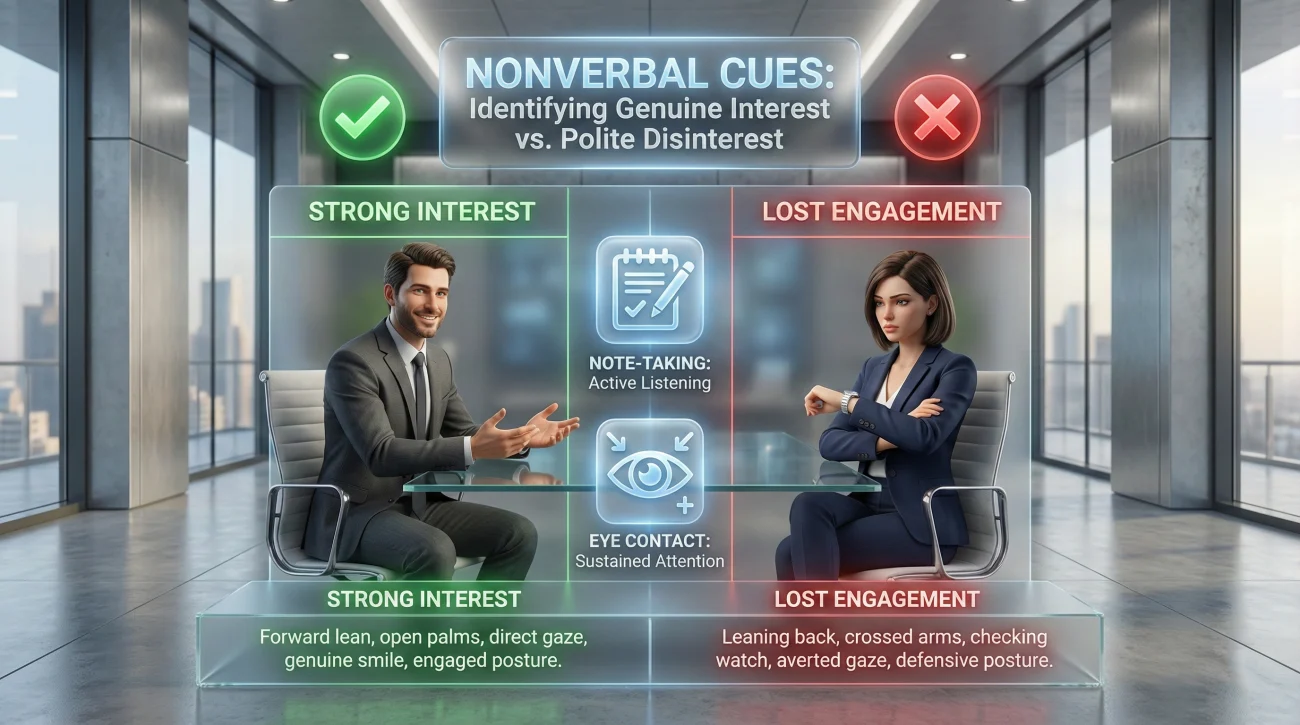
Interested interviewers lean forward, maintain consistent eye contact, and reduce distractions. They put down pens, close laptops, or stop checking phones when you’re speaking. Note-taking that suddenly increases signals they’re capturing information they consider important for decision-making. Nodding, smiling at appropriate moments, and mirroring your energy level demonstrate emotional investment in the conversation beyond basic courtesy.
- ✅ Strong interest: Forward lean, maintained eye contact, active note-taking
- ✅ Genuine engagement: Spontaneous smiling, nodding, energy matching
- ✅ Mental investment: Reduced distractions, laptop closed, phone ignored
- ⚠️ Polite disinterest: Backward lean, minimal notes, checking time
- ⚠️ Lost engagement: Multitasking, breaking eye contact, shortened responses
Time Expansion Signals
Interviewers who are highly interested regularly exceed scheduled time limits. They extend conversations beyond the original timeframe, introduce you to additional team members unplanned, or suggest facility tours not on the agenda. This time investment reveals they’re prioritizing evaluating you over their other commitments – a powerful buying signal that supersedes verbal assurances.
Expert advice: When an interviewer frequently references your resume or portfolio during conversation, they’re connecting your background to role requirements – a signal they’re building the case for hiring you.
Question Patterns That Signal Interest
The types of questions interviewers ask reveal whether they’re still evaluating fit or have moved to assessing logistics and compatibility. Understanding interview engagement cues through question analysis helps you recognize buying signals early.
Deep-Dive Follow-Ups
Interested interviewers probe deeper into your experiences with multiple follow-up questions rather than surface-level inquiry. They ask for specific examples, challenge your approaches constructively to understand your thinking, or request elaboration on technical details. This depth signals they’re seriously evaluating how you’d handle actual role challenges rather than completing perfunctory screening.
| Question Type | Interest Level | Example |
|---|---|---|
| Surface screening | Low-medium | “Tell me about your experience with X” |
| Depth probing | High | “Walk me through your specific decision process when you encountered Y” |
| Scenario testing | High | “How would you approach Z situation in our environment?” |
| Team fit assessment | Very high | “How do you prefer to receive feedback from managers?” |
| Logistics questions | Offer preparation | “What’s your notice period?” “Are you interviewing elsewhere?” |
Addressing Concerns vs. Exploring Strengths
When interviewers focus disproportionately on gaps or concerns in your background, they’re signaling hesitation rather than buying. Conversely, when they spend more time exploring your strengths, successful projects, or areas of expertise, they’re building confidence in their hiring decision. Pay attention to this ratio – strength exploration exceeding concern clarification indicates strong interest.
Adapting Strategy Based on Signals
Recognizing buying signals means nothing without strategic response. Understanding interviewer body language meaning and verbal cues enables real-time strategy adjustment that maximizes your success probability.
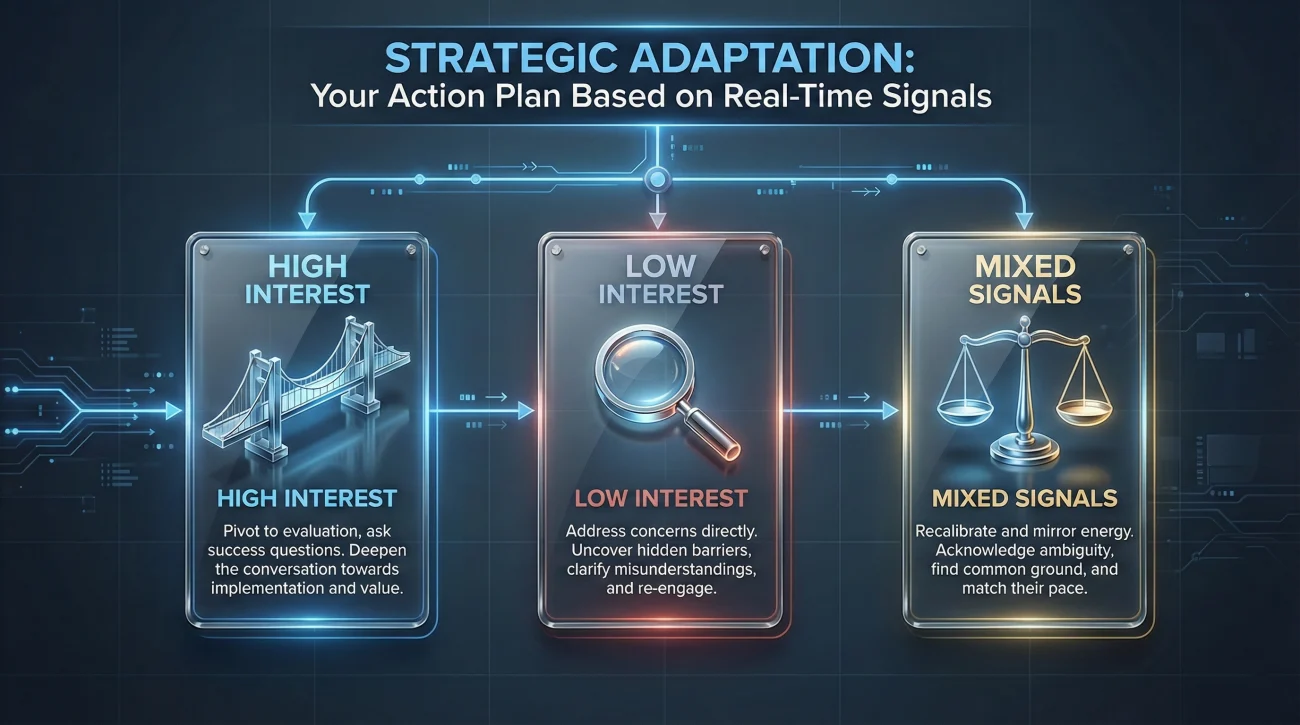
When Signals Show High Interest
Once you identify strong buying signals, stop overselling. Shift your energy toward asking strategic questions that help you evaluate the opportunity rather than continuing to prove your qualifications. Interested interviewers have mentally offered you the position – now you need to determine if you want it. Ask about challenges, team dynamics, growth opportunities, or specific role expectations that help you make an informed decision.
When you notice multiple buying signals, use closing questions that assume the offer: “What would success look like in my first 90 days?” rather than “What skills are you looking for?”
When Signals Show Hesitation
Lack of buying signals requires addressing concerns directly rather than hoping they’ll resolve themselves. If the interviewer appears disengaged, ask: “Based on our conversation, what aspects of my background would you like me to elaborate on?” This direct approach gives you opportunity to address hesitations before they become decision factors. Provide additional examples, clarify misunderstandings, or acknowledge gaps while demonstrating how you’d overcome them.
Interpreting Mixed Signals
Sometimes interviewers display contradictory signals – verbal enthusiasm paired with disengaged body language, or vice versa. Trust nonverbal cues over verbal politeness when signals conflict. Most people control their words more easily than their physical reactions. An interviewer who verbally expresses interest while checking their phone and leaning away is being polite, not genuinely engaged.
Avoiding False Signal Interpretation
Not every positive interaction signals guaranteed offers. Understanding the difference between courtesy and genuine interest prevents premature celebration or inappropriate strategy shifts.
Distinguishing Politeness from Interest
Professional interviewers maintain polite engagement regardless of their hiring intent. Smiling, nodding, and asking follow-up questions represent basic professionalism rather than buying signals unless combined with other indicators. Single isolated signals mean less than patterns – look for multiple consistent buying signals rather than interpreting every positive interaction as confirmation.
Standard Process vs. Special Treatment
Some apparent buying signals simply reflect standard company processes. Meeting multiple team members might indicate serious interest or standard procedure for all candidates. Distinguish between special treatment and routine process by asking about their typical interview flow. If they’re doing something different with you – accelerating timeline, adding meetings, or involving senior leadership earlier than normal – those represent genuine buying signals.
Don’t misinterpret extended interview time as always positive – sometimes it signals they need more convincing rather than being already convinced.
❓ FAQ
🎯 How soon in an interview can I identify buying signals?
Strong buying signals typically emerge 15-20 minutes into conversations as interviewers move from scripted questions to organic discussion. Early interviews focus on screening, so expect buying signals in later rounds.
💼 What if I’m not seeing any buying signals?
Absence of buying signals doesn’t guarantee rejection – some interviewers maintain neutral professionalism throughout. Focus on delivering strong answers and asking thoughtful questions rather than fixating on signal interpretation.
⏰ Should I directly ask if they’re interested in moving forward?
Frame this professionally: “Based on our conversation, what aspects of my background align best with what you’re seeking?” This invites them to express interest while giving you insight into their evaluation.
📋 Do virtual interviews have different buying signals?
Yes – look for increased eye contact with camera, leaning toward screen, turning off camera self-view, and eliminating distractions. Verbal signals remain similar but physical cues are harder to read.
✨ Can showing too much confidence hurt if I misread signals?
Confidence paired with professionalism never hurts. Avoid arrogance by remaining respectful regardless of buying signals. Strong signals justify assertive closing questions but not presumptuous behavior.
Final Thoughts
Developing skill in identifying interviewer interest separates candidates who blindly follow scripts from those who adapt strategically based on real-time feedback. Strong candidates recognize when they’ve already won the interviewer over and pivot to evaluating fit rather than continuing sales pitches. They identify hesitation signals early and address concerns before they solidify into rejection decisions.
Mastering reading buying signals transforms interviews from anxiety-inducing unknowns into dynamic conversations where you maintain strategic control. The most successful candidates treat interviews as two-way evaluations, using buying signals to inform when they should sell harder, when they should shift to evaluation mode, and when they should directly address lingering concerns that might prevent offers.
Practice observing these patterns across multiple interviews. Your signal-reading accuracy improves with experience, enabling increasingly sophisticated real-time strategy adjustments that maximize both your offer rate and your ability to evaluate opportunities effectively.
⚠️ Disclaimer: The interview strategies, sample answers, and negotiation tips provided in this guide are for educational purposes only. Hiring decisions are subjective and vary by company and industry. While these strategies are based on professional HR standards, they do not guarantee a specific job offer or result.