Expertise Without Intimidation
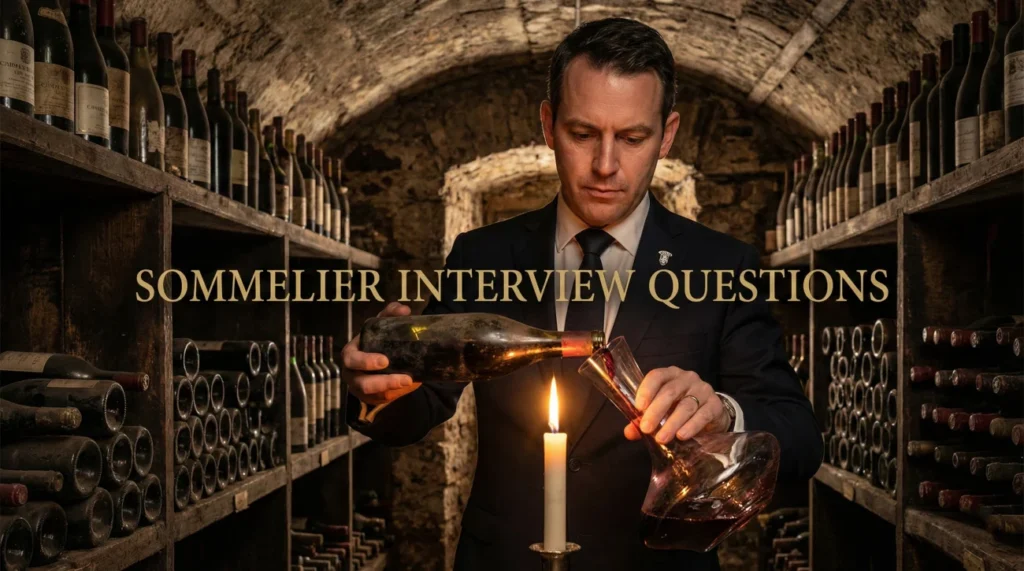
Sommelier interview questions test two things at once: knowledge and approachability. You can know every region in Burgundy, but if you make guests feel small, you will not last on the floor. Modern wine service is about translating complexity into confidence.
In the interview, expect pairing prompts, service scenarios, and business questions about margin, inventory, and training staff. Your edge is showing you can guide a guest toward the right bottle with warmth, clarity, and respect for their budget.
Pairing Philosophy & Palate
Pairing is the core product. Interviewers want to see that you understand the “Why” behind the match, not just memorize classic pairings.
Q: What is your philosophy on food and wine pairing?
Answer: I believe in two main principles: Congruent and Contrasting pairings. A congruent pairing amplifies shared flavors (e.g., an earthy Pinot Noir with mushroom risotto). A contrasting pairing uses wine to cut through the food (e.g., a high-acid Riesling cutting through the fat of a pork belly). My ultimate goal is balance; the wine should not overpower the food, nor should the food hide the wine. I always ask the guest about their personal preferences first, because the “perfect” pairing is useless if they hate the varietal.
Q: Pair a wine with a spicy Thai Green Curry.
Answer: Spice is tricky because alcohol and tannins amplify heat. I would avoid high-alcohol reds or oaky Chardonnays. Instead, I would suggest an off-dry German Riesling or an Alsatian Gewürztraminer. The slight residual sugar tames the chili heat, and the high acidity refreshes the palate. The aromatic/floral notes of these wines also complement the lemongrass and galangal in the curry perfectly.
Q: A guest orders a heavy steak but prefers White Wine. What do you recommend?
Answer: I respect their preference but guide them to a wine with weight and texture. I would suggest a full-bodied, oaked Chardonnay from California or a structured White Rhône (Viognier/Roussanne blend). These wines have the mouthfeel and intensity to stand up to the texture of the steak, even if they lack the tannins of a red. I might also suggest a mature Champagne, as the acidity and bubbles act as a fantastic palate cleanser for the fat.
Q: Explain the difference between Old World and New World wines to a novice.
Answer: Generally, Old World (Europe) wines come from cooler climates and focus on “Terroir” (earthiness/minerality) with higher acidity and lower alcohol. They are often named by region (e.g., Bordeaux, Chianti). New World (US, Australia, Chile) wines come from warmer climates and are more “Fruit Forward,” with higher alcohol and fuller body. They are usually named by the grape varietal (e.g., Cabernet Sauvignon, Shiraz). It is the difference between “Elegant/Earthy” and “Bold/Fruity.”
Service Rituals & Etiquette
Wine service is a dance. Interviewers will often ask you to demonstrate or describe the steps to ensure you have the technical polish.
Q: Walk me through the steps of presenting and opening a bottle of wine.
The Strategy: Technical Precision.
Answer: 1. Present the label to the host to confirm. 2. Cut the foil neatly below the second lip. 3. Wipe the top. 4. Insert corkscrew and remove cork gently (no pop). 5. Wipe the lip again. 6. Pour a small taste for the host. 7. Once approved, pour for guests (ladies first, clockwise) and the host last. 8. Place the bottle on the table/bucket with the label facing the host.
Q: When do you decant a wine?
The Strategy: Knowing the “Why.”
Answer: I decant for two reasons: Aeration for young, tannic reds (like a young Napa Cab or Barolo) to “open them up” and soften the tannins. Sediment removal for old, vintage wines (like an aged Bordeaux or Port). For old wines, I decant gently near a light source to watch for sediment. I ask the guest for permission first, as some prefer to watch the wine evolve in the glass.
Q: A guest says the wine is “corked” (TCA taint). You taste it and think it is fine.
The Strategy: Hospitality First.
Answer: I never argue. Perception is reality for the guest. I say, “I am so sorry about that. Let me grab you a fresh bottle immediately.” I remove the bottle. Later, I taste it again with a colleague to confirm. If it is fine, I can sell it by the glass to recover the cost. If it is corked, I note it for supplier credit. At the table, the guest is always right.
Q: How do you handle a sparkling wine cork that is stuck?
The Strategy: Safety.
Answer: I keep the cage (muselet) loosened but still over the cork for grip and safety. I use a clean service cloth (“torchon”) for better traction. I hold the cork firm and twist the bottle base, not the cork. If it is truly seized, I might use wine pliers (carefully) in the back of house, but I never struggle with it at the table where I could lose control and point it at a guest.
Q: What is the correct pouring amount for a glass of wine?
The Strategy: Portion Control.
Answer: A standard pour is usually 5 oz (150ml), which gets 5 glasses per bottle. For a tasting flight, it might be 2-3 oz. I practice pouring with water to hit the exact mark consistently without measuring tools. Consistent pouring is crucial for cost control; over-pouring kills the profit margin.
Q: How do you top up wine without being intrusive?
The Strategy: Invisible Service.
Answer: I monitor levels from a distance. When a glass is below one-third full, I approach during a break in conversation. I hold the bottle by the punt/base, pour silently (no clinking), and twist at the end to catch the drip. I do not interrupt their speech. If they are deep in conversation, I wait.
Business Acumen & Cellar Management
A cellar is an investment portfolio. Interviewers need to know you can sell the inventory, not just hoard it.
Q: How do you calculate Wine Cost Percentage?
Answer: Wine Cost % = (Cost of Wine Sold / Total Wine Sales). A healthy target is typically 25-35%. To manage this, I balance the list. I might run a high cost % on a prestigious Champagne (to keep the price competitive/accessible) but run a very low cost % on our by-the-glass program to balance the average. I track “dead stock” monthly and run specials to convert that inventory back into cash.
Q: How do you approach building a wine list for this specific restaurant?
Answer: I look at the Chef’s menu and the price point first. The wine list must mirror the food. If we are a rustic Italian trattoria, I focus on Nebbiolo and Sangiovese, not Napa Cabs. I ensure there is a price hierarchy: plenty of “comfort zone” bottles in the $40-$80 range, but enough “trophy” bottles for high rollers. I also leave 10% of the list for “discovery” wines (like obscure Greek or Portuguese varietals) to engage adventurous drinkers.
Q: How do you train the floor staff to sell wine?
Answer: Servers are my sales force. I keep training short and practical. I don’t lecture on soil types; I give them “selling hooks.” For example: “This Malbec is like a warm hug – jammy and smooth.” I open bottles for them to taste daily at pre-shift. If they love it, they sell it. I also run competitions (e.g., “Whoever sells the most Rosé tonight gets a bottle to take home”).
Trends & Situational Questions
The wine world changes fast. You need to show you are current and adaptable.
A guest asks for “Natural Wine” but you don’t have any on the list.
The Strategy: Pivot to Profile.
Answer: I ask what they like about natural wine (Is it the funkiness? The unfiltered texture? The ethical farming?). If they like the ethics, I point them to a biodynamic producer on our list who farms cleanly but makes classic wine. If they like the “funky” flavor, I might suggest a traditional Beaujolais or an earthy Chinon that mimics those characteristics. I validate their interest while selling what I have.
A table orders a bottle of white and a bottle of red. They arrive at the same time.
The Strategy: Logistics.
Answer: I bring appropriate glassware for both. I ask the host, “Would you like to start with the white, or would you like both open now?” Usually, they start with white. I open the white and serve it. I open the red but might leave it on the sideboard to breathe (or decant it) so it is ready when they switch courses. I manage the table real estate so it isn’t cluttered.
What is your opinion on “Orange Wine” (Skin-contact white)?
The Strategy: Professional Knowledge.
Answer: Orange wine is a fantastic category for food pairing. Because of the tannins from the skin contact, it pairs well with hard-to-match foods like artichokes, fermented vegetables, or fatty pork. It bridges the gap between white and red. I think every modern list should have at least one approachable orange wine to offer guests looking for something different.
Sommelier Knowledge Quiz
Test Your Wine IQ
1. “Terroir” refers to:
- A type of grape
- The complete natural environment (soil, climate, topography) affecting the wine
- A wine terror
- The barrel aging process
2. Which grape is the primary varietal in Chianti Classico?
- Merlot
- Sangiovese
- Nebbiolo
- Cabernet Sauvignon
3. “Tannin” creates what sensation in the mouth?
- Sweetness
- Dryness / Astringency (like oversteeped tea)
- Salivation
- Heat
4. Ideally, a full-bodied Red Wine should be served at:
- Refrigerator temperature (40°F)
- Just below room temperature (60-65°F / 15-18°C)
- Hot room temperature (75°F)
- Ice cold
5. “Corked” wine smells like:
- Vinegar
- Wet cardboard or damp basement (TCA taint)
- Burnt rubber
- Flowers
6. Champagne is made using which method?
- Charmat Method (Tank)
- Méthode Traditionnelle (Secondary fermentation in the bottle)
- Carbonation Injection
- Still wine method
7. “Vintage” refers to:
- The year the wine was bottled
- The year the grapes were harvested
- The age of the winery
- Old wine
8. A “Sommelier’s Knife” is essentially:
- A steak knife
- A waiter’s corkscrew with a foil cutter and lever
- A saber
- A cheese knife
9. Which region is famous for Pinot Noir in the USA?
- Napa Valley
- Willamette Valley (Oregon)
- Texas Hill Country
- Florida
10. “Noble Rot” (Botrytis) helps create:
- Bad wine
- Sweet dessert wines (like Sauternes) by dehydrating the grapes
- Red wine
- Sparkling wine
11. A “Magnum” bottle holds:
- 750ml (Standard)
- 1.5 Liters (2 Standard Bottles)
- 3 Liters
- 5 Liters
12. “Residual Sugar” determines:
- Alcohol content
- The sweetness level of the wine
- The color
- The price
13. Chablis is made from 100% of which grape?
- Sauvignon Blanc
- Chardonnay
- Riesling
- Chenin Blanc
14. “Body” describes:
- The bottle shape
- The weight and viscosity of the wine in the mouth (Light, Medium, Full)
- The smell
- The cork
15. Ideally, white wines should be served:
- Room temperature
- Chilled (45-55°F / 7-12°C)
- Frozen
- Hot
16. “Legs” or “Tears” on the glass indicate:
- High quality
- Alcohol content and viscosity (not necessarily quality)
- Sugar only
- Old wine
17. A “Blend” (like Bordeaux) uses:
- Only one grape
- Multiple grape varieties mixed together to balance flavor
- Food coloring
- Water
18. “AOC” (France) or “DOC” (Italy) certifies:
- The wine is cheap
- The wine comes from a specific region and follows strict production rules
- The wine is organic
- The wine is sweet
19. “Varietal” refers to:
- The region
- The type of grape used (e.g., Merlot)
- The vineyard owner
- The bottle size
20. Decanting is primarily for:
- White wine
- Red wine (and some whites) to separate sediment and aerate
- Beer
- Water
❓ FAQ
📜 Do I need CMS or WSET to get hired?
Not always, but certifications help for high-end programs. If you do not have them, lean on demonstrated tasting ability, strong service habits, and clear pairing logic. Many venues value hospitality and sales skill as much as credentials.
👃 Will there be a blind tasting portion?
Often, yes. If you are unsure, describe your method: appearance, aroma, structure, then a conclusion. Even when the grape is not perfect, a calm, logical process shows real competence.
📦 How do I talk about inventory and cost control?
Mention organization and discipline. Talk about tracking by-the-glass movement, reducing dead stock, rotating vintages, and counting regularly. Tie it back to profitability, because a cellar is capital sitting on the wall.
🕴️ What does a professional sommelier look like on the floor?
Polished and quiet. Clean nails, sharp shoes, a crisp uniform, and controlled movements at the table. Guests should feel you are confident and present without taking over their night.
🧩 Can I start part-time and grow into the role?
Yes. Many restaurants split duties between a lead sommelier and a manager, especially on slower nights. Part-time roles can be a strong entry point if you consistently sell, train, and support service.
Final Thoughts
A sommelier interview is part exam, part sales conversation. In sommelier interview questions, show that you can pair with purpose, serve with precision, and still keep the experience relaxed for the table.
Close by linking knowledge to results: higher check averages, fewer returns, a trained floor, and a cellar that turns instead of gathering dust. When you speak that language, you sound like an investment.
⚠️ Disclaimer: The interview strategies, sample answers, and negotiation tips provided in this guide are for educational purposes only. Hiring decisions are subjective and vary by company and industry. While these strategies are based on professional HR standards, they do not guarantee a specific job offer or result.