- Why Action Matters Most: Action is the core of STAR because it proves competency through what you did and why, so it should take roughly 50–60% of your answer time.
- Own Your Contribution: Use “I” for most statements, clarify your specific piece in team work, and acknowledge collaboration without hiding behind “we.”
- Explain Your Reasoning: Add the rationale behind choices using data, trade-offs, and alternatives considered to show judgment, not just a checklist of steps.
- Keep It Clear And Structured: Separate Action from Result, give process-level detail (not tiny technical trivia), and present actions in a logical sequence interviewers can follow.
- Avoid Weak Patterns And Refine: Cut vague verbs and passive voice, stop mixing outcomes into Action, and practice the “specificity test” plus timing to sharpen impact.
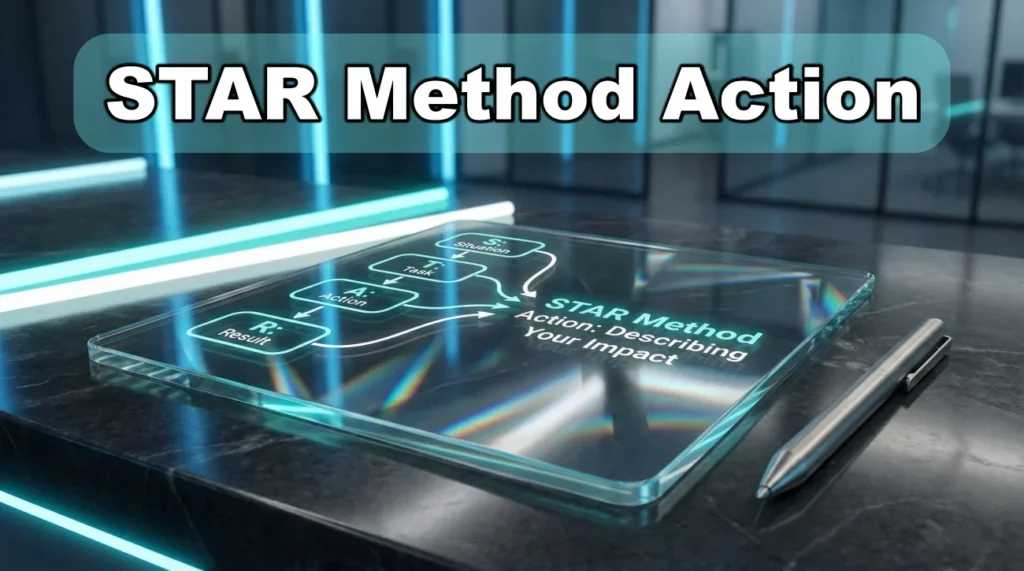
STAR Method Action (Describing Your Impact)
Candidates who say “we decided” and “the team implemented” throughout their answers leave interviewers wondering what they personally contributed. Team collaboration matters, but interviews evaluate individual capabilities. When you hide behind collective pronouns, you obscure the very information interviewers need to assess whether you’re qualified.
The star method action component showcases what you specifically did to address the challenge. This isn’t about taking credit for team accomplishments – it’s about clearly articulating your role within collaborative efforts. Strong Action sections distinguish your contributions from ambient team activity.
Effective describing your contributions requires balancing detailed explanation with concise delivery. You need enough specificity to prove competence without drowning listeners in unnecessary minutiae. This component typically consumes 50-60% of your total answer time because it contains the evidence interviewers use to evaluate your capabilities, as outlined in Harvard Business Review’s guide on the STAR interview method.
Understanding Action’s Central Role
The Action section forms the heart of STAR answers. Situation provides context, Task defines the goal, Result proves success – but Action demonstrates how you think, make decisions, and execute solutions.
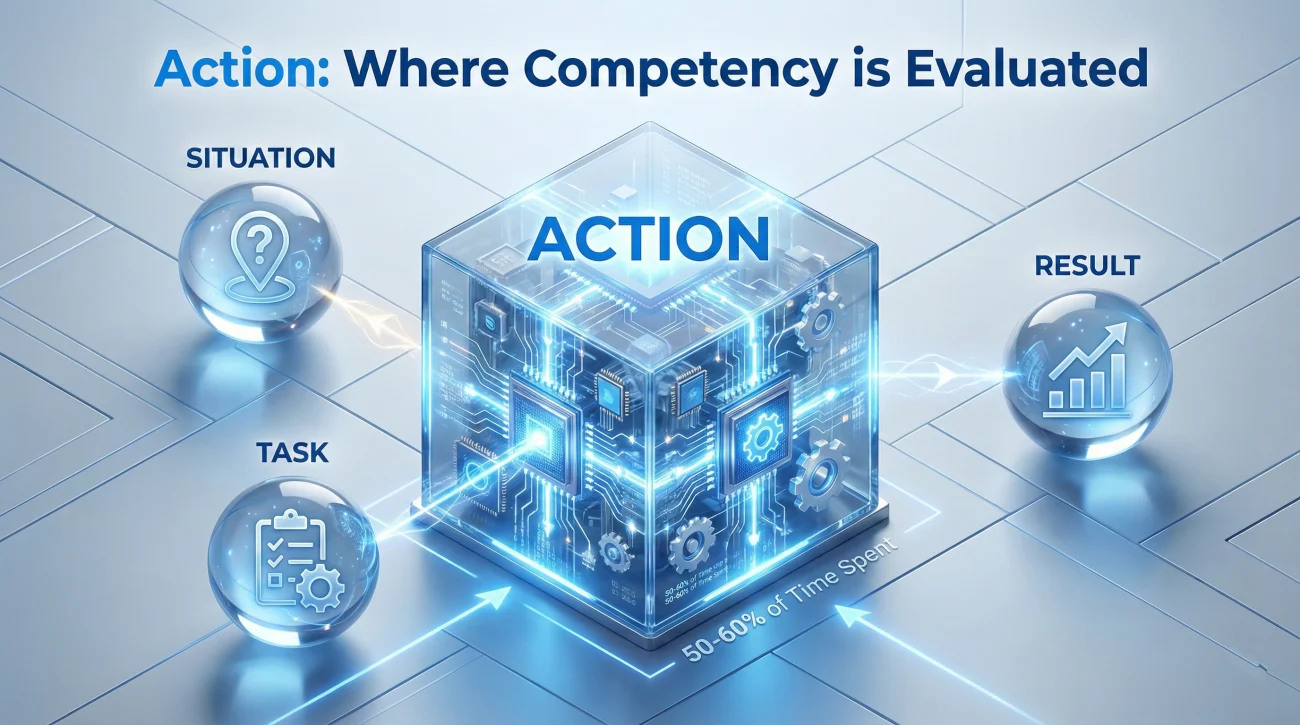
Where Competency Gets Demonstrated
Interviewers evaluate competencies through Actions, not Situations or Tasks. “I faced a difficult client” (Situation) and “I needed to salvage the relationship” (Task) don’t prove you can handle difficult clients. “I scheduled daily check-ins to rebuild trust and created a detailed project tracker they could access anytime” (Action) provides the evidence.
This explains why Action deserves the most time in your answer. The other components enable evaluation, but Action contains what’s being evaluated. Rushing through Actions to get to Results wastes the opportunity to showcase your approach.
Expert insight: Strong Actions reveal your decision-making process, not just your decisions. Explaining why you chose a particular approach demonstrates deeper competence than listing steps mechanically. The reasoning behind actions often matters as much as the actions themselves.
Action vs Result: The Distinction
Action describes what you did. Result describes what happened because of what you did. “I refactored the codebase to improve performance” is Action. “Response time decreased from 2 seconds to 500ms” is Result. Candidates often confuse these, burying outcomes in the Action section or describing activities in the Result.
Maintain clean separation. Actions are steps you took. Results are measurable changes that occurred. This clarity makes your answer easier to follow and more impactful.
Establishing Personal Accountability
Personal accountability interview responses require clear ownership statements. Interviewers need to understand your specific contribution, not general team activities.
Using “I” Not “We”
Replace “we” with “I” when describing your actions. “We implemented the solution” hides whether you led, contributed equally, or merely observed. “I implemented the authentication module while my teammate handled the payment integration” clarifies your piece.
| Weak (We) | Strong (I) |
|---|---|
| “We analyzed the data and found patterns” | “I analyzed error logs and identified that 80% of failures occurred during peak hours” |
| “We decided to refactor the code” | “I proposed refactoring based on the bottleneck analysis, and the team agreed” |
| “We built a new feature” | “I designed the API endpoints and wrote the backend logic” |
| “We met with stakeholders” | “I facilitated weekly stakeholder meetings to align on requirements” |
Using “we” occasionally to acknowledge collaboration is fine. But if your entire Action section uses “we,” you haven’t demonstrated personal contribution. Aim for 80%+ “I” statements.
Acknowledging Collaboration Without Hiding
You can recognize teamwork while still clarifying your role. “I led the initiative to migrate our infrastructure, coordinating with the DevOps team who managed the deployment automation while I focused on database migration and testing.”
This approach credits others appropriately without obscuring what you specifically did. Interviewers appreciate candidates who work well with teams but can articulate individual impact clearly.
Explaining Your Reasoning
Action steps explanation becomes powerful when you include the why behind your choices, not just the what you did.

Sharing Decision Rationale
Don’t just list actions – explain why you took them. “I implemented caching” is incomplete. “I implemented caching because profiling showed database queries were the bottleneck, consuming 80% of response time” demonstrates analytical thinking and problem-solving approach.
The rationale reveals how you approach challenges. Two candidates might implement the same solution, but one who can articulate why they chose that approach over alternatives demonstrates deeper competence.
- 🔍 Analysis-based: “After analyzing the logs, I determined the issue stemmed from…”
- ⚖️ Trade-off consideration: “I chose approach A over B because we prioritized speed to market over perfect optimization…”
- 📊 Data-driven: “User feedback indicated navigation was confusing, so I redesigned the menu structure…”
- 🎯 Strategic alignment: “This solution aligned with our goal of reducing technical debt while maintaining feature velocity…”
- 🚀 Risk management: “I implemented the change gradually, rolling out to 10% of users first to minimize risk…”
Discussing Alternatives Considered
Mentioning alternatives you evaluated shows thorough thinking. “I considered rebuilding from scratch but decided incremental refactoring was less risky given our tight timeline” proves you thought critically rather than jumping to the first solution.
Expert insight: Senior roles especially value seeing how candidates evaluate trade-offs. Discussing why you rejected certain approaches demonstrates strategic thinking and judgment, not just execution capability.
Balancing Detail and Brevity
Demonstrating ownership requires enough detail to prove competence without overwhelming listeners with technical minutiae.
Finding the Right Granularity
Provide process-level detail, not code-level specifics. “I optimized the database queries by adding indexes on frequently searched columns and implementing connection pooling” works. Explaining the exact SQL syntax doesn’t add value in most interviews.
Think about what demonstrates your capability versus what’s unnecessary technical trivia. The interviewer needs to understand your approach and competence level, not recreate your exact work.
💡 Pro tip: Gauge detail level based on interviewer reaction. If they’re nodding and engaged, your current level works. If they look confused or bored, adjust. Technical interviews might welcome more depth than behavioral interviews.
Organizing Actions Sequentially
Present actions in logical order, typically chronological. “First, I analyzed the problem. Then, I designed a solution. Next, I implemented it in phases. Finally, I validated the results” creates clear narrative flow.
Sequential organization helps interviewers follow your thinking. Jumping randomly between different actions or timeframes creates confusion about your actual process.
| Action Phase | What to Include | Example |
|---|---|---|
| Investigation | How you gathered information | “I interviewed 10 customers to understand pain points” |
| Planning | How you designed the approach | “I created a phased rollout plan with clear milestones” |
| Execution | Specific steps you implemented | “I rewrote the checkout flow using React hooks” |
| Validation | How you confirmed it worked | “I ran A/B tests comparing old vs new flow” |
| Iteration | Adjustments based on feedback | “User testing revealed confusion, so I simplified the UI” |
Showing Leadership and Influence
Individual impact stories become especially powerful when they demonstrate how you influenced others and drove outcomes beyond your direct responsibilities.

Demonstrating Informal Leadership
Leadership actions don’t require a manager title. “I organized weekly knowledge-sharing sessions where engineers presented recent learnings” shows initiative and influence regardless of formal authority.
Highlight times you motivated others, aligned stakeholders, resolved conflicts, or drove initiatives. These actions prove leadership capability more convincingly than stating “I’m a natural leader.”
Managing Stakeholders
Include how you communicated with and influenced stakeholders. “I created weekly progress dashboards for executives so they could track metrics without attending detailed meetings” demonstrates communication skills and stakeholder management.
Technical achievements matter, but business context matters more at senior levels. Show you understand how your work connects to organizational goals and how you kept relevant parties informed and aligned.
Navigating Obstacles
Don’t hide challenges encountered during execution. “When initial user testing revealed confusion about the interface, I ran additional focus groups to understand the issue and redesigned the flow” shows adaptability and problem-solving.
Obstacles overcome make success more impressive than smooth execution. They reveal how you respond when plans don’t work perfectly – critical information for interviewers evaluating real-world capability.
Common Action Mistakes
Predictable errors weaken Action sections, reducing their ability to showcase your competencies effectively.
Being Too Vague
“I worked on improving the system” doesn’t tell interviewers anything. What specifically did you do? How did you improve it? What was your approach? Vague Actions provide no evidence of competence.
Generic verbs like “worked on,” “helped with,” “contributed to” signal weak Actions. Use specific verbs: “designed,” “implemented,” “analyzed,” “facilitated,” “optimized.”
Using Passive Voice
“The solution was implemented” obscures who did the work. “I implemented the solution” takes clear ownership. Active voice creates stronger, more direct statements that clearly attribute actions to you.
Listing Without Explaining
Actions become a checklist: “I did A, then B, then C” without explaining why. The rationale demonstrates critical thinking. Without it, you’re just describing a sequence of tasks, not problem-solving capability.
Mixing Action and Result
Candidates often blend actions with outcomes. “I improved response time by 50%” belongs in Result. “I optimized database queries and implemented caching” belongs in Action. Keep them separate for clarity.
Crafting Technical Actions
Technical roles require demonstrating both technical depth and broader problem-solving approach in Action sections.

Appropriate Technical Specificity
Include enough technical detail to prove competence without becoming inaccessible. “I implemented a caching layer using Redis with a 1-hour TTL” works for technical interviews. “I added caching to improve performance” might suffice for less technical audiences.
Calibrate based on interviewer background. If they’re technical, they’ll appreciate accuracy. If they’re non-technical stakeholders, focus on the problem-solving approach rather than implementation details.
Highlighting Methodology and Process
Technical excellence includes following sound practices. “I wrote comprehensive unit tests achieving 90% coverage before merging” or “I conducted thorough code reviews with the team” shows professional rigor beyond just writing code.
These process-oriented actions demonstrate you understand software engineering as a discipline, not just coding as a task. They’re especially valuable for senior roles where methodology matters as much as technical skill.
Crafting Non-Technical Actions
Behavioral competencies like leadership, communication, and conflict resolution require different Action approaches than technical problems.
Describing Interpersonal Actions
For people-focused challenges, emphasize how you influenced, aligned, or resolved. “I scheduled one-on-ones with each team member to understand their concerns, then facilitated a group discussion where we collaboratively defined new processes everyone could support.”
These actions prove soft skills through specific behaviors rather than claiming “I’m a good communicator.” Show communication skills by describing how you communicated.
Change Management Actions
When describing change initiatives, include how you managed the human element. “I created a communication plan to explain the why behind the reorganization, held town halls to address concerns, and established feedback channels to hear reactions.”
Technical changes fail without adoption. Actions that demonstrate you understand change management prove you can drive initiatives in real organizations, not just ideal scenarios.
Practicing and Refining Actions
Strong Action sections come from iterative refinement, identifying where you’re vague and adding necessary specificity.
The Specificity Test
Read your Action section and ask: “Could another person approximately recreate what I did from this description?” If not, add detail. “I improved the process” fails this test. “I automated the three most time-consuming manual steps using Python scripts” passes.
Another test: “Does this prove I personally have the skill being evaluated?” If you could have said the same thing while contributing minimally, you haven’t demonstrated competence clearly enough.
💡 Pro tip: Record yourself delivering your STAR answer. Listen specifically to the Action section. Does it sound convincing? Would you hire someone who described actions this way? If not, strengthen it.
Balancing Time Allocation
Practice timing your answers. Action should consume 50-60% of your response. If you’re spending equal time on all four components, you’re probably rushing through Actions or over-explaining Situation and Task.
For comprehensive behavioral interview preparation covering all STAR components and question types, browse our complete collection of behavioral interview guides with proven strategies for structuring compelling answers.
❓ FAQ
🎯 How much technical detail should I include in Actions?
Enough to prove competence without overwhelming non-technical listeners. Focus on approach and decision-making rather than implementation minutiae. For technical interviewers, you can go deeper if they engage with technical questions. For behavioral interviews, emphasize problem-solving process over specific technologies.
💼 How do I show my contribution on team projects without taking all the credit?
Be specific about your piece while acknowledging the team context. “I designed the database schema while my teammate handled the API layer” gives credit appropriately while clarifying your role. Interviewers evaluate you individually even in collaborative contexts – they need to know what you contributed.
⏰ What if my actions didn’t work initially?
Include the pivot in your Action. “My first approach didn’t reduce errors as expected, so I analyzed why and tried a different strategy” demonstrates adaptability and persistence. Obstacles overcome make success more impressive than smooth execution. Just ensure you eventually reached a positive outcome for the Result section.
📋 Should Actions be chronological or organized by theme?
Chronological typically works best – it creates natural narrative flow. However, for complex scenarios, grouping related actions thematically can work: “On the technical side, I…, and for stakeholder management, I…” Use whatever organization makes your thought process clearest to follow.
✨ How do I avoid making Actions sound like a task list?
Add the why behind each action. Instead of “I did A, then B, then C,” explain “I started with A because profiling indicated it was the bottleneck. Once that improved performance 30%, I addressed B.” The reasoning transforms a checklist into a problem-solving narrative.
Final Thoughts
The Action component carries the weight of proving your competence in STAR answers. Situation and Task set up the problem, Result validates your success, but Action demonstrates how you think, decide, and execute. Interviewers evaluate capabilities through Actions – everything else serves to contextualize those actions.
Strong Actions balance three elements: specificity about what you did, clarity about your individual contribution, and explanation of your reasoning. You need enough detail to prove competence, clear ownership statements to demonstrate personal accountability, and rationale that reveals your decision-making process.
Master star method action techniques by practicing specific, first-person descriptions of your work. Replace “we” with “I” in 80% of statements. Add the why behind your choices, not just the what you did. Organize actions sequentially so interviewers can follow your process. Time your responses to ensure Actions receive 50-60% of your answer. When you nail the Action component, you provide exactly the evidence interviewers need to confidently assess your capabilities and envision you succeeding in their role.
⚠️ Disclaimer: The interview strategies, sample answers, and negotiation tips provided in this guide are for educational purposes only. Hiring decisions are subjective and vary by company and industry. While these strategies are based on professional HR standards, they do not guarantee a specific job offer or result.