- Core purpose: STAR structures behavioral answers so interviewers hear clear evidence, not rambling stories.
- Four parts and pacing: Situation sets context, Task defines the goal, Action explains what you did and why, Result proves impact with numbers or solid estimates.
- What strong answers do: Keep Situation and Task short, put most detail in Action, use “I” to show your contribution, then close with measurable outcomes.
- Preparation that wins: Build a 5-7 story bank across leadership, collaboration, problem-solving, adaptability, and failure recovery, then practice aloud to stay within 2-3 minutes.
- Mistakes to avoid: Overexplaining background, hiding behind “we,” skipping Results, and listing actions without reasoning, plus adjust emphasis by level from students to executives.
STAR Method Interview Guide (Situation Task Action Result)
Rambling answers lose interviewers. “Tell me about a time you solved a conflict” triggers a ten-minute story covering irrelevant background, tangential details, and no clear outcome. The interviewer zones out, learns nothing about your capabilities, and moves to the next candidate.
The star method interview framework solves this by providing structure that highlights competencies systematically. Every behavioral answer follows the same pattern: Situation establishes context, Task defines the challenge, Action explains what you did, Result quantifies impact. This consistent format makes your accomplishments clear and memorable.
Companies increasingly use competency based interviewing because past behavior predicts future performance better than hypothetical questions. They’re not asking “How would you handle conflict?” but “How have you actually handled conflict?” The STAR technique ensures you answer with concrete evidence rather than theoretical platitudes. This structured approach has been widely adopted across industries, with organizations like Indeed documenting its effectiveness for job seekers worldwide.
Understanding the STAR Framework
The situation task action result structure breaks complex professional experiences into digestible components. Each element serves a specific purpose in demonstrating your competence.
The Four Core Components
| Component | Purpose | Key Questions | Time Allocation |
|---|---|---|---|
| Situation | Set context efficiently | Where were you? What was happening? | 20% |
| Task | Define the challenge | What needed to be solved? What was at stake? | 15% |
| Action | Explain your approach | What did YOU specifically do? Why those choices? | 50% |
| Result | Quantify impact | What changed? What metrics improved? | 15% |
Notice Action receives the most time. Interviewers care about what you did and why you did it. Situation and Task provide necessary context but should be concise. Result closes the story with measurable outcomes that validate your approach worked.
Why STAR Works Better Than Alternatives
Without structure, answers drift. You might spend three minutes on background context, rush through what you actually did, and forget to mention results entirely. STAR prevents this by allocating appropriate weight to each component.
The framework also forces specificity. “I’m a good team player” means nothing. “I resolved a conflict between frontend and backend teams by facilitating a design review meeting, which reduced integration bugs by 40%” demonstrates team collaboration with evidence.
Expert insight: STAR answers are easy to evaluate because they follow predictable structure. Interviewers can quickly identify whether you provided context, explained your thinking, and achieved results. This consistency helps you stand out in their notes when comparing candidates.
Crafting Effective Situation Statements
The Situation sets the scene without drowning listeners in backstory. Provide enough context to understand the challenge, but no more.
What to Include
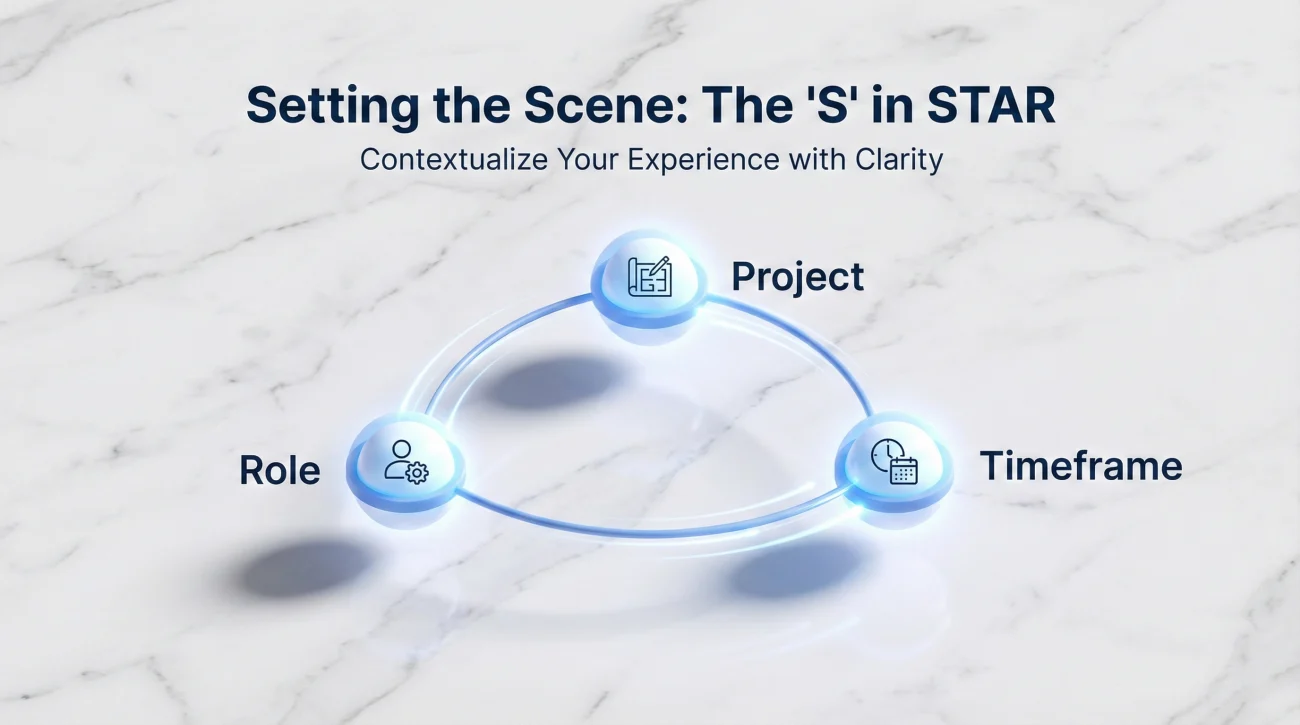
Identify your role, the organization or project, and the timeframe. “I was a backend engineer at TechCorp working on the payment processing system” establishes relevant context in one sentence. You don’t need company history, team org chart, or technology stack details unless they’re critical to understanding the story.
Describe the broader situation that created the challenge. “Our payment system was processing 100,000 transactions daily, but error rates had climbed to 5% over two months, frustrating customers and costing revenue.” This explains why action was needed without getting lost in technical minutiae.
💡 Pro tip: Keep Situation to 2-3 sentences maximum. If you find yourself explaining organizational politics or project history in detail, you’re providing too much context. Cut to the essential facts.
For detailed techniques on setting the scene effectively, including how to balance context with brevity and avoid common Situation mistakes, explore our dedicated guide on crafting the S component of STAR.
Defining the Task Component
Task explains what specifically needed to be accomplished. This bridges Situation to Action by clarifying the problem you set out to solve.
Making the Challenge Clear
Define what you were responsible for fixing or achieving. “My task was to identify the root cause of payment errors and reduce the error rate below 2% within one month” sets clear success criteria. The interviewer now knows what problem you tackled and what would constitute success.
Distinguish between organizational goals and your specific responsibility. The company might have wanted to improve customer satisfaction overall, but your task was the concrete technical problem contributing to that larger goal. Stay focused on what you owned.
Express stakes when relevant. “If we didn’t resolve this quickly, we risked losing our largest client who processed 30% of our transaction volume” adds urgency that explains why your actions mattered. But don’t manufacture drama if the task was routine problem-solving.
Learn advanced techniques for defining compelling Tasks, including how to articulate constraints, stakeholder expectations, and success metrics in our focused guide on the T component.
Describing Your Actions
Action forms the heart of STAR answers. This section demonstrates how you think, make decisions, and execute solutions. Spend roughly half your answer time here.
Emphasizing YOUR Contributions
Use “I” not “we” when describing actions. Interviewers need to understand your specific role, not team accomplishments. “I analyzed error logs and discovered 80% of failures occurred during peak traffic hours” shows what you personally did. “We looked at the data and found patterns” hides your contribution.
Explain your reasoning, not just actions. “I decided to implement caching for frequently-accessed payment data because the database was bottlenecking under load” shows problem-solving thought process. The why behind decisions reveals how you approach challenges.
Break complex actions into clear steps. “First, I set up monitoring to capture error patterns. Then I reviewed code changes from the past month. Finally, I ran load tests to reproduce the issue in staging.” Sequential explanation helps interviewers follow your methodology.
Expert insight: Strong Action sections reveal how you collaborate, communicate, and navigate obstacles. Don’t just list technical tasks – show how you influenced others, adapted when plans changed, or overcame resistance.
Master the art of describing impactful Actions with our comprehensive guide covering how to highlight leadership, initiative, problem-solving approach, and collaboration in the A component.
Quantifying Results
Results validate that your actions worked. Specific metrics beat vague success claims every time.

Choosing Strong Metrics
Use numbers whenever possible. “I reduced payment error rate from 5% to 1.2%, preventing an estimated $2M in lost revenue” beats “The errors decreased significantly.” Concrete data makes impact tangible and memorable.
If you lack precise metrics, estimate based on available information. “The solution saved approximately 10 hours per week of manual work across the team” works when you can’t measure exactly but know the magnitude. Reasonable estimates demonstrate results-oriented thinking.
| Result Type | Weak Example | Strong Example |
|---|---|---|
| Performance Improvement | “Made the system faster” | “Reduced API response time from 800ms to 200ms” |
| Cost Savings | “Saved money on infrastructure” | “Cut monthly AWS costs by $15,000 through optimization” |
| Team Impact | “Helped the team work better” | “Reduced deployment time from 2 hours to 20 minutes” |
| Customer Impact | “Customers were happier” | “Increased NPS score from 32 to 58 over three months” |
| Quality Improvement | “Fixed bugs” | “Decreased production incidents by 65%” |
Include secondary outcomes when relevant. “The solution not only fixed the immediate error rate problem but also improved our monitoring capabilities, which helped us catch two other issues before they affected customers.” Shows broader thinking beyond the initial task.
Dive deeper into Result techniques with our specialized guide covering how to quantify soft outcomes, handle situations without clear metrics, and connect your work to business impact in the R component.
Building Your Story Bank
Behavioral answer framework preparation requires having stories ready before interviews. You can’t improvise compelling STAR answers on the spot.

Selecting Stories Strategically
Identify 5-7 core stories that demonstrate different competencies. You’ll need examples of leadership, conflict resolution, failure recovery, technical problem-solving, collaboration, and innovation. One story can showcase multiple competencies when told with different emphasis.
Choose recent examples when possible. Stories from the past year feel more relevant than college projects from five years ago, especially for experienced candidates. Recency signals current capabilities rather than outdated skills.
- 💼 Leadership: Times you influenced without authority, mentored others, or drove initiatives
- 🤝 Collaboration: Cross-functional projects, conflict resolution, building consensus
- 🔧 Problem-solving: Complex technical challenges, debugging difficult issues, innovative solutions
- 📈 Impact: Measurable improvements to metrics, cost savings, efficiency gains
- 🎯 Adaptability: Pivoting when plans changed, learning new technologies quickly, handling ambiguity
- ⚠️ Failure recovery: Mistakes made, lessons learned, how you applied those lessons
Develop a comprehensive story bank strategy with our detailed guide on preparing your behavioral answer library, including how many stories you need and techniques for adapting stories to different questions.
Common STAR Mistakes to Avoid
Even with the framework, candidates make predictable errors that weaken answers.
Frequent Pitfalls
Using “we” instead of “I” throughout the Action section hides your contribution. Interviewers can’t evaluate what you specifically did when you speak only about team accomplishments. Clarify your role explicitly.
Spending too much time on Situation and Task leaves insufficient time for Action. Rambling background stories with rushed endings make it impossible to assess your capabilities.
Forgetting to include Results leaves the story incomplete. Saying “I implemented the solution and moved on to other projects” doesn’t demonstrate impact. Always close with measurable outcomes, even if approximate.
Providing only surface-level Actions without explaining reasoning misses opportunities to showcase problem-solving approach. “I added caching” tells what; “I added caching because database queries were the bottleneck, as confirmed by profiling” tells why.
Explore the complete catalog of STAR mistakes with our dedicated guide on common errors and how to avoid them, including subtle mistakes that even experienced interviewees make.
Adapting STAR for Different Experience Levels
Structured interview responses work for everyone, but emphasis shifts based on career stage.
Students and New Graduates
Without extensive work experience, draw from academic projects, internships, volunteer work, or extracurricular activities. The STAR framework applies equally to leading a student organization through a crisis or completing a complex class project.
Focus on transferable skills. A story about organizing a hackathon demonstrates project management, stakeholder coordination, and problem-solving – all relevant to professional work even though the context is academic.
Learn specialized techniques for building STAR answers without traditional work experience in our guide designed specifically for students and entry-level candidates.
Executives and Senior Leaders
Senior roles require STAR stories that emphasize strategic thinking over tactical execution. Your Action sections should highlight how you influenced organizational direction, managed stakeholders, or developed people rather than individual technical contributions.
Results need to connect to business outcomes. “Reduced deployment time by 50%” matters less than “Improved deployment efficiency, enabling the team to ship features 3x faster and capture market opportunities ahead of competitors.”
Discover executive-level STAR techniques with our specialized guide on adapting the framework for leadership interviews, including how to balance strategic vision with concrete examples.
Practicing STAR Responses
Understanding the framework intellectually differs from delivering polished answers under pressure. Effective practice builds fluency.
Effective Practice Techniques
Write out your core stories in full STAR format. The act of writing forces clarity about each component. You’ll discover gaps in your thinking – maybe you can’t articulate Task clearly or realize you lack specific Result metrics.
Practice delivering answers aloud, timing yourself. Aim for 2-3 minutes per story. Going much longer risks losing the interviewer’s attention. Much shorter suggests insufficient depth. Verbal practice reveals where you stumble or use filler words.
Expert insight: Record yourself answering questions. Watching or listening back reveals verbal tics, unclear explanations, and pacing issues invisible when you’re in the moment. Self-review accelerates improvement dramatically.
Conduct mock interviews with peers or mentors. Having someone interrupt with follow-up questions simulates real interview dynamics. You need to stay in STAR structure even when probed on specific details or asked to clarify aspects of your story.
💡 Pro tip: Practice adapting the same story to different questions. One project might demonstrate leadership when asked about influence, collaboration when asked about teamwork, or adaptability when asked about handling change.
STAR Method Resources
The framework becomes powerful when you master each component and develop strong examples. Browse our specialized guides for deeper dives into specific aspects.
| Resource | Focus Area |
|---|---|
| STAR Method Situation | Setting context efficiently without rambling |
| STAR Method Task | Defining challenges with clear success criteria |
| STAR Method Action | Describing your impact and decision-making |
| STAR Method Result | Quantifying outcomes with strong metrics |
| Behavioral Interview Story Bank | Building and organizing your example library |
| Common STAR Method Mistakes | Avoiding pitfalls that weaken answers |
| STAR Method for Students | Adapting framework without work experience |
| STAR Method for Executives | Emphasizing strategy and leadership impact |
| STAR Method Examples | Sample answers across competency areas |
For comprehensive interview preparation beyond behavioral questions, browse our complete collection of behavioral interview guides covering different question types, competencies, and answer strategies.
❓ FAQ
🎯 How long should a STAR answer be?
Aim for 2-3 minutes when delivering verbally. This provides enough depth to demonstrate competence without losing the interviewer’s attention. In writing, 200-300 words typically covers all four components with appropriate detail. Practice timing yourself to develop a natural sense of appropriate length.
💼 Can I use the same story for multiple questions?
Yes, if you emphasize different aspects. One project might demonstrate leadership when you focus on influencing stakeholders, collaboration when you highlight cross-team work, or technical depth when you explain problem-solving approach. The core facts stay the same but your emphasis shifts based on what the question targets.
⏰ What if I don’t have metrics for Results?
Estimate based on available information or describe qualitative outcomes specifically. “The team reported smoother deployments and fewer rollbacks” works when you can’t quantify precisely. “Stakeholders expressed satisfaction” is too vague. Provide concrete details even when numbers aren’t available.
📋 Should I memorize STAR answers word-for-word?
No. Memorized answers sound robotic and fall apart when interviewers ask follow-ups. Instead, know your stories well enough that you can deliver them naturally in STAR structure while adapting based on the specific question and conversation flow.
✨ How many stories should I prepare?
Prepare 5-7 core stories covering different competencies – leadership, collaboration, problem-solving, failure recovery, adaptability, and impact. This provides flexibility to answer most behavioral questions while keeping your preparation focused rather than trying to prepare dozens of examples.
Final Thoughts
Behavioral interviews aim to predict future performance by examining past behavior. Random, unstructured stories don’t provide that evidence effectively. Interviewers can’t assess capabilities they can’t clearly identify in your answer.
The STAR framework solves this by creating consistent structure that highlights competencies systematically. Situation and Task establish context. Action reveals how you think and execute. Result demonstrates measurable impact. This formula works because it provides exactly the information interviewers need to evaluate you.
Master star method interview techniques by understanding each component deeply, building a strategic story bank, and practicing delivery until the structure becomes natural. The framework isn’t restrictive – it’s liberating. Instead of wondering what to say, you know exactly how to organize your experience into compelling evidence of your capabilities. Prepare thoroughly, deliver confidently, and trust that well-structured examples speak louder than vague claims about being a team player or problem solver.
⚠️ Disclaimer: The interview strategies, sample answers, and negotiation tips provided in this guide are for educational purposes only. Hiring decisions are subjective and vary by company and industry. While these strategies are based on professional HR standards, they do not guarantee a specific job offer or result.