Learning From Real Answers
Understanding the STAR framework is one thing. Seeing it executed well is another. These star method examples show how effective answers balance structure with natural storytelling across the most common behavioral question categories.
Study the patterns in these samples, then develop your own stories using the same principles. Each example demonstrates specific techniques you can adapt to your experience.
What These Examples Look Like in Real Interviews
After twelve years of evaluating STAR answers, I have learned that written examples only tell part of the story. Here is what separates candidates who use these patterns effectively from those who stumble.
The Leadership Answer That Got the Promotion
A candidate named David interviewed for a senior manager role at a logistics company. When asked about leading through change, he told a story about consolidating three warehouse teams after a restructure. What made his answer memorable was not the content but the delivery.
He started with context that took fifteen seconds, not two minutes. He said: “We acquired two competitors and I had to merge three warehouse teams with different systems and cultures into one functional unit within ninety days.” Then he spent most of his time on the specific actions: meeting with each team lead individually, identifying the informal influencers who could help or hurt the transition, creating mixed shifts so people from different teams worked together immediately.
When he got to results, he did not just say it worked. He said: “We hit our efficiency targets in sixty-three days. Turnover during the transition was four percent compared to the company average of eighteen percent for acquisitions. And three people from the acquired teams are now shift supervisors.”
David got the role because his answer demonstrated he understood that leading change is about people, not processes. The specificity of his numbers made his claims credible.
The Conflict Answer That Changed My Mind
I was ready to pass on a candidate named Mia based on her resume gaps. Then she answered the conflict question in a way that completely shifted my assessment.
She described a situation where she disagreed with her manager about firing a struggling team member. Her manager wanted to terminate immediately. Mia believed the employee had been set up to fail with inadequate training. Instead of going along or going over her manager’s head, she asked for two weeks to work with the employee directly.
She said: “I created a daily check-in system and paired him with our strongest performer. I documented everything so my manager could see progress or confirm her instincts. By week two, his metrics had improved forty percent. He was not our top performer, but he was no longer a termination case.”
What impressed me was not that she saved someone’s job. It was that she disagreed with her boss constructively, took personal responsibility for the outcome, and created accountability through documentation. Those behaviors predicted exactly what I needed in the role I was hiring for.
The Problem-Solving Answer That Felt Real
Many candidates describe problems that were obviously going to be solved. The hero narrative is predictable. A product manager named James told a story where the ending was genuinely uncertain.
He described a product launch where, three days before release, they discovered a competitor had announced an almost identical feature. His company’s version was slightly better technically but the competitor had better marketing. Leadership wanted to delay the launch to differentiate further.
James argued for launching on schedule. He said: “I showed data that our existing customers were waiting for this feature and would not care about the competitor. Delaying would hurt retention more than the competitive timing. I also proposed a rapid response campaign targeting the specific advantages we had, rather than trying to create new ones.”
His result was nuanced: “We launched on time. Retention improved as predicted. But honestly, we lost some market share to the competitor in new customer acquisition. Looking back, I would add that I should have pushed harder for competitive differentiation in the original roadmap. I was right about the launch decision but wrong about not anticipating the competitive timing earlier.”
That self-critical reflection at the end made his story more credible than a clean success. He showed me he could analyze his own decisions honestly, which is exactly what I need from product leaders.
The Teamwork Answer That Showed Real Leadership
A candidate for a team lead role described helping a struggling colleague. But unlike typical answers where the candidate is the hero, she gave genuine credit to the person she helped.
She said: “I noticed a new team member was struggling with our code review process. His PRs kept getting rejected and he was getting discouraged. I offered to pair program with him, not because I was asked to, but because I remembered how lost I felt when I started.”
Then she described their work together, but she emphasized what he did: “He actually figured out most of the issues himself once I showed him how to read the error logs properly. I just gave him a framework. Within a month, he was helping other new hires the same way.”
Her story showed leadership through enabling others rather than taking credit. When I asked follow-up questions, she knew specific details about his progress, which confirmed she was genuinely invested in his development, not just using him for a good interview story.
Leadership Examples
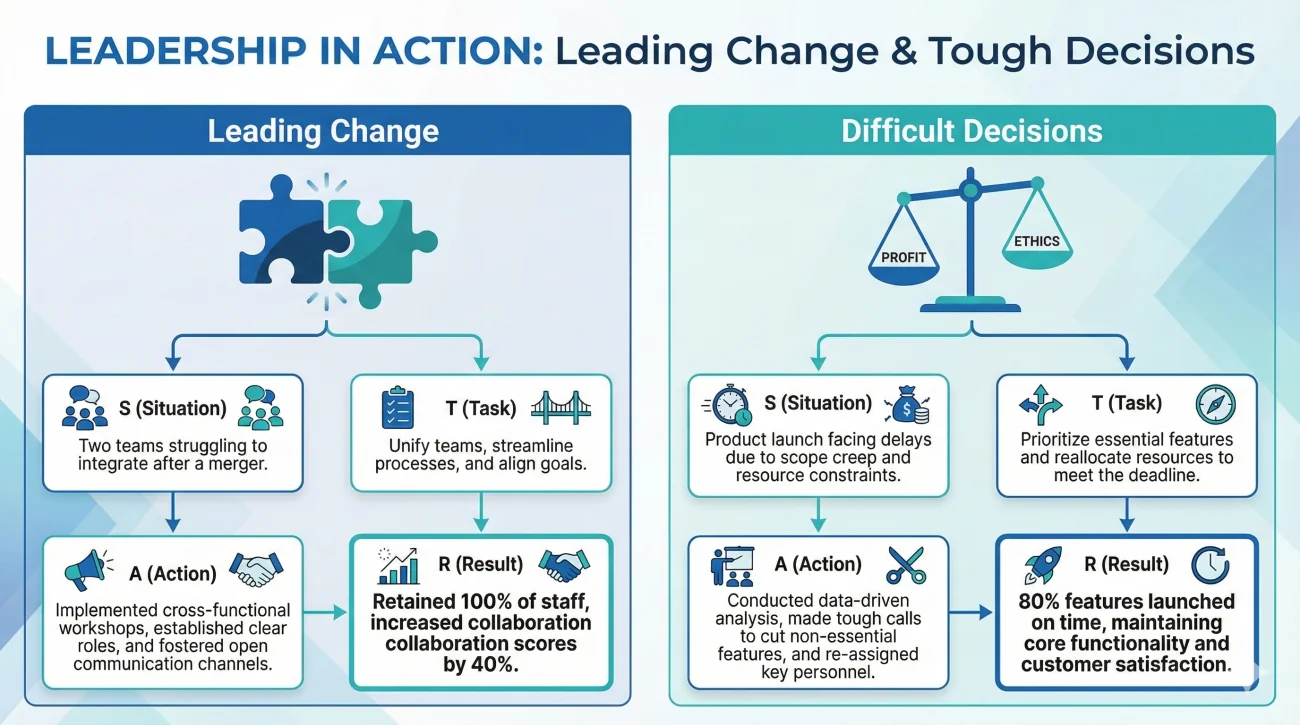
Leading Team Through Change
Question: Tell me about a time you led a team through a significant change.
Situation
Our company acquired a smaller competitor, and I was asked to integrate their customer service team of eight people into my existing team of twelve. The two groups had different processes, tools, and cultures, and there was real anxiety on both sides about job security and how work would change.
Task
I needed to merge the teams within sixty days while maintaining service levels and minimizing turnover. Success meant keeping customer satisfaction stable and retaining at least ninety percent of the combined staff.
Action
I began with one-on-one conversations with every team member to understand concerns, strengths, and what each person needed to feel secure and effective. That also helped surface differences in expectations early, before they turned into “us vs them” narratives.
From the acquired team, I identified two informal leaders and invited them into the integration planning. Involving them made the process feel collaborative rather than imposed, and it gave their team trusted voices in the room.
For the first month, we created mixed working pairs so people could learn each other’s workflows, share shortcuts, and build relationships through day-to-day work. I also held weekly team meetings where we openly discussed friction points, tracked progress, and celebrated quick wins to build momentum and reduce uncertainty.
When disagreements came up about whose process was “better,” I avoided declaring winners. Instead, I facilitated data-driven comparisons using metrics that mattered, resolution time, escalations, and customer feedback, so we could adopt the best elements from both teams and explain decisions transparently.
Result
We completed the integration in fifty-two days. Customer satisfaction improved by four points during the transition, and we retained all twenty team members, exceeding the retention goal.The informal leaders I identified later became formal team leads within six months, and the overall integration approach was used as a model for subsequent acquisitions.
Notice how this answer quantifies results and shows leadership through influence rather than authority.
Making an Unpopular Decision
Question: Describe a time you had to make a difficult decision that not everyone agreed with.
Situation
As project lead, I realized we couldn’t deliver every planned feature by the launch date without cutting corners and risking quality. The challenge was that marketing had already announced the full feature set, and sales was counting on those features for a major client pitch.
Task
I needed to recommend a path forward that balanced customer expectations, team capacity, and product quality, while managing the disappointment and pressure from key stakeholders.
Action
I started by turning the problem into a clear decision rather than a debate. I prepared an analysis that showed what we could realistically ship by launch at different quality levels, along with the risks and downstream costs of each option, especially the support impact of releasing unstable features.Before the group decision meeting, I met with marketing and sales separately. The goal was to understand their constraints, what commitments they had already made, and what flexibility existed in messaging and the pitch. Those conversations also helped lower the temperature so the later meeting wouldn’t feel like an ambush.
In the group meeting, I presented three options with explicit tradeoffs instead of simply announcing what we were going to do. I then advocated for a phased launch: ship the core feature set at full quality on the original date, and commit to a specific follow-up date for the remaining features. I backed the recommendation with data, but I also acknowledged the business impact and helped outline how we could communicate the change to customers and prospects without damaging trust.
Result
We launched on time with about eighty percent of the features at full quality, and the remaining features shipped six weeks later as planned. Sales was able to run the client pitch with a clear roadmap, and the pitch succeeded.
Most importantly, we avoided the support burden and reputation risk that would have come from launching buggy functionality. Sales later told me the phased approach actually strengthened conversations because it showed we prioritized quality and delivered predictably.
Conflict Resolution Examples
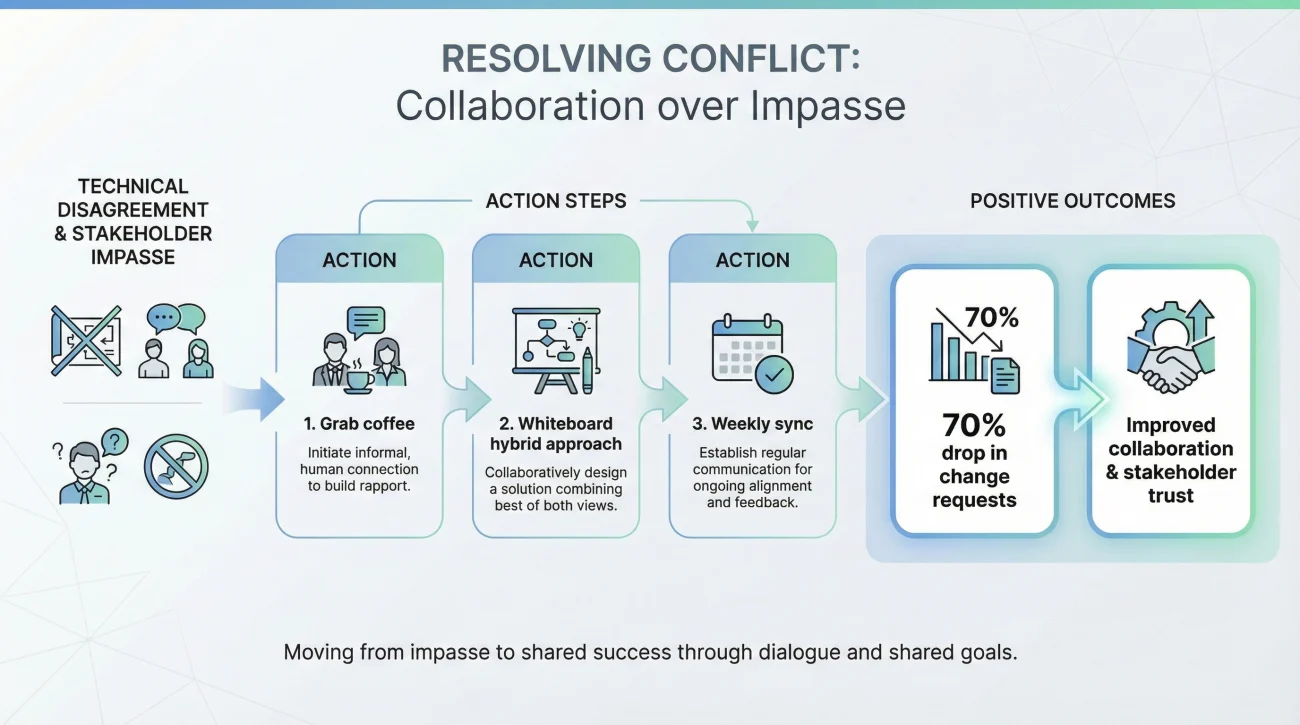
Resolving Colleague Disagreement
Question: Tell me about a time you had a conflict with a coworker.
Situation
A developer and I disagreed strongly about the technical architecture for a new feature. He wanted a microservices approach, while I advocated for extending our existing monolith. The back-and-forth was slowing progress and the tension was becoming visible to the rest of the team.
Task
I needed to break the impasse in a way that led to the right technical decision, kept momentum on the project, and preserved a healthy working relationship.
Action
I asked if we could talk over coffee away from the office so the conversation felt less like a debate in front of others. I opened by trying to understand his reasoning first instead of defending my position. That helped uncover that his push for microservices was mainly driven by scalability concerns for a specific use case I hadn’t fully considered.
Once I understood that, I shared my concerns in the same problem-solving tone: the operational complexity, maintenance overhead, and risk of moving too fast into distributed systems without strong supporting infrastructure. We then whiteboarded the requirements, the risk areas, and what success needed to look like.
We landed on a hybrid approach that addressed both sets of concerns, keeping the core workflow in the monolith while isolating the scalability-sensitive piece behind a cleaner boundary. I also explicitly acknowledged that his expertise in distributed systems was stronger than mine in that area, which helped reinforce that I was evaluating the best idea, not trying to “win.”
Result
We presented the hybrid solution together and the team approved it. The feature launched successfully and scaled well under the targeted use case.
Just as importantly, the process improved our relationship. We learned how to challenge each other’s ideas without making it personal, and we became regular collaborators on architecture decisions afterward.
For more strategies on handling conflict questions, explore our detailed conflict resolution guides.
Managing a Difficult Stakeholder
Question: Describe a situation where you had to work with a difficult stakeholder.
Situation
A senior vice president frequently requested scope changes in the middle of our sprints, which created rework and frustrated the team. Others had tried to address it before without success, and he had a reputation for being inflexible, so the pattern kept repeating.
Task
I needed to reduce disruptive mid-sprint change requests while maintaining a positive relationship with a powerful stakeholder and keeping the team focused on delivery.
Action
Rather than pushing back on the behavior directly, I focused on understanding what was driving it. I scheduled a meeting with him and framed it as wanting to better support his goals and anticipate his needs. That lowered defensiveness and made the conversation collaborative.
During the discussion, I learned the requests were often triggered by new customer information that felt urgent, and he didn’t have a clear outlet to surface those priorities in a way that fit our sprint cycle. Based on that, I proposed a simple change: a brief weekly sync where he could share emerging priorities early, so we could evaluate them, plan them, and incorporate them thoughtfully instead of reactively.
To reinforce that structure, I also began sending him short weekly project updates. The goal was to keep him informed proactively, so he didn’t feel the need to “check in” by injecting last-minute changes to regain visibility or control.
Result
Mid-sprint scope change requests dropped by seventy percent, which reduced rework and noticeably improved team morale. The SVP became one of our strongest advocates because he felt heard and consistently informed.
The weekly sync and update rhythm worked well enough that other project leads later adopted the same approach with senior stakeholders.
Teamwork Examples
Cross-Functional Collaboration
Question: Tell me about a successful project you worked on as part of a team.
Situation
I was part of a cross-functional team launching a new product line, with people from engineering, marketing, sales, and operations who had never worked together before. Early meetings were unproductive because each group focused on their own priorities, and we didn’t have a shared view of what “success” required from everyone.
Task
As the project coordinator, I needed to create alignment and establish practical collaboration habits, so we could move forward even with competing priorities and different ways of working.
Action
I started by creating a shared project charter that clarified the goal, the key deliverables, and the dependencies between groups. Instead of leaving responsibilities vague, I made handoffs explicit so everyone could see how their work connected to the timeline and where delays would ripple.
To keep momentum, I set up daily fifteen-minute standups with a strict focus: blockers, handoffs, and decisions needed that day. That structure reduced debate and turned meetings into problem-solving sessions.
When conflicts came up, I facilitated short conversations focused on options and tradeoffs, not blame. I pushed for “what do we need to decide right now” and “what would unblock the next step,” so issues didn’t sit and grow into resentment.
Finally, I made a point of recognizing collaboration publicly, especially when one team went out of their way to help another. It reinforced the behavior we needed and helped shift the group from “my function” to “our launch.”
Result
We launched two weeks ahead of schedule. The working relationships built during the project carried into future efforts, and cross-team collaboration became noticeably faster afterward.
Three team members specifically mentioned in their reviews that the project changed how they thought about working across departments, which reinforced that the collaboration patterns stuck beyond just this launch.
Supporting a Struggling Team Member
Question: Describe a time you helped a teammate who was struggling.
Situation
A new team member was missing deadlines and seemed overwhelmed. People were starting to complain, and our manager was considering putting him on a performance plan after only two months.
Task
I wanted to help him turn things around before it became a formal performance issue, both because I thought he had real potential and because the current situation wasn’t giving him a fair chance to show it.
Action
I offered to pair with him on a few tasks so I could see where he was getting stuck in real time. That quickly revealed the root issue: he was spending a lot of time polishing work that didn’t need that level of detail because he didn’t fully understand what the team prioritized.
I walked him through how we think about impact and urgency, and we created a simple rule of thumb together: which deliverables needed “close to perfect” versus which ones should be “good enough and on time.” We also broke his tasks into smaller checkpoints so he could get faster feedback before going too deep in the wrong direction.
To reduce friction, I introduced him to teammates who were the quickest sources for specific questions, so he didn’t lose hours trying to figure everything out alone. I encouraged him to ask earlier and more narrowly scoped questions, and I modeled that behavior by doing it alongside him when we paired.
Result
Within a month, he was meeting all deadlines. Within three months, he had become one of our most reliable team members. He later told me the support was what kept him from quitting, and my manager mentioned my mentorship and initiative in my own performance review.
Problem Solving Examples
Handling an Unexpected Challenge
Question: Tell me about a time you solved a difficult problem.
Situation
Two days before a major product demo for a potential enterprise client, we discovered a critical bug that caused data corruption under specific conditions. The scenario was rare, but it matched the client’s exact use case, so it wasn’t something we could ignore or “demo around” without risking credibility.
Task
I needed to find a path that allowed the demo to move forward safely, while staying honest about the product’s current state and avoiding promises we couldn’t confidently support.
Action
I treated it like an incident and immediately assembled a small, focused team to diagnose the root cause. We reproduced the bug, narrowed it to the specific conditions the client would likely trigger, and identified a fix. The problem was that we couldn’t fully regression-test it in the remaining time.
To balance speed, safety, and honesty, I proposed a two-part plan. First, we implemented the fix in the demo environment with extra monitoring and safeguards so we could detect issues quickly during the session. Second, we prepared a fallback demo script that delivered the same value story but avoided the problematic path if anything looked unstable.
In parallel, I briefed our sales lead with clear talking points: what we found, what we changed, what remained to be validated after the demo, and our remediation timeline. That way, if the client asked detailed questions, we could respond confidently and transparently without improvising or minimizing risk.
Result
The demo ran successfully with the fix in place, and we didn’t need to switch to the fallback. When we shared that we had identified and addressed an issue relevant to their use case, the client appreciated the transparency rather than seeing it as a red flag.
They signed the contract, and they explicitly cited our responsiveness and honesty as factors in their decision.
Improving a Broken Process
Question: Give me an example of when you improved a process or system.
Situation
Customer refunds were taking an average of fourteen days to process, which triggered frequent complaints and a growing number of support tickets. Finance blamed customer service for sending incomplete requests, and customer service blamed finance for slow processing, so the issue kept bouncing between departments without real ownership.
Task
I volunteered to investigate what was actually causing the delays and recommend improvements, even though the workflow crossed multiple teams and wasn’t part of my formal responsibilities.
Action
I started by mapping the end-to-end refund process so we had one shared view of what was happening. I shadowed staff in both customer service and finance, noted handoffs, and tracked where requests stalled.
The biggest bottleneck was consistent: missing information. That forced back-and-forth emails, rework, and queue resets, which compounded delays. To fix it, I designed a simple intake form that captured all required details upfront, so requests entered finance “complete” the first time.
I also created a shared dashboard so both teams could see refund status, ownership, and next steps without chasing each other. To get buy-in, I met with both department heads and framed the change in terms they cared about, fewer interruptions, fewer escalations, and less wasted time, then showed how the form and dashboard would reduce workload and frustration on both sides.
Result
Average refund processing time dropped from fourteen days to two days. Support tickets about refund status decreased by eighty percent, and we estimated the improvements saved roughly one hundred thousand dollars per year in staff time.
Beyond the metrics, the shared visibility and clearer handoffs reduced finger-pointing and noticeably improved the working relationship between finance and customer service.
Patterns to Notice
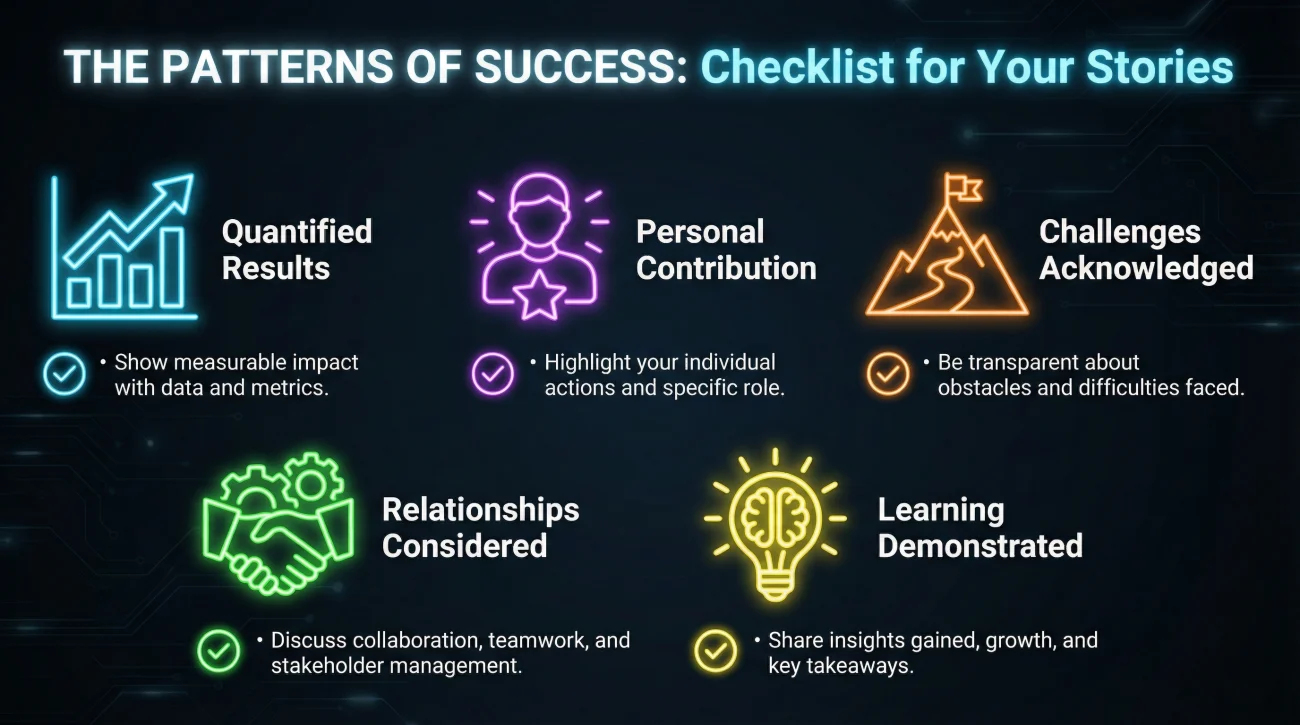
Across all these examples, several elements consistently appear:
- Specific quantified results: Percentages, timeframes, dollar amounts, satisfaction scores
- Personal contribution clarity: What you specifically did, not just what happened
- Challenges acknowledged: Obstacles faced rather than smooth sailing
- Relationships considered: How actions affected people and working dynamics
- Learning demonstrated: What the experience taught or changed
Use these patterns as a checklist when developing your own stories. Missing elements often separate good answers from great ones.
❓ FAQ
🎯 Can I use these examples directly in my interviews?
Use them as models, not scripts. Interviewers can often tell when answers are borrowed rather than authentic. Study the structure and techniques, then develop your own stories following the same patterns.
💼 What if my examples are less impressive than these?
Authenticity matters more than impressiveness. A genuine story about a small challenge handled well often resonates more than an exaggerated story about a major accomplishment. Focus on clear structure and honest reflection.
⏰ How long should my answers be compared to these examples?
When spoken aloud, aim for ninety seconds to two minutes. These written examples would run slightly longer if read verbatim. Practice until you can deliver the key points naturally within the time frame.
📋 Should I memorize my STAR answers?
Memorize key points and transitions, not word-for-word scripts. You should know your stories well enough to tell them naturally while hitting essential details. Practice variations to build flexibility.
✨ How do I adapt examples to different questions?
The same story can answer multiple questions by emphasizing different elements. A teamwork story might become a conflict story or a leadership story depending on which aspects you highlight. Practice telling each story with different focal points.
From Examples to Your Stories
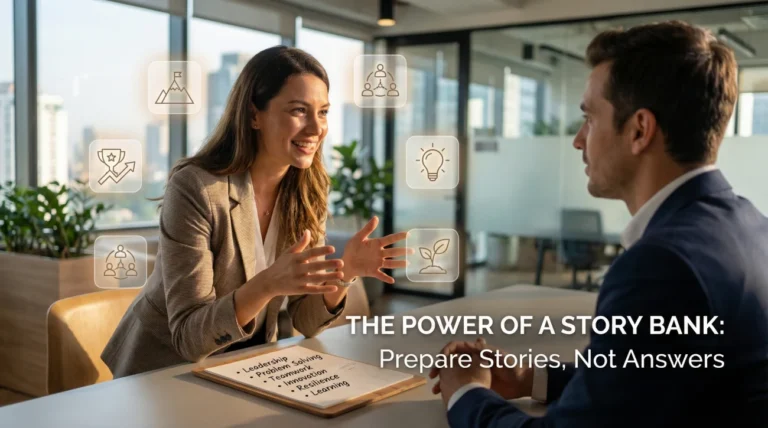
These star method examples demonstrate what effective behavioral answers look like. Now the work begins: identifying your own experiences, structuring them using the same framework, and practicing until delivery feels natural. The best answers feel like conversations, not performances. Start developing your story bank today.
⚠️ Disclaimer: The interview strategies, sample answers, and negotiation tips provided in this guide are for educational purposes only. Hiring decisions are subjective and vary by company and industry. While these strategies are based on professional HR standards, they do not guarantee a specific job offer or result.