You Have More Experience Than You Think
When interviewers ask about a time you led a team or resolved a conflict, panic sets in. You have never managed anyone. Your work history is a summer job and maybe an internship. How can you compete with candidates who have years of professional experience?
Here is the truth: interviewers hiring entry level candidates do not expect extensive work history. They want evidence of potential. The star method for students works exactly the same as for experienced professionals. The difference is knowing where to find your stories.
Where Students Find STAR Stories
Professional experience is just one source of behavioral examples. Students have rich pools of material that demonstrate the exact competencies employers assess: problem solving, teamwork, communication, initiative, and resilience.
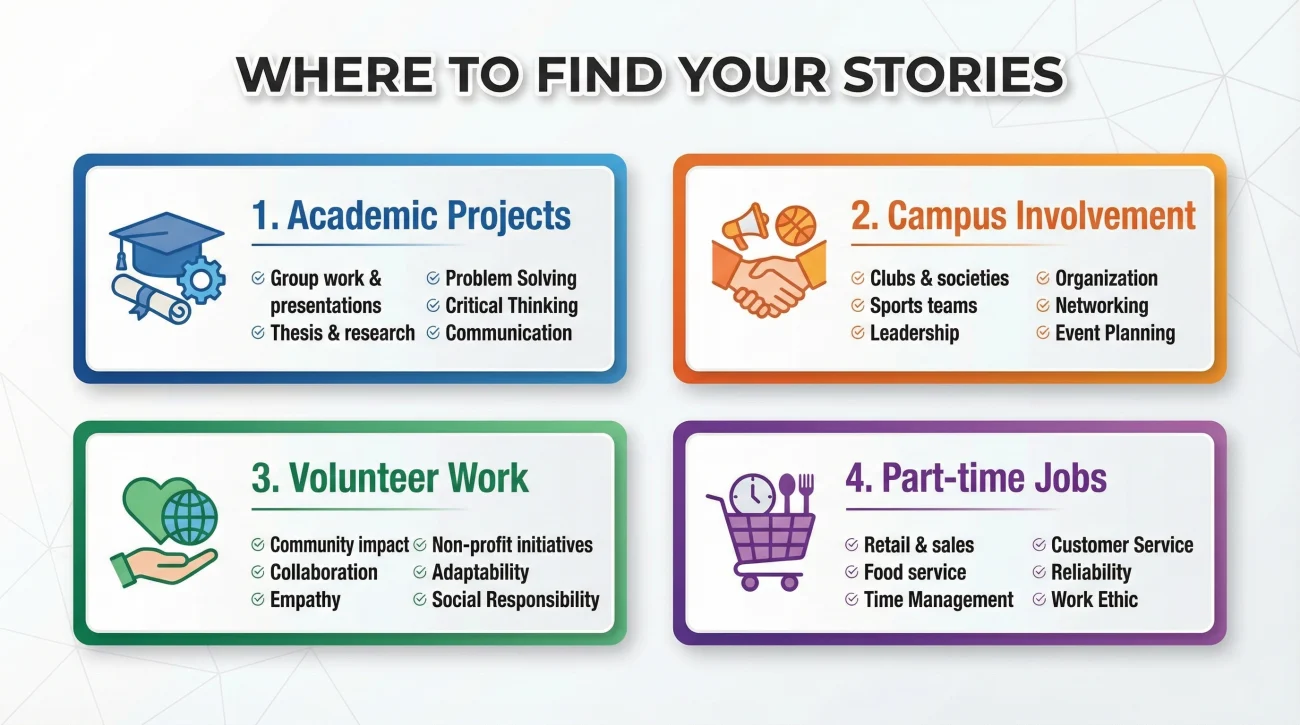
Academic Projects and Coursework
Group projects are goldmines for behavioral stories. Think about times when team dynamics got difficult, deadlines seemed impossible, or your approach to a problem differed from classmates. Research projects demonstrate analytical thinking and persistence. Presentations show communication skills under pressure.
Do not dismiss coursework as “just school.” A challenging semester where you balanced five demanding classes while maintaining grades demonstrates time management. A thesis or capstone project shows sustained effort toward complex goals.
Campus Activities and Organizations
Student organizations provide leadership opportunities most entry level jobs cannot match. Planning events, managing budgets, recruiting members, and coordinating with university administration all translate directly to workplace skills.
- 🎯 Club leadership: Organizing events, delegating tasks, motivating volunteers
- 🤝 Team sports: Collaboration, handling pressure, receiving feedback
- 📊 Academic competitions: Problem solving, time constraints, performing under stress
- 🎭 Theater or music: Meeting deadlines, group coordination, handling criticism
Volunteer and Community Service
Volunteer experiences often involve more responsibility than paid positions. Organizing donation drives, tutoring struggling students, or coordinating community events demonstrates initiative and impact. The fact that you chose to contribute without pay can strengthen your story.
Part-Time and Summer Jobs
Retail, food service, and customer facing roles generate countless behavioral examples. Handling difficult customers, managing rush periods, training new employees, and solving unexpected problems are all valuable stories regardless of industry.
A summer job at a coffee shop can demonstrate customer service skills as effectively as years in a corporate role.
Student Candidates Who Impressed Me
I have interviewed hundreds of recent graduates and students. The best ones understood that their “lack of experience” was a framing problem, not a content problem. Here are real examples of students who turned non-traditional experience into job offers.
The Barista Who Demonstrated Leadership
A senior applying for a marketing analyst position had only worked as a barista during college. When I asked about leadership, she told me about the morning her shift supervisor did not show up. Rather than calling the manager and waiting, she organized the other baristas, assigned positions, and managed the morning rush herself. She had no authority to do this. She just did it because customers were lining up.
Then she described what she did after: she documented everything that went wrong during that shift, from running low on supplies to one barista not knowing how to handle a mobile order issue. She turned her notes into a checklist and gave it to her manager, who adopted it as the emergency shift protocol.
I hired her. Not because of the barista job, but because she demonstrated exactly what we needed: someone who takes ownership without being asked and turns problems into process improvements. Her title was irrelevant. Her behavior was exactly what we wanted.
The Economics Major Who Made Group Projects Sound Strategic
Most students describe group projects poorly. They say “we worked together on a project and got an A.” That tells me nothing. One economics student did it differently.
She described a semester-long research project where her team had four members with completely different working styles. One wanted to finish early; one always waited until the last minute. One preferred in-person meetings; one lived off campus and could only do video calls. She mapped out everyone’s constraints in the first week and created a project plan with staggered deadlines that accommodated all four working styles.
When I asked about results, she did not just say they got an A. She said their professor asked to use their project structure as an example for future classes. She also mentioned that one teammate who had struggled with group work in other classes later thanked her for making the collaboration manageable.
This student understood that the story was not about the research. It was about how she organized diverse people toward a common goal. That is project management. That is exactly what she would be doing in an entry level role.
The Student Who Owned a Real Failure
Entry level candidates often struggle with failure questions because they feel they have not failed at anything important yet. One junior impressed me by describing a genuine failure: he was president of a student organization and membership dropped forty percent during his term.
He did not make excuses. He told me he had focused too much on events he personally found interesting rather than surveying what members actually wanted. He had also failed to delegate because he thought he could do everything better himself. The combination burned him out and alienated members who wanted to contribute.
Then he told me what he changed. He surveyed remaining members. He created committee chairs with real authority. He stepped back from day-to-day execution and focused on support and strategy. Membership recovered the following semester under his revised approach.
That answer showed me more maturity than most candidates with five years of professional experience. He did not have a small, safe failure. He had a real one. And he owned it completely while demonstrating genuine learning.
The Volunteer Coordinator Who Talked Like a Manager
A student who had spent two years coordinating volunteers at a local food bank applied for an operations role. She described the volunteer program like a staffing operation: volunteer acquisition (recruiting), onboarding (training), retention (keeping people coming back), and capacity planning (ensuring enough coverage for each shift).
She had data: volunteer retention improved twenty-five percent after she implemented a feedback system. No-show rates dropped after she started sending reminder texts. Weekend coverage increased after she partnered with a Greek organization that required service hours.
She never used the word “just” to describe her work. She did not say “I just volunteered at a food bank.” She said “I managed a volunteer workforce of about fifty people across three weekly shifts.” The framing made all the difference. Same experience, completely different impression.
Translating Student Experience to Professional Context
The challenge is not finding stories but framing them professionally. Interviewers do not care that your experience happened in a classroom rather than an office. They care about the skills you demonstrated and the results you achieved.
Using Professional Language
Replace casual descriptions with professional terminology. A group project becomes cross-functional collaboration. Convincing classmates to adopt your approach becomes stakeholder alignment. Fixing a teammate’s mistakes becomes quality assurance.
| Student Language | Professional Framing |
|---|---|
| Group project partner did not do their work | Managed accountability within a cross-functional team |
| Stayed up all night finishing assignment | Prioritized critical deliverables under deadline pressure |
| Argued with teammate about approach | Navigated differing perspectives to reach consensus |
| Professor gave harsh feedback | Incorporated constructive criticism to improve outcomes |
Emphasizing Transferable Skills
Connect your student experience to workplace requirements explicitly. If describing a group project, mention that coordinating with teammates across different schedules mirrors managing remote collaboration. If discussing a challenging course, note that mastering unfamiliar material quickly is exactly what the job will require.
Interviewers may not make these connections automatically. Your job is to bridge the gap between what you did and what the role needs.
STAR Examples for Common Student Situations
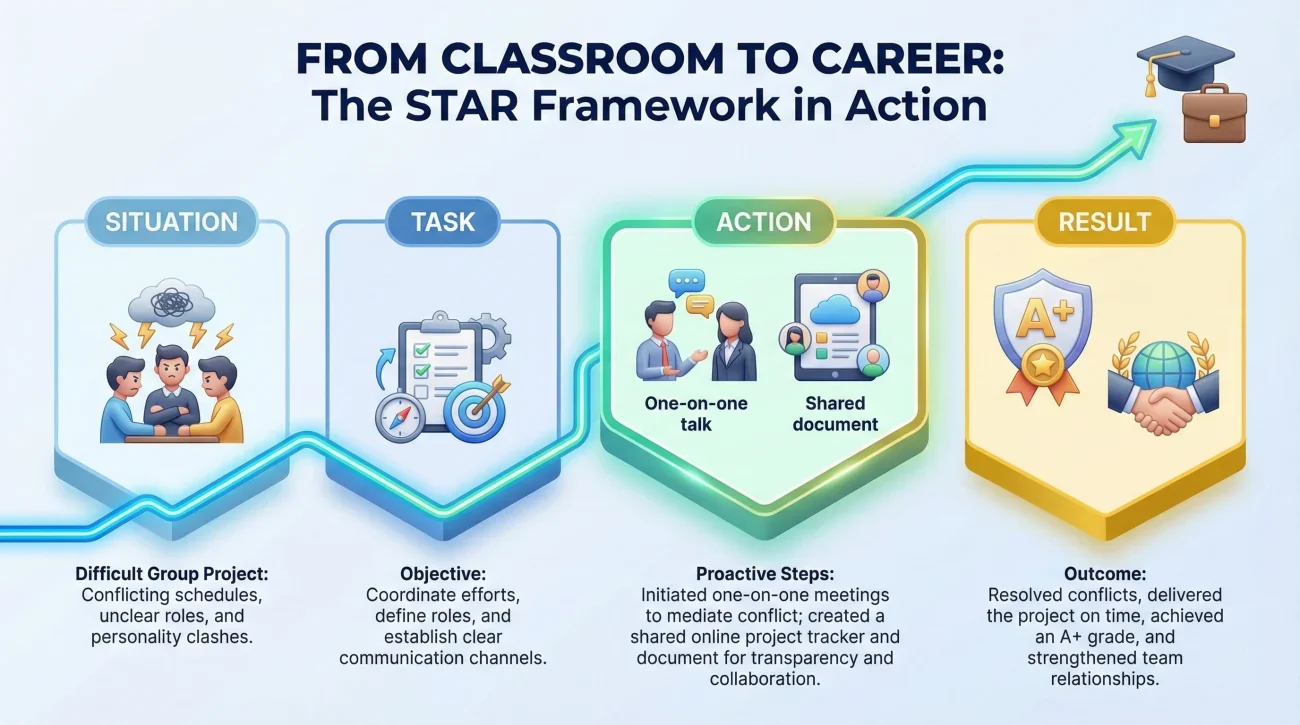
Teamwork with Difficult Group Member
During my senior year marketing project, one team member repeatedly missed meetings and submitted incomplete work. It started putting our timeline, and ultimately our grade, at risk because we couldn’t finalize pieces that depended on their contributions.
As the unofficial project coordinator, I needed to either help this person re-engage and contribute reliably or adjust the workload so the team could still deliver, without creating conflict that would derail the project.
I set up a one-on-one conversation to understand what was going on instead of calling them out in front of the group. In that conversation, I learned they were dealing with an overwhelming family situation and felt embarrassed to ask for help, so they were avoiding meetings and falling behind.
I brought the situation back to the team in a respectful way and proposed a temporary redistribution of tasks so we could keep momentum. We also created a shared document where updates, drafts, and next steps were centralized, which made it easier for them to contribute asynchronously when they had time rather than feeling like they had to catch up live in meetings.
To keep them connected and reduce the chance of slipping again, I checked in weekly, clarified what “done” looked like for their adjusted responsibilities, and made it easy for them to ask questions without feeling judged.
The teammate completed their adjusted responsibilities and felt supported instead of excluded. We delivered the project on time and earned an A.
It also taught me an important lesson I’ve carried forward: what looks like a performance problem often has an underlying cause, and you get better outcomes when you understand it before assuming the worst.
Taking Initiative Without Authority
At my campus job in the admissions office, I noticed prospective students and families kept asking the same questions that weren’t clearly answered in our standard brochures or tour materials. It created confusion for visitors and added repetitive work for staff and tour guides.
I wanted to improve the visitor experience, but I didn’t have authority to change official processes or rewrite published materials, so I needed a simple improvement that could be adopted easily.
I started by tracking the common questions in a spreadsheet over two weeks so I could confirm patterns instead of relying on anecdotal impressions. I grouped them into themes and noted which questions came up most frequently.
Based on that data, I drafted a one-page FAQ sheet written in plain language and designed to fit easily into the existing tour packet. I brought the spreadsheet summary and the draft to my supervisor and proposed adding it to packets as a low-effort test.
To make it easier to approve, I also offered to own maintenance, collecting feedback from tour guides and updating the sheet periodically as questions changed over time.
My supervisor approved the FAQ sheet, and tour guides reported fewer repetitive questions during visits. The admissions director highlighted it at a staff meeting as an example of student initiative.
My supervisor later used me as a reference for future jobs, and the FAQ became a small but lasting improvement to the visitor experience.
Handling Questions When Examples Feel Weak
Sometimes you genuinely lack experience in a specific area. Interviewers understand this for entry level candidates. The key is handling the gap honestly while still demonstrating relevant qualities.
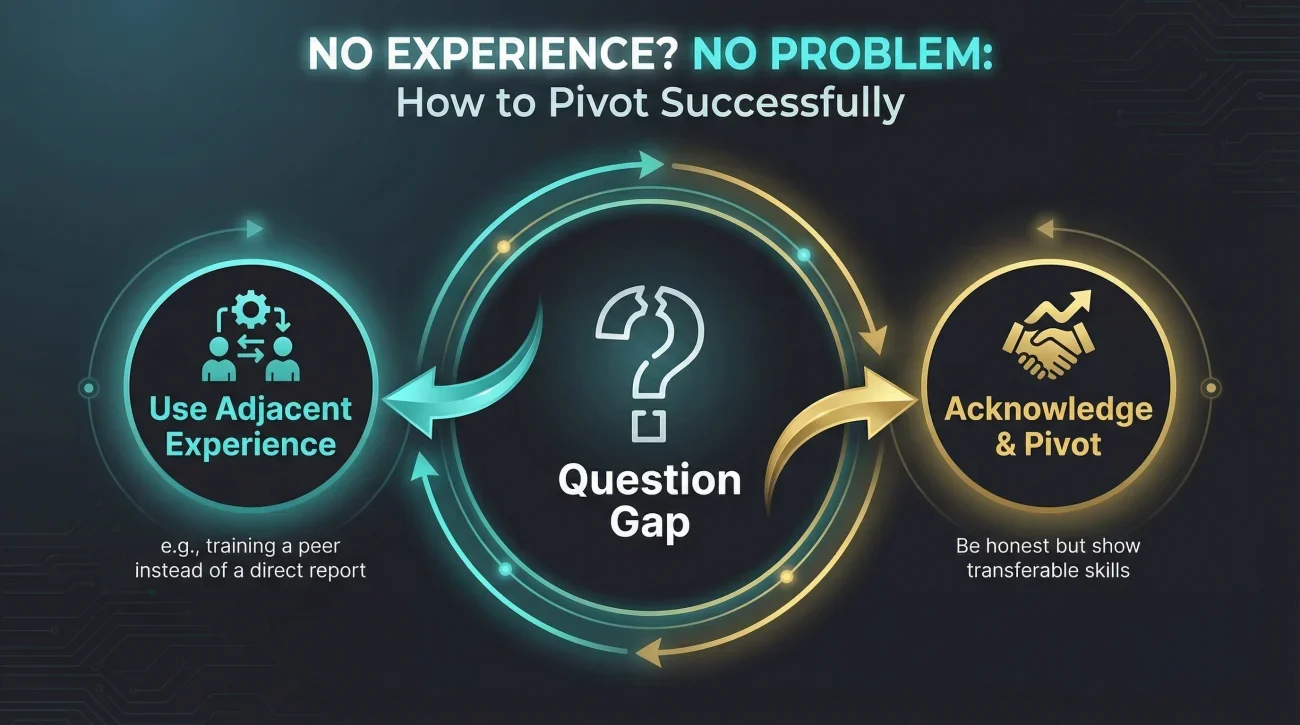
Using Adjacent Experience
When asked about managing direct reports and you have never supervised anyone, draw from related experience. Perhaps you trained new hires at a summer job, mentored younger students, or coordinated volunteers for an event. These situations demonstrate similar skills even without the formal title.
Acknowledging Gaps Professionally
If nothing fits, acknowledge the gap briefly and pivot: “I have not faced that exact situation in a professional setting, but here is how I handled something similar.” Then deliver your closest relevant story while connecting the transferable skills.
Avoid going hypothetical unless absolutely necessary. “I would probably…” answers are far weaker than “Here is what I actually did in a related situation…” Even imperfect examples demonstrate real behavior rather than speculation.
For more guidance on structuring your answers effectively, explore our behavioral interview preparation resources.
❓ FAQ
🎯 Can I use the same story for multiple interviews?
Absolutely. Develop five to seven strong stories and adapt them for different questions. Emphasize different aspects depending on what the question asks. A story about a group project can demonstrate leadership, conflict resolution, or time management depending on which elements you highlight.
💼 How recent should my examples be?
Prioritize examples from the past two to three years when possible. For students, this typically means college experiences rather than high school. Recent examples demonstrate current capabilities and are easier to remember in detail.
⏰ Are classroom examples really acceptable?
Yes, especially for entry level positions. Employers know students have limited professional experience. Academic projects, research, and coursework demonstrate real skills. The key is framing them professionally and emphasizing transferable competencies.
📋 What if my results are not impressive?
Focus on what you learned and how you grew rather than dramatic outcomes. Entry level interviewers value self-awareness and learning agility. A story about recovering from a mistake or improving after feedback can be more impressive than a story where everything went perfectly.
✨ How do I compete with candidates who have more experience?
You bring fresh perspectives, current knowledge, and adaptability. Experienced candidates sometimes have ingrained habits that do not fit new environments. Demonstrate enthusiasm, coachability, and willingness to learn. These qualities often matter more than years of experience for entry level roles.
Your Experience Counts
The star method for students requires looking beyond traditional work history to find compelling examples. Your academic projects, campus involvement, volunteer work, and part-time jobs contain exactly the stories employers want to hear. Frame them professionally, practice delivery, and walk into interviews knowing you have real evidence of your capabilities. Lack of experience is only a weakness if you let it limit your stories.
⚠️ Disclaimer: The interview strategies, sample answers, and negotiation tips provided in this guide are for educational purposes only. Hiring decisions are subjective and vary by company and industry. While these strategies are based on professional HR standards, they do not guarantee a specific job offer or result.