Beyond Tactical Storytelling
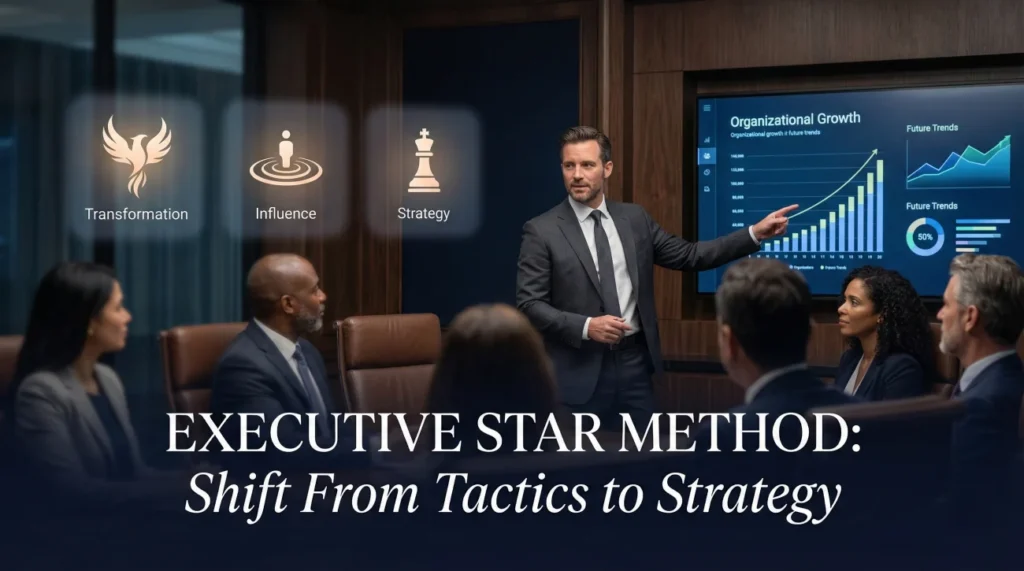
Executive interviews operate differently than those for individual contributors. Interviewers already assume you can do the tactical work. What they want to understand is how you think strategically, influence at scale, and drive organizational transformation. The star method for executives requires shifting from operational details to strategic narrative.
The framework remains the same: Situation, Task, Action, Result. But the content and emphasis change dramatically when boards and C-suite peers evaluate your leadership capabilities.
The Strategic Shift in Executive Answers
Expanding Scope to Organizational Impact
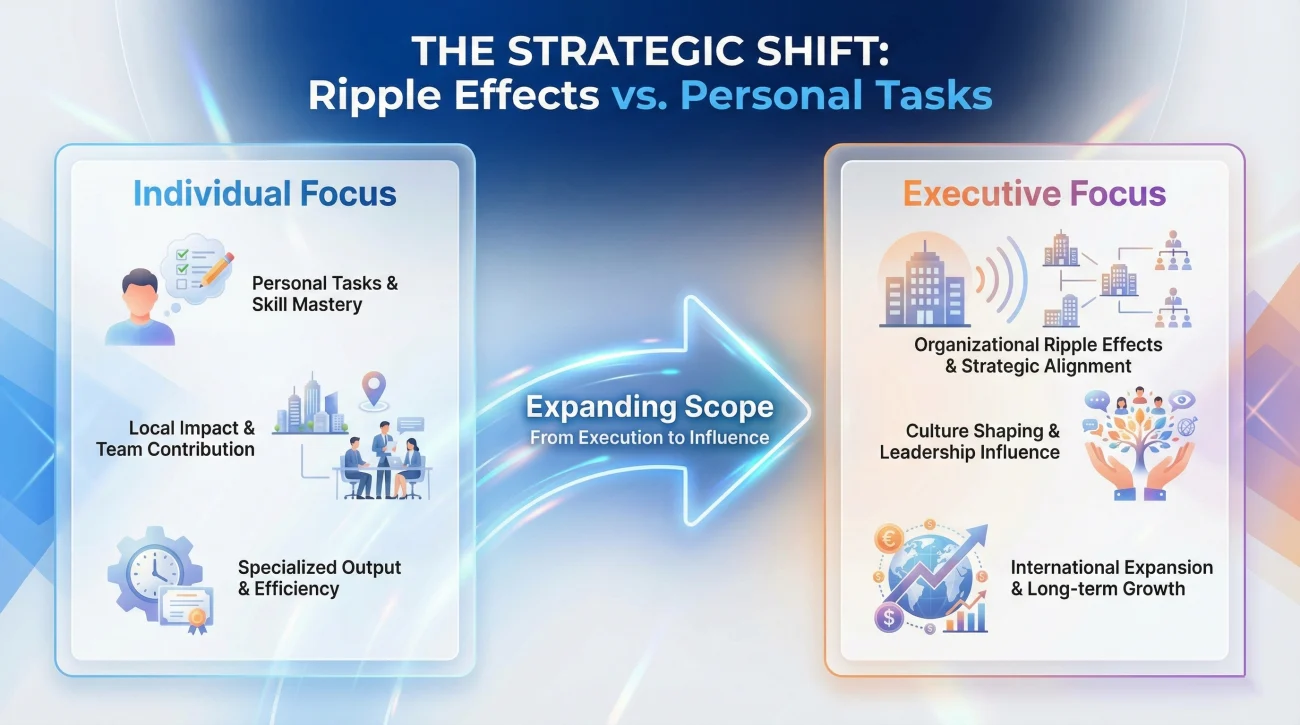
Individual contributor stories focus on personal accomplishment. Executive stories must demonstrate ripple effects across teams, departments, or entire organizations. When you describe your actions, interviewers should see how those decisions shaped culture, influenced strategy, or transformed capabilities beyond your immediate area.
Consider the difference:
I implemented a new project management system that improved my team’s efficiency by 30%.
I championed a transformation initiative that standardized operations across twelve regional teams, creating the infrastructure for our subsequent international expansion.
Demonstrating Stakeholder Complexity
Senior roles involve navigating competing interests: boards, investors, executive peers, regulators, customers, and employees. Your stories should show how you balanced these tensions rather than solving simple problems with clear solutions.
Board members and hiring committees want evidence that you can operate in ambiguous environments where perfect answers do not exist and every decision involves tradeoffs.
Showing Long-Term Thinking
Tactical answers focus on immediate results. Executive answers should demonstrate how short-term actions connected to multi-year strategy. What vision drove your decisions? How did you balance quarterly demands against sustainable growth? What did you sacrifice now for future positioning?
Executive Interviews: What Separates the Great From the Good
I have sat on interview panels for VP and C-level roles at multiple companies. The difference between executives who get offers and those who do not often comes down to how they tell their stories. Here are real examples that illustrate executive-level interviewing done well and poorly.
The CFO Who Thought Like a CEO
We interviewed a CFO candidate for a growth-stage company. When asked about her most significant leadership challenge, she described restructuring the finance function. But she did not talk about systems or processes. She talked about how the existing finance culture was preventing the company from making fast decisions.
She described identifying that the real problem was not capability but mindset: the finance team saw themselves as gatekeepers rather than strategic partners. She restructured the team to embed finance people within each business unit rather than maintaining a centralized function. She personally spent time with business leaders understanding their frustrations with finance.
Her results were not just “improved efficiency.” She said: “Decision cycle times dropped from three weeks to four days. We launched two new product lines that year because business leaders finally had financial partners who could model scenarios in real time rather than explaining why ideas would not work.”
She got the offer because she demonstrated CEO-level thinking: understanding that organizational design affects culture, which affects speed, which affects competitive advantage. That chain of causation is exactly how boards want their executives to think.
The VP Who Could Not Get Out of the Weeds
Contrast that with a VP of Operations candidate who described implementing a new ERP system. He spent fifteen minutes on technical details: the vendor selection process, the data migration challenges, the integration testing protocols. His story sounded like it came from the implementation project manager rather than the executive sponsor.
When we asked about stakeholder resistance, he talked about convincing IT to allocate resources. When we asked about organizational impact, he mentioned reduced manual processes. Everything stayed at the operational level. He never once mentioned how the system enabled strategic capabilities, how he built executive alignment, or what business outcomes resulted beyond efficiency.
He was clearly competent, but his interview demonstrated director-level thinking, not VP-level. We passed because we needed someone who could connect operational decisions to strategic outcomes and influence peers, not just manage implementations.
The Chief Marketing Officer Who Owned a Failure
One of the strongest executive interviews I have witnessed came from a CMO candidate describing a failed brand repositioning. She spent significant budget on a rebrand that did not resonate with customers. Market research suggested it would work. It did not.
Most executives would minimize this story or blame external factors. She did the opposite. She said: “I trusted the research over my own instincts. The data said customers wanted us to be more premium. What I should have recognized is that our customers liked us because we were accessible, not aspirational. I let the research methodology lead me to the wrong conclusion.”
Then she described the recovery: acknowledging the mistake to the board, rolling back elements of the rebrand, and implementing a new research approach that weighted behavioral data over stated preferences. She ended with: “We recovered within eighteen months, but that failure taught me to challenge research that confirms what stakeholders want to believe.”
The board extended an offer partially because of this story. They knew she would tell them the truth, take ownership when things went wrong, and have the resilience to recover. Those qualities matter more than a perfect track record.
The CEO Candidate Who Understood Board Dynamics
A CEO candidate for a portfolio company was asked about managing board relationships during a strategic pivot. His answer demonstrated sophisticated understanding of board dynamics that most candidates lack.
He described a situation where his board was split: two members wanted aggressive growth, two wanted profitability first. Rather than picking a side, he created a framework that showed both paths and their implications over a three-year horizon. He scheduled individual calls with each board member before the meeting to understand their underlying concerns, then facilitated a discussion focused on risk tolerance rather than strategy preference.
He said: “I realized the disagreement was not about strategy. It was about how each investor’s fund timeline affected their risk appetite. Once we named that explicitly, we could have a productive conversation about sequencing: growth investments now with profitability gates that would satisfy everyone’s timeline.”
That answer demonstrated three things boards value: understanding stakeholder motivations, creating frameworks that enable decision-making rather than forcing choices, and facilitating alignment rather than demanding agreement. He got the role.
Adapting Each STAR Component
Situation: Set Strategic Context
Your situation should establish the strategic landscape, not just the immediate problem. Include market conditions, competitive pressures, organizational constraints, or board expectations that made the challenge significant. Help interviewers understand why this situation required executive judgment rather than operational execution.
Expert advice: Frame your situation in terms of business impact. Revenue at risk, market position threatened, or strategic opportunity closing creates stakes that resonate with executive evaluators.
Task: Clarify Your Mandate
Executive tasks often involve ambiguous mandates rather than clear assignments. You may have identified the need yourself, shaped the strategic direction, or navigated conflicting expectations about what success meant. Make clear the scope of your authority and accountability.
Action: Show Strategic Decision-Making
This is where executives often falter by getting too deep into operational details. Instead of listing every step, focus on the critical decisions you made, the stakeholders you influenced, and the tradeoffs you navigated. Demonstrate your thinking process as much as your actions.
- What alternatives did you consider and why did you choose this path?
- Who did you need to align and how did you achieve buy-in?
- What resistance did you encounter and how did you address it?
- What did you delegate versus handle personally, and why?
Result: Quantify Organizational Impact
Executive results should speak in terms meaningful to boards and investors: revenue growth, market share gains, cost reduction, capability development, risk mitigation, or strategic positioning. Connect your outcomes to organizational value creation, not just project completion.
| Weak Result | Executive-Level Result |
|---|---|
| Project completed on time | Launched capability that captured 15% market share in new segment |
| Team morale improved | Reduced executive turnover from 25% to 8% over two years |
| Customer satisfaction increased | NPS improvement contributed to 40% reduction in customer acquisition cost |
Key Topics for Executive Behavioral Questions
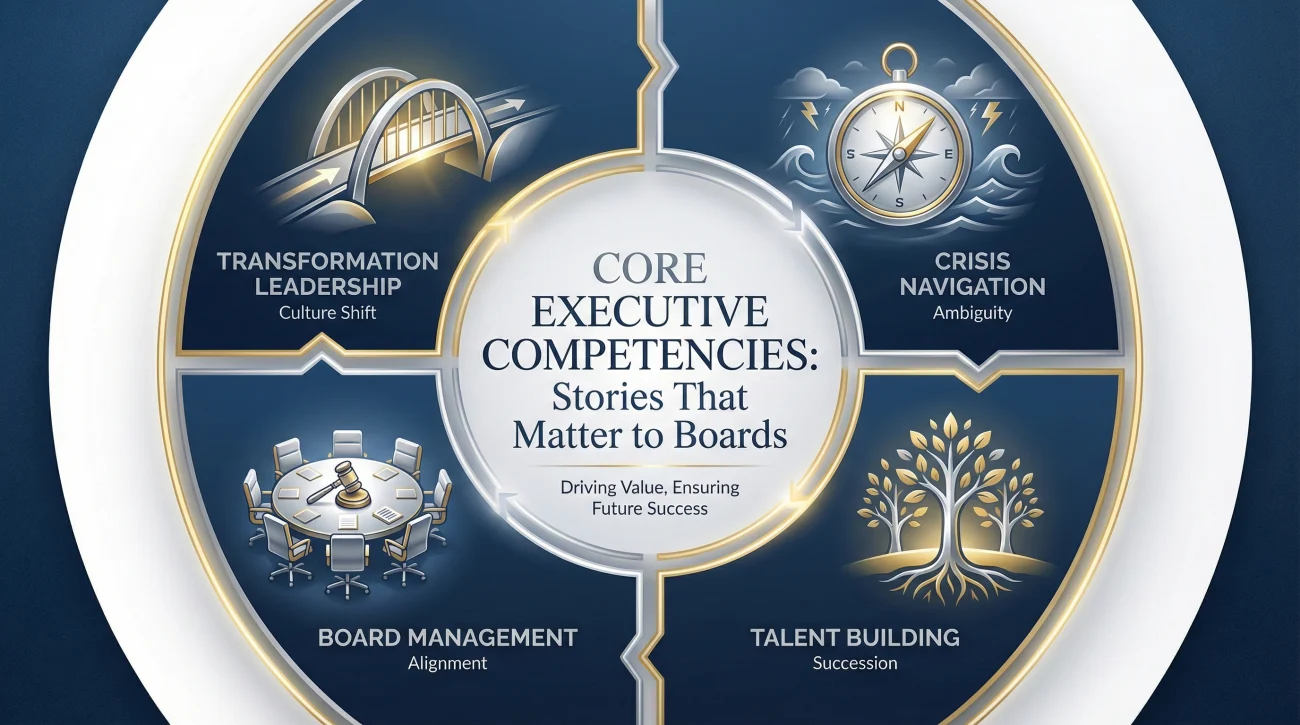
Executive interviews probe specific leadership competencies. Prepare stories that address these areas with strategic depth:
Leading Organizational Transformation
Boards want leaders who can drive change at scale. Prepare stories about culture shifts, digital transformation, operational restructuring, or strategic pivots. Emphasize how you built momentum, overcame entrenched resistance, and sustained change beyond initial implementation.
Navigating Crisis or Ambiguity
How you perform when the playbook does not exist matters enormously at executive levels. Prepare examples of leading through market disruption, organizational crisis, or situations where available information was incomplete and stakes were high.
Building and Developing Talent
Executive success depends on the leaders you develop. Prepare stories about succession planning, building high-performing teams, making difficult personnel decisions, and creating development opportunities for high-potential employees. Connect these to organizational capability building.
Board and Stakeholder Management
For C-suite roles especially, demonstrate experience influencing boards, managing investor relationships, or navigating complex stakeholder dynamics. Show how you balanced competing interests while maintaining strategic direction. Visit our behavioral interview resources for more preparation strategies.
Common Executive Interview Pitfalls
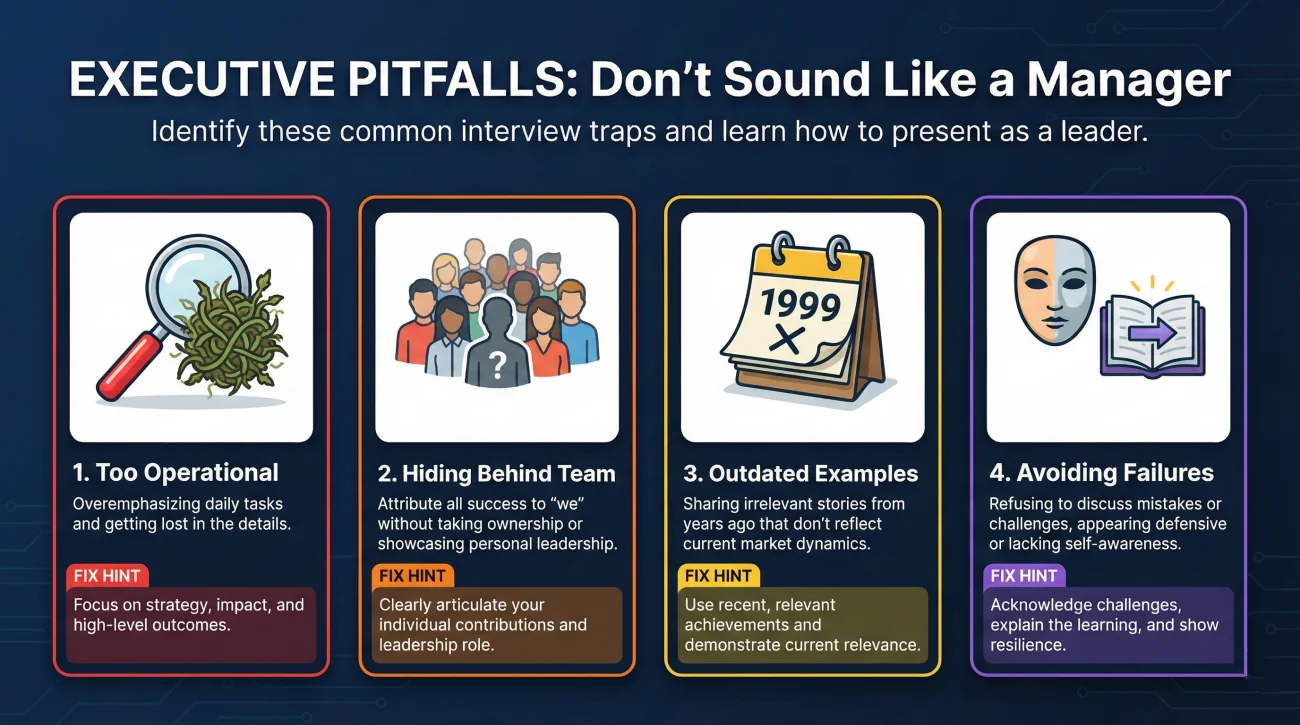
Getting Too Operational
The biggest mistake senior leaders make is telling stories that could come from a manager three levels below. If your answer focuses on how you personally executed work rather than how you led others and shaped direction, you are not demonstrating executive capability.
Hiding Behind the Team
Collaborative leadership matters, but excessive use of “we” without clear articulation of your unique contribution raises questions. Interviewers want to understand what would not have happened without your specific involvement.
Using Outdated Examples
Stories from early in your career may demonstrate formative skills but do not show current executive capability. Prioritize examples from the past five to seven years that reflect the strategic scope appropriate for the role you are pursuing.
Avoiding Failure Stories
Executives who claim perfect track records seem either dishonest or lacking self-awareness. Prepare thoughtful stories about setbacks that demonstrate learning, resilience, and mature judgment about what you would do differently.
❓ FAQ
🎯 How long should executive STAR answers be?
Two to three minutes for the initial answer, with expectation of follow-up questions. Executive interviewers often probe deeper into specific decisions or stakeholder dynamics. Structure your initial answer to invite productive follow-up rather than exhaustively covering every detail.
💼 Should I discuss confidential information?
Protect genuinely confidential details like specific revenue figures or proprietary strategy. However, you can often discuss outcomes in relative terms: percentage improvements, market position changes, or general financial impact. Demonstrating discretion while still providing substantive answers actually strengthens your executive credibility.
⏰ How many stories should executives prepare?
Eight to ten well-developed stories covering transformation, crisis, talent development, strategic success, and learning from failure. Executive interviews often go deeper on fewer topics rather than covering many questions superficially. Depth of preparation matters more than breadth.
📋 What if the interviewer wants more tactical detail?
Start strategic and add tactical detail when prompted. If an interviewer asks follow-up questions about execution specifics, provide them. But leading with tactical detail signals you may not yet think at the strategic level required for executive roles.
✨ How do I differentiate from other executives?
Specificity and authenticity differentiate strong candidates. Generic stories about leading change or driving growth sound like every other executive. Distinctive details, genuine reflection on challenges, and clear articulation of your unique leadership approach set you apart from polished but forgettable competitors.
Lead With Strategy
The star method for executives demands more than structure. It requires strategic framing that demonstrates you operate at an organizational level, not just a functional one. When your stories show how you shaped direction, influenced stakeholders, navigated complexity, and created enterprise value, you position yourself as a leader ready for the next level of responsibility.
⚠️ Disclaimer: The interview strategies, sample answers, and negotiation tips provided in this guide are for educational purposes only. Hiring decisions are subjective and vary by company and industry. While these strategies are based on professional HR standards, they do not guarantee a specific job offer or result.