
- Why “Result” is non-negotiable: It proves your Actions worked, turning a nice story into evidence interviewers can actually evaluate.
- Quantify whenever possible: Use clear before-and-after metrics like time, cost, revenue, error rate, productivity, or customer impact so your outcome is memorable and credible.
- If numbers are limited: Make qualitative results specific with proof signals like stakeholder praise, adoption by other teams, awards, goal completion, or promotion trajectory.
- Make results matter: Add business context by explaining “So what?”, tailor the impact to the audience, and show timeline plus sustainability (how fast it improved, how long it stayed stable).
- Avoid weak results: Do not stay vague, do not skip outcomes, do not claim full team credit, and use a simple formula (Metric change + Baseline + Business significance) to close strong.
STAR Method Result (Quantifying Success)
Candidates who describe elaborate actions but never explain what happened waste the entire answer. Interviewers sit through detailed explanations of your process wondering “Did it work?” When you skip Results or provide vague outcomes like “things improved,” you leave evaluation incomplete. The proof that your actions were appropriate lies in demonstrating they achieved meaningful change.
The star method result component validates everything that came before. You set context with Situation, defined goals with Task, explained approach with Action – Result proves it mattered. Without concrete outcomes, even brilliant Actions remain unverified claims rather than demonstrated capabilities.
Effective quantifying interview outcomes transforms stories from interesting anecdotes into evidence of competence. Numbers make impact tangible and memorable. “I improved performance” disappears from interviewer memory within minutes. “I reduced API response time from 2 seconds to 300ms, handling 10x more traffic” sticks, as emphasized in National Careers Service guidance on the STAR method.
Understanding Result’s Critical Role
The Result completes the narrative arc and provides the evidence interviewers use to assess whether your approach actually works in real situations.

Validating Your Actions
Results prove your Actions were effective. You can describe sophisticated technical solutions eloquently, but if the Result shows no improvement, the Action wasn’t as smart as it seemed. Conversely, even simple Actions become impressive when Results demonstrate significant impact.
This validation function explains why skipping Results is fatal. Without outcomes, interviewers can’t distinguish between candidates who sound competent and candidates who deliver actual results. Your story lacks the proof point that separates theory from execution.
Expert insight: Strong Results don’t just state what happened – they demonstrate the significance of what happened. “The project completed” is a Result. “The project completed two weeks early, enabling the product launch that generated $2M in first-quarter revenue” shows why that Result mattered to the organization.
Result vs Action: Maintaining Separation
Results describe outcomes, not activities. “I implemented the solution” is Action. “Error rates dropped from 5% to 0.3%” is Result. Candidates frequently blur these, either describing implementation steps in the Result section or burying outcomes within Action descriptions.
Maintain clean boundaries. Actions are what you did. Results are what changed because of what you did. This clarity makes your answer easier to evaluate and more impactful.
Quantifying Results Effectively
Measurable achievement stories rely on specific metrics that make impact concrete rather than abstract.
Types of Metrics That Work
Numbers make Results memorable and verifiable. Revenue generated, costs reduced, time saved, error rates decreased, customer satisfaction improved, team productivity increased – these quantified outcomes provide evidence your actions delivered value.
| Metric Category | Example Results |
|---|---|
| Performance Improvement | “Reduced page load time from 4 seconds to 800ms” | “Increased throughput from 100 to 500 requests/second” |
| Cost Reduction | “Saved $50,000 annually by optimizing cloud infrastructure” | “Cut deployment costs by 40%” |
| Revenue Impact | “Generated $2M in new sales through campaign” | “Increased conversion rate from 2% to 5%” |
| Time Savings | “Reduced deployment time from 2 hours to 15 minutes” | “Automated process saving 20 hours/week” |
| Quality Metrics | “Decreased bug count by 65%” | “Improved code coverage from 40% to 85%” |
| Customer Impact | “Increased NPS from 35 to 62” | “Reduced support tickets by 30%” |
| Team Productivity | “Enabled team to ship 3x more features per sprint” | “Reduced onboarding time from 6 weeks to 3” |
Using Specific Numbers
Precise metrics strengthen credibility. “Improved performance significantly” sounds manufactured. “Reduced response time from 1,850ms to 320ms” sounds like you actually measured the impact and can verify it.
💡 Pro tip: Use actual numbers from your experience. If you don’t remember exact figures, reasonable estimates work: “Saved approximately 15-20 hours per week” is better than “saved a lot of time.” Just don’t invent precise numbers you can’t support.
Percentages vs Absolute Numbers
Both convey impact differently. “Increased sales by 50%” sounds impressive. “Increased sales from $2,000 to $3,000” provides context but smaller scale. “Increased sales from $2M to $3M” combines percentage and absolute number for maximum impact.
Consider which presentation strengthens your case. Sometimes percentages look better (200% increase), sometimes absolute numbers (saved $500,000). Often, combining both works: “Reduced errors by 80%, from 500 monthly incidents to fewer than 100.”
Handling Non-Quantifiable Results
Demonstrating impact interviews sometimes involves outcomes that resist easy quantification. You can still make these Results concrete and compelling.

Making Qualitative Results Specific
Not everything comes with metrics, but specific qualitative outcomes beat vague claims. “Team morale improved” is weak. “Team members reported feeling more aligned, turnover decreased from 3 people in six months to zero in the following six months, and engagement survey scores increased” provides evidence even without a single metric attached to “morale.”
- 🎯 Stakeholder feedback: “The VP of Engineering praised the initiative in the all-hands meeting and requested we roll it out company-wide”
- 📊 Adoption indicators: “Five other teams adopted our process within three months without being asked”
- 🏆 Recognition received: “The project won the company’s quarterly innovation award”
- ✅ Goal achievement: “We launched on the original deadline despite the setback, meeting all acceptance criteria”
- 🔄 Process changes: “The approach became standard practice for all future migrations”
- 📈 Trajectory indicators: “I was promoted to senior engineer six months later, two years ahead of typical timeline”
When You Don’t Have Exact Numbers
Estimate based on available information. If you automated a process but don’t remember exactly how much time it saved, calculate based on what you know: “The task previously took about 30 minutes daily and ran Monday through Friday. Automating it saved roughly 2.5 hours weekly, over 100 hours annually.”
Don’t fabricate precise statistics when you’re guessing. “Approximately,” “roughly,” “estimated” signal you’re making informed estimates rather than claiming false precision. Honesty about approximation builds more credibility than invented exactness.
Connecting Results to Business Impact
Result metrics examples become more powerful when you explain why those outcomes mattered to the organization.
The “So What?” Test
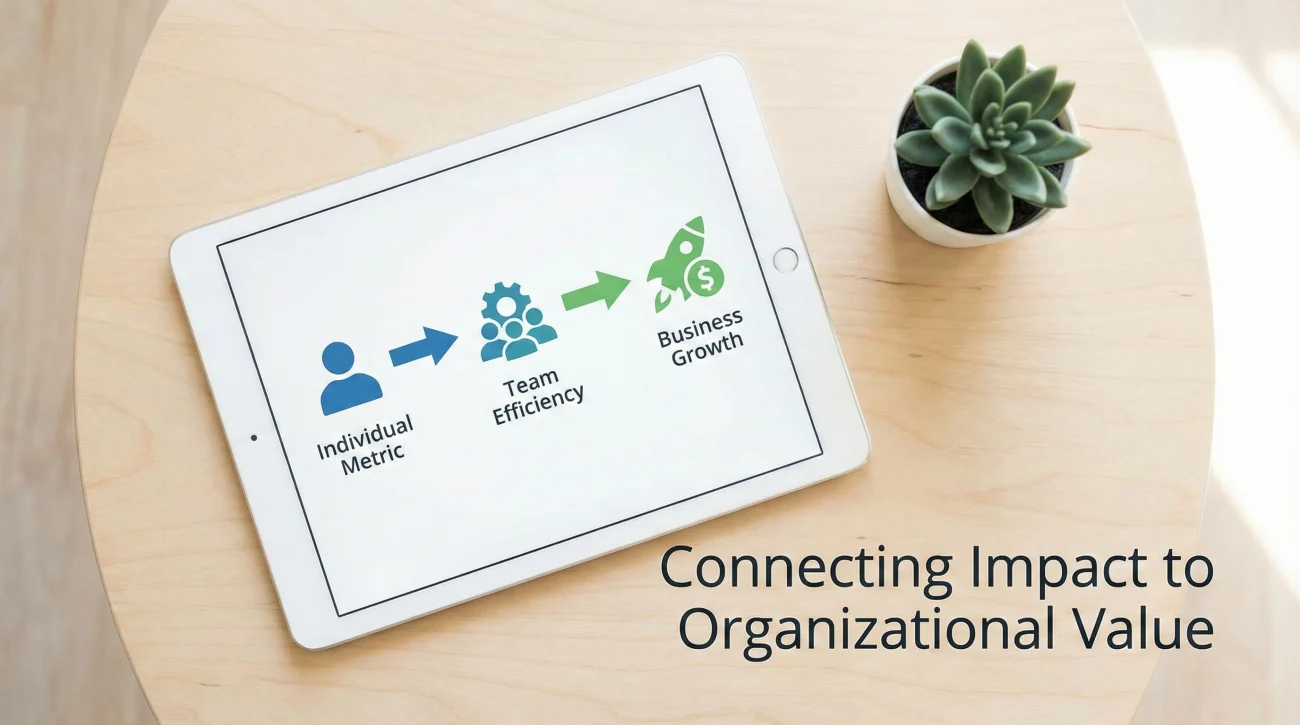
State your Result, then ask “So what?” until you reach business impact. “I reduced deployment time from 2 hours to 20 minutes” → So what? → “The team could deploy 3x per day instead of once” → So what? → “We shipped features to customers 3x faster, reducing time-to-market and enabling rapid iteration based on feedback.”
This cascading logic shows you understand how technical work connects to organizational value. Junior engineers might stop at the technical metric. Senior engineers explain business implications.
Articulating Value to Different Stakeholders
Frame Results considering what the interviewer cares about. Technical interviewers appreciate performance metrics. Business stakeholders want to hear revenue impact or cost savings. Product managers care about customer outcomes and user experience improvements.
Expert insight: Multilevel Results demonstrate mature thinking: “The optimization reduced server costs by $30,000 annually (finance cares), improved page load speed by 60% (product cares), and freed up backend capacity to handle new features without infrastructure expansion (engineering cares).”
Including Timeline and Sustainability
Outcome validation techniques often involve demonstrating both when results appeared and how long they lasted.

Time to Achieve Results
How quickly you delivered outcomes matters. “Reduced error rate to 1%” is good. “Reduced error rate to 1% within two weeks of implementation” is better – it shows your solution worked fast, not just eventually.
Timeline context also helps interviewers understand constraints you worked under. “Launched the feature by the quarterly deadline” demonstrates you delivered under time pressure, not unlimited runway.
| Result Without Timeline | Result With Timeline |
|---|---|
| “Improved customer satisfaction” | “Increased CSAT from 72% to 88% within three months” |
| “Reduced technical debt” | “Decreased critical security vulnerabilities from 45 to 3 in six weeks” |
| “Increased team productivity” | “Enabled team to ship 40% more features per quarter starting immediately after rollout” |
| “Completed the migration” | “Finished migration two weeks ahead of schedule with zero downtime” |
Demonstrating Lasting Impact
Short-term wins that degraded quickly look less impressive than sustained improvements. “Error rates dropped to 1% and remained stable for the next year” proves your solution was robust, not a temporary fix that later regressed.
Long-term outcomes also show you follow through: “The process I established is still used today, three years later” demonstrates you created lasting value, not just completed a project and moved on.
Including Secondary and Learning Results
Primary outcomes prove your Actions worked. Secondary outcomes and lessons learned add depth and show mature reflection.
Unexpected Positive Outcomes
Include beneficial results you didn’t initially anticipate. “Not only did response time improve by 60%, but the cleaner code also made it easier for junior developers to contribute, accelerating their onboarding.”
Bonus outcomes demonstrate thoroughness and sometimes reveal insights into your problem-solving that the primary Result alone wouldn’t show.
What You Learned
Especially valuable when Results weren’t perfect. “I achieved 12% improvement against a 20% goal. This taught me to validate assumptions with small-scale testing before full rollout – a lesson I applied successfully in subsequent projects.”
Learning Results show growth mindset and ability to extract value even from partial success. They’re particularly appropriate for questions about failures or challenges you faced.
💡 Pro tip: For failure questions, structure as: what went wrong (Result 1), what you learned (Result 2), how you applied that learning successfully (Result 3). This transforms negative outcomes into evidence of resilience and growth.
Common Result Mistakes
Predictable errors weaken Result sections, undercutting the proof your Actions delivered value.
Vague Outcomes
“Things got better” or “the situation improved” provides zero evidence. What improved? How much? Compared to what baseline? Vague Results leave interviewers unable to assess the significance of your actions.
Generic success language – “very successful,” “greatly improved,” “highly effective” – signals you lack concrete Results. Replace qualitative superlatives with quantitative specifics.
Skipping Results Entirely
Candidates get so absorbed describing Actions they forget to close with outcomes. The interviewer has to ask “So what happened?” to extract basic Result information that should have been volunteered.
This mistake is especially common when time runs short. Prioritize including Results over exhaustive Action detail. A complete story with basic Results beats a detailed Action with no conclusion.
Claiming Full Credit for Team Results
When describing team achievements in Result, clarify your contribution. “The project increased revenue by $5M” might be accurate, but if you were one of 20 contributors, claiming it as your Result misleads.
Better: “I designed the recommendation algorithm that contributed to the project’s $5M revenue increase, specifically improving conversion rate by 15% on the pages where it was deployed.”
Not Explaining Significance
Stating outcomes without context about whether they’re impressive. “Reduced processing time by 10 seconds” might be massive for a critical transaction or trivial for a background batch job. Add context: “Reduced checkout processing from 30 to 20 seconds, directly addressing our top customer complaint.”
Crafting Strong Result Statements
Effective Results balance conciseness with sufficient detail to prove significance.
The Result Formula
Strong Results often follow this pattern: “Achieved [specific metric] [compared to baseline], which [business impact/significance].”
Examples following the formula:
- “Reduced deployment time from 2 hours to 15 minutes, enabling the team to deploy 3x daily and respond to customer feedback within hours instead of days.”
- “Increased email campaign click-through rate from 2.3% to 4.1%, generating 80% more qualified leads for the sales team.”
- “Decreased API error rate from 5% to 0.3%, eliminating customer complaints about failed transactions and saving an estimated $200K in lost revenue.”
Structuring Multiple Results
Present Results in order of significance. Lead with the most impressive outcome, then add secondary benefits. “The primary Result was 40% cost reduction. Additionally, the new system improved maintainability, reducing time spent on support tickets by 10 hours weekly.”
This hierarchy helps interviewers quickly grasp your biggest win without getting lost in a list of equal-weight outcomes.
Practicing and Refining Results
Strong Results come from identifying metrics you overlooked and adding context that clarifies significance.
Mining Your Experience for Metrics
Go back through your work history looking for quantifiable outcomes you didn’t initially track. Check old emails, performance reviews, project retrospectives. Numbers exist in more places than you remember – you just need to excavate them.
For each accomplishment, ask: How much? How many? How fast? How often? Compared to what? Before and after? The answers to these questions turn vague achievements into specific Results.
💡 Pro tip: Create a “wins document” where you record accomplishments with metrics as they happen. Trying to remember numbers years later during interview prep is harder than capturing them in the moment.
Balancing Result Time Allocation
Results typically consume 10-15% of your total answer time. More than that and you’re probably repeating yourself or over-explaining. Less than that and you’re likely being too vague or skipping important outcomes.
For comprehensive behavioral interview preparation covering all STAR components, browse our complete collection of behavioral interview guides with strategies for structuring answers that demonstrate clear, measurable impact.
❓ FAQ
🎯 What if my actions didn’t produce measurable results?
Focus on qualitative outcomes that are still specific: “Stakeholders approved the proposal unanimously,” “The process became team standard practice,” “Zero incidents occurred in the following six months.” If truly no positive outcome occurred, choose a different example – Results are non-negotiable in STAR answers.
💼 How precise do my numbers need to be?
Exact precision isn’t required, but reasonable accuracy is. “Approximately 30-40% improvement” works when you don’t remember exactly. “Around 10 hours saved weekly” is fine. Just don’t claim “reduced errors by 73.4%” unless you actually tracked it that precisely.
⏰ Should I include negative results?
Only for questions specifically about failures or learning experiences. Frame as: initial Result didn’t meet goals, but you learned X, applied it to Y situation, which then succeeded with Z Result. This demonstrates growth mindset and resilience.
📋 What if the result hasn’t happened yet?
For very recent work, state current progress: “Early results show 25% improvement, and full rollout is expected to reach 40% by quarter end.” Or use different examples with completed outcomes. Unfinished stories weaken STAR answers significantly.
✨ How do I avoid sounding like I’m bragging?
State facts plainly without emotional inflation. “Increased revenue by 50%” is direct. “I achieved an absolutely incredible, amazing 50% revenue increase that nobody thought possible” sounds arrogant. Let impressive numbers speak for themselves. Acknowledge team contributions where appropriate while clarifying your role.
Final Thoughts
The Result component transforms your STAR answer from an interesting anecdote into evidence of capability. Without Results, interviewers have only your word that your Actions were appropriate. With concrete, quantified Results, you provide proof your approach delivers value.
Strong Results share common characteristics: specific metrics whenever possible, clear comparison to baselines, timeline context, explanation of business significance, and honest representation of your contribution. Numbers make impact tangible. Context makes numbers meaningful. Connection to business value demonstrates strategic thinking beyond tactical execution.
Master star method result techniques by mining your experience for quantifiable outcomes. Go back through past work identifying metrics you can use. Practice explaining not just what improved, but why that improvement mattered to the organization. Connect technical achievements to business impact. Include timeline context showing how quickly you delivered. When you quantify success effectively, you provide the evidence interviewers need to confidently conclude you can replicate those results in their organization.
⚠️ Disclaimer: The interview strategies, sample answers, and negotiation tips provided in this guide are for educational purposes only. Hiring decisions are subjective and vary by company and industry. While these strategies are based on professional HR standards, they do not guarantee a specific job offer or result.