- What “Task” does: It bridges Situation to Action by stating your exact responsibility and what success looked like.
- Task vs Situation: Situation describes the environment, Task defines your goal inside it with a clear target (metric, deadline, scope).
- What to include: Specific objective, success criteria, and the key constraints that made it hard (time, budget, resources, technical limits).
- Common mistakes: Repeating the Situation, staying vague (“help the team”), or describing company goals instead of your owned piece.
- How to use it in interviews: Make Task precise so your Actions feel logical and your Result becomes easy to measure and believe.
STAR Method Task (Defining the Challenge)
Jumping from context straight to what you did leaves interviewers confused about why your actions mattered. Without a clear Task definition, they can’t evaluate whether your approach was appropriate or if your results represent meaningful achievement. The bridge between Situation and Action matters more than candidates realize.
The star method task component defines the specific challenge you took on and what success looked like. This isn’t repeating the Situation – it’s clarifying your responsibility within that context. The Situation says “the system was slow.” The Task says “I needed to reduce response time below 500ms within two weeks.”
Effective defining interview challenges transforms vague problem descriptions into concrete objectives. When interviewers understand exactly what you were trying to accomplish, they can properly evaluate whether your actions were smart and your results were significant. This clarity separates forgettable answers from memorable ones, as demonstrated in comprehensive STAR method guides from Big Interview.
Understanding Task’s Function
The star framework task translates general situations into specific assignments. It answers “What were you responsible for fixing or achieving?” rather than just describing what was happening.
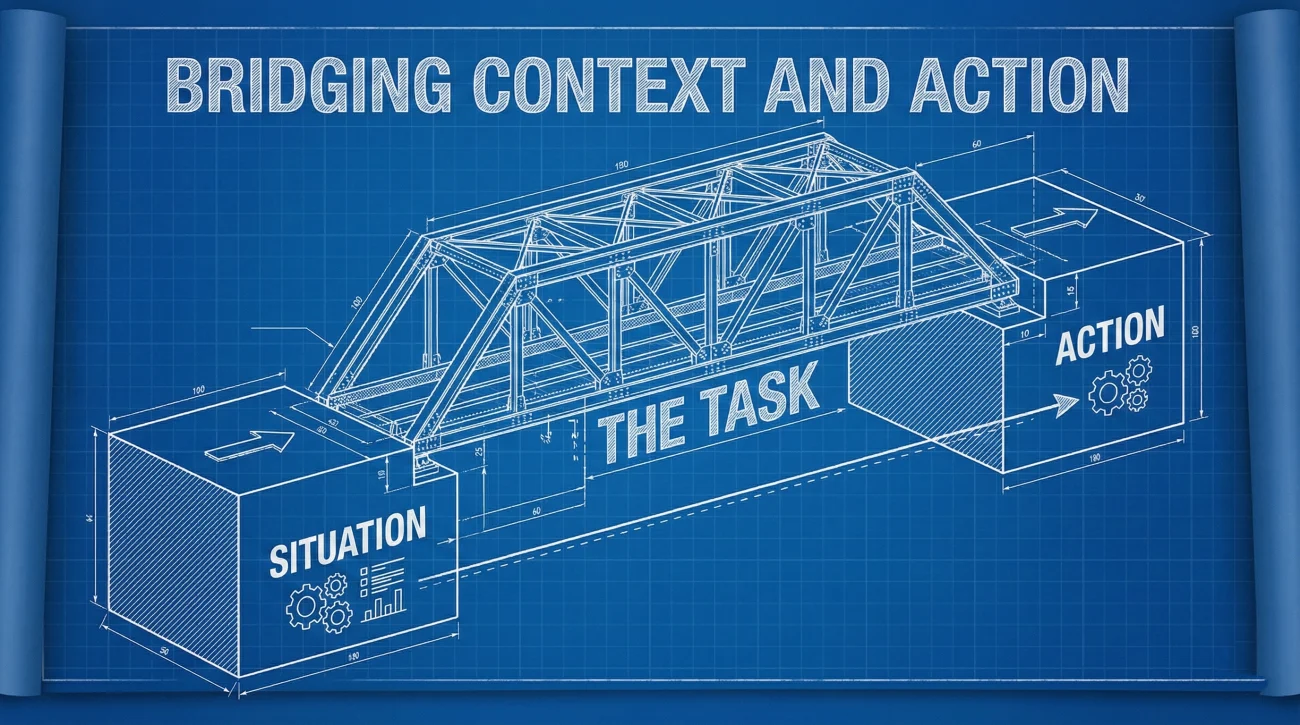
Task vs Situation: The Key Difference
Situation describes the environment and initial problem state. Task defines your specific goal within that environment. “Our database queries were slow” is Situation. “My task was to identify bottlenecks and improve query performance by 50%” is Task.
The distinction matters because the Situation might involve many problems while your Task focused on one specific aspect. Making this explicit prevents interviewers from assuming you were responsible for everything mentioned in the Situation.
Expert insight: Strong Task statements include both the goal and how you’d measure success. “Improve performance” is vague. “Reduce API response time from 2 seconds to under 500ms” provides clear success criteria that makes evaluating your Result straightforward.
Establishing Ownership
The Task clarifies what you personally owned versus what the team or organization tackled. “The company needed to migrate to the cloud” is organizational context. “I was tasked with migrating our authentication service to AWS” defines your piece.
This specificity becomes critical when interviewers probe your contributions. If you claim broad responsibility in the Task but reveal limited involvement in the Action, credibility suffers. Define scope accurately from the start.
Essential Task Components
Task statement clarity requires including specific elements that make your challenge comprehensible and your success measurable.
The Specific Objective
State exactly what needed to be accomplished. Avoid vague language like “improve things” or “fix the problem.” Specify the outcome: “Reduce customer complaint rate,” “Implement a new feature,” “Train the junior developers,” “Resolve the conflict between teams.”
| Vague Task | Specific Task |
|---|---|
| “Make the system better” | “Reduce system downtime from 2 hours/month to under 30 minutes” |
| “Help the team collaborate” | “Establish a code review process that all PRs passed through before merging” |
| “Fix the bugs” | “Resolve the 15 critical bugs blocking the product launch” |
| “Improve customer satisfaction” | “Increase NPS score from 32 to above 50 within three months” |
Success Criteria
Define how you’d know when you succeeded. Quantitative metrics work best: “Reduce error rate to below 1%,” “Complete migration by end of Q2,” “Train 10 engineers on the new framework.” These criteria set up your Result section naturally.
💡 Pro tip: If you struggle articulating success criteria, you’ll struggle demonstrating results later. The Task should make your Result section almost automatic – either you hit the criteria or you didn’t.
Constraints and Context
Include relevant limitations that made the challenge harder. Time pressure, resource constraints, technical limitations, or stakeholder requirements all shape how interviewers evaluate your approach.
- ⏰ Time constraints: “Complete the migration within two weeks before the deadline”
- 💰 Budget limitations: “Reduce costs without purchasing new hardware or services”
- 👥 Resource constraints: “As the only designer supporting three product teams”
- 🔧 Technical constraints: “Without modifying the legacy database schema”
- 📊 Quality requirements: “While maintaining 99.9% uptime during the transition”
Common Task Mistakes
Predictable errors weaken Task statements, making Actions harder to evaluate and Results less impressive.

Repeating the Situation
The most common mistake is restating what you already covered. “So my task was to work on the payment system that was experiencing errors” just repeats the Situation. You’ve wasted time without adding new information.
If your Task sounds like a rephrasing of your Situation, you haven’t defined the challenge – you’ve just described the context twice.
Vague Objectives
“My task was to make things better” or “I needed to help the team” doesn’t establish what you were trying to accomplish. Interviewers can’t evaluate your actions without understanding the goal.
Challenge articulation demands specificity. “Help the team” becomes “Onboard two junior developers so they could contribute to production code within one month.” Now the interviewer knows what success meant.
Organizational Goals vs Personal Task
Describing what the company wanted rather than what you personally owned creates confusion. “The organization needed to improve security” is different from “I was assigned to implement two-factor authentication for all user accounts.”
Make your responsibility explicit. Even on team projects, clarify your piece: “My role was to design the database schema while others handled the API layer.”
Crafting Effective Task Statements
Goal setting interviews becomes clearer with concrete examples showing how to transform general problems into specific tasks.
Technical Problem Tasks
For technical challenges, specify the metric you were improving and the target. “My task was to reduce API latency from 800ms to under 200ms” or “I needed to scale our system to handle 10x traffic during the Black Friday launch.”
Include technical constraints when relevant: “I was tasked with improving performance without rewriting the core algorithm the business logic depended on.” This context helps interviewers appreciate your approach.
| Challenge Type | Task Example |
|---|---|
| Performance | “Reduce page load time from 4 seconds to under 1 second for our dashboard” |
| Reliability | “Decrease production incidents from 15/month to fewer than 3” |
| Migration | “Move 50 microservices from on-prem to Kubernetes without downtime” |
| Debugging | “Identify and fix the memory leak causing weekly server crashes” |
| Feature Development | “Implement real-time notifications by end of quarter for 100k users” |
Leadership and Collaboration Tasks
For behavioral competencies, define the relationship goal or outcome. “My task was to align the engineering and product teams on feature prioritization for the next quarter” establishes clear success – either alignment happened or it didn’t.
“I needed to mentor the junior developer until they could handle complex features independently” sets measurable criteria. You’ll demonstrate success in the Result by showing they shipped features solo.
Conflict Resolution Tasks
When describing conflicts, clarify what resolution looked like. “My task was to resolve the disagreement between design and engineering about the UX approach before the sprint planning meeting” defines both the goal and the deadline.
Avoid implying you were responsible for others’ behavior: “Make them agree” isn’t a valid task. “Facilitate a resolution process” or “Find a compromise both teams could commit to” represents what you could actually control.
Connecting Task to Action
A well-crafted Task sets up your Action section perfectly. The interviewer should immediately understand why you took the steps you describe.

Creating Smooth Flow
The Task statement should make your Actions feel inevitable. “My task was to reduce deployment time from 2 hours to 30 minutes” naturally leads to “I first analyzed the deployment pipeline to identify bottlenecks.”
If your Actions feel disconnected from your Task, revisit the Task definition. Either you’ve defined the wrong goal or you’re about to describe actions that don’t address what you said needed fixing.
Expert insight: Test your Task by asking “Does this make my upcoming Actions obvious and logical?” If you define a performance task but then describe only code refactoring for readability, something’s misaligned.
Ensuring Scope Alignment
The breadth of your Task should match the depth of your Action. If you claim a massive, organization-wide task but then describe minor individual contributions in the Action, credibility suffers.
Better to define a focused Task you owned completely than claim broad responsibility you’ll contradict when explaining actual work. “I was tasked with optimizing our three most expensive database queries” beats “I was responsible for all database performance” when you only touched three queries.
Special Situation Task Definitions
Certain scenarios require adapted Task approaches while maintaining core clarity principles.
Ambiguous or Evolving Tasks
When the challenge wasn’t clearly defined upfront, acknowledge this in your Task. “Initially, I was asked to investigate why deployment failures had increased, but the root cause wasn’t clear” sets up a Task about discovery rather than solving a known problem.
You can then explain how you defined the task: “I determined my real task was to implement better monitoring so we could diagnose these failures systematically.” This shows initiative in problem definition, which many roles value.
Team vs Individual Tasks
On team projects, separate team goals from your piece. “The team was tasked with rebuilding the checkout flow. My specific responsibility was implementing the payment integration and fraud detection.”
💡 Pro tip: Using “we” in the Task is acceptable for team context, but quickly pivot to “I” when defining your portion: “We needed to launch by Q4, and I was responsible for the backend API.”
Tasks Where You Failed
When describing situations where you didn’t fully succeed, still define the original Task clearly. “My task was to reduce churn by 20%, though I ultimately only achieved 12%.” Setting the ambitious goal shows what you aimed for, and honesty about partial success demonstrates integrity.
The Action section will explain what you tried, and the Result will discuss lessons learned. But the Task should reflect your actual objective, not be retroactively scaled down to match mediocre results.
Practicing and Refining Task Statements
Strong Task definitions come from iterative refinement. Your first draft usually lacks the specificity or clarity that makes evaluation easy.
The Specificity Test
Read your Task statement and ask: “Could someone replicate this goal from my description?” If not, add detail. “Improve the process” fails this test. “Reduce the code review cycle time from 3 days to 24 hours” passes.
Another useful test: “Does this Task naturally set up success metrics for my Result?” If you can’t imagine what metrics would demonstrate success, your Task lacks definition.
The Interviewer Perspective
Imagine hearing your Task as an interviewer. Would you immediately understand what success looked like? Could you start evaluating whether subsequent Actions made sense? If you’d have questions, so will they.
Common interviewer questions signal weak Tasks: “Wait, what exactly were you trying to achieve?” or “How would you know if you succeeded?” means your Task lacked clarity. Strengthen it until those questions become unnecessary.
For comprehensive behavioral interview preparation covering all STAR components, browse our complete collection of behavioral interview guides with strategies for structuring compelling answers.
❓ FAQ
🎯 How long should the Task component be?
Aim for 1-2 sentences or 10-15 seconds verbally. The Task should be crisp and focused – define the goal, success criteria, and any critical constraints without elaboration. It’s typically the second-shortest component after Situation, representing about 15% of your total answer time.
💼 Should I explain why the task mattered?
Only if it significantly impacts how your actions are evaluated. “This was critical because we’d lose our largest client if it failed” adds useful stakes. But usually, stating the objective clearly is sufficient – the interviewer can infer importance from context.
⏰ What if I defined the task myself rather than being assigned it?
Mention this briefly as it demonstrates initiative. “I identified the need to improve our testing coverage and set a goal of reaching 80%” shows proactive problem-solving. This becomes particularly valuable for leadership and initiative questions.
📋 Can the Task overlap with the Situation?
Some overlap is natural, but avoid pure repetition. The Situation describes the general problem; the Task specifies your objective within that context. “The system was slow” (Situation) and “I needed to reduce response time below 500ms” (Task) connect logically without repeating.
✨ What if my task had multiple objectives?
Either focus on the primary objective or briefly list all goals if they’re tightly connected. “My task was to migrate to the new framework while maintaining backward compatibility and training the team on the changes” works if all three objectives are essential to the story. Otherwise, pick the most relevant.
Final Thoughts

The Task component bridges context and action, transforming general situations into specific challenges with measurable success criteria. Without clear Task definition, interviewers struggle to evaluate whether your actions were appropriate and your results significant.
Strong Tasks answer three questions concisely: What were you trying to accomplish? How would you measure success? What made this challenging? These elements set up your Action naturally and make your Result meaningful.
Master star method task techniques by practicing specific, measurable goal statements. Edit out vagueness and repetition. Test whether your Task makes your subsequent Actions feel obvious and your Results easy to evaluate. When you nail the Task definition, the rest of your STAR answer becomes dramatically more compelling because interviewers understand exactly what you achieved and why it mattered.
⚠️ Disclaimer: The interview strategies, sample answers, and negotiation tips provided in this guide are for educational purposes only. Hiring decisions are subjective and vary by company and industry. While these strategies are based on professional HR standards, they do not guarantee a specific job offer or result.