Change Is the Only Constant
Darwin never actually said “survival of the fittest.” What he observed was survival of the most adaptable. This distinction matters because questions about adapting to change test exactly that: not whether you are the smartest or most skilled, but whether you can evolve when circumstances shift.
A CHRO at Salesforce explained her perspective: “We restructure something significant every eighteen months. New tools, new processes, new reporting structures. The employees who thrive aren’t necessarily the best performers in stable conditions. They’re the ones who treat every change as a new puzzle to solve rather than a personal attack. When I interview, I’m listening for how candidates talk about disruption. Do they sound victimized or energized?”
Types of Change to Consider
| Change Type | Example Scenarios |
|---|---|
| Organizational | Restructures, mergers, new leadership, team changes |
| Process | New workflows, methodology shifts, tool migrations |
| Technology | System replacements, automation, digital transformation |
| Strategic | Priority shifts, market pivots, product direction changes |
| Role | Expanded responsibilities, new functions, lateral moves |
Choose a change significant enough to demonstrate real adaptability. Minor adjustments do not show much. Major organizational shifts or technology transformations that required you to fundamentally alter how you worked are more compelling.
Adaptation Stories That Revealed True Flexibility
Claiming to embrace change is easy. These interview stories showed me candidates who actually demonstrated adaptability when tested.
The Merger That Changed Everything
A marketing manager named Roberto described surviving three rounds of layoffs during an acquisition. His entire team was eliminated except him. His role was redefined to report to someone at the acquiring company with different priorities, different processes, and different expectations. Most of his peers in similar situations left within six months.
Roberto stayed and thrived. He told me his approach: “Instead of mourning how things used to be, I treated it like starting a new job. I scheduled meetings with twenty people at the new company to understand how they worked and what they needed. I asked my new boss what success looked like for him, not what it used to look like for my old boss.”
He discovered that the acquiring company valued data-driven marketing more than the creative-driven approach his old company favored. Rather than resisting, he took online courses in analytics and rebuilt his marketing playbook around measurement. Within a year, he was promoted to lead a combined team because he had become fluent in both cultures.
Roberto’s answer showed me that adaptability is not just tolerating change. It is actively reinventing yourself to succeed in the new environment.
The Technology Shift That Made Her Skills Obsolete
A senior accountant named Patricia spent fifteen years mastering complex Excel models for financial analysis. Then her company implemented new enterprise software that automated eighty percent of what she did. Colleagues with similar backgrounds were laid off or shunted into diminished roles.
Patricia requested to be part of the implementation team. She learned the new system from the inside, becoming a power user while implementation consultants were still on site. She noticed that the software generated data that no one was analyzing strategically because accountants were too busy learning the basics.
She proposed creating an analytics function that would translate the software’s outputs into strategic insights for leadership. Her deep domain knowledge combined with her new technical skills made her uniquely qualified to bridge that gap. What could have ended her career instead expanded it.
Patricia told me: “Every technology shift creates jobs while destroying others. The question is whether you position yourself for the new jobs or cling to the old ones. I chose to run toward the change instead of away from it.”
The Role That Became Something Completely Different
A customer success manager named Derek was hired to manage enterprise accounts. Six months in, his company pivoted from enterprise to mid-market, making his entire book of business irrelevant. He now had to manage fifty accounts instead of five, with completely different needs, buying patterns, and success metrics.
Derek could have complained that he was hired for something different. Instead, he saw an opportunity. He studied mid-market customer behavior obsessively. He identified patterns that the company’s existing playbooks missed because they were designed for enterprise. He built new frameworks for onboarding and engagement that worked better for the smaller, faster-moving mid-market segment.
His work became the foundation for the company’s new customer success methodology. When I asked how he felt about the bait-and-switch, he said: “The company I joined didn’t exist anymore. I could either quit and join a company that might change tomorrow too, or I could make myself valuable in this new company that happened to have the same name.”
That mindset, seeing change as the emergence of a new company rather than the betrayal of a promise, is exactly the adaptability I look for when hiring.
The Adaptability Mindset
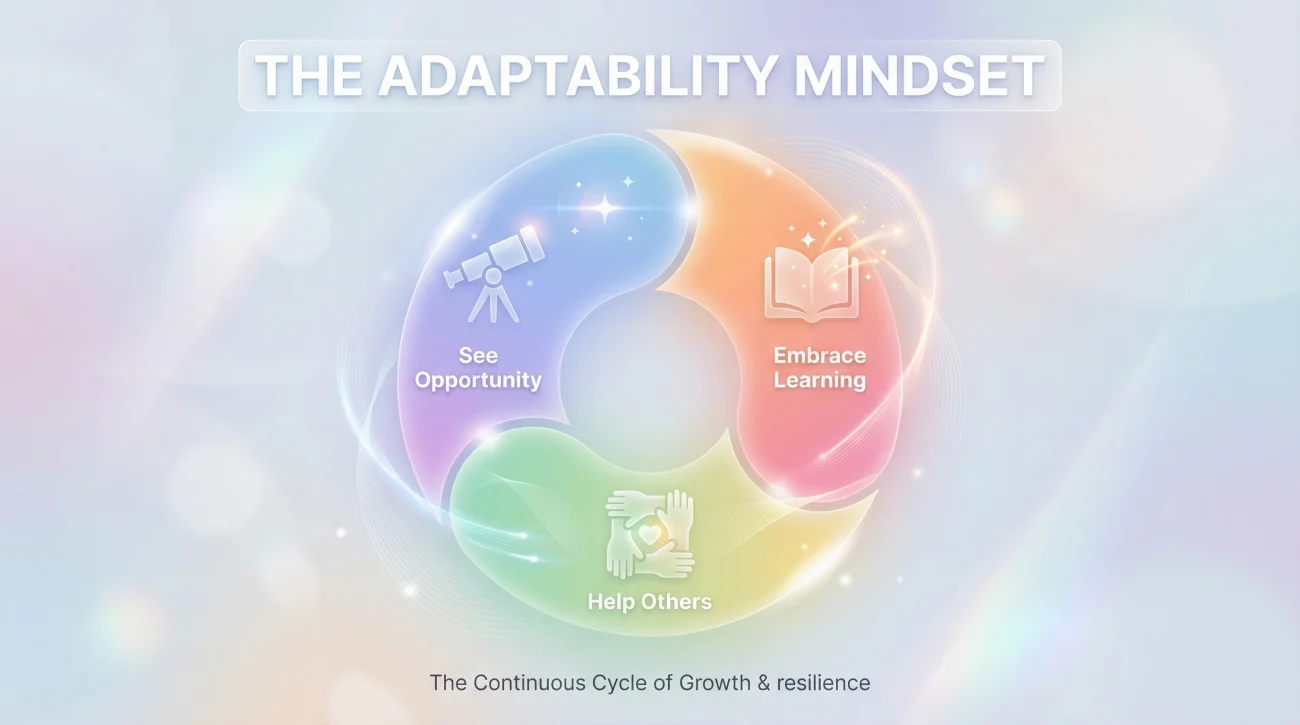
See Opportunity in Disruption
While others focus on what they are losing, adaptable people identify what they might gain. Your answer should show you looked for positive possibilities in the change rather than only dwelling on difficulties. This does not mean ignoring legitimate challenges but balancing them with forward-looking perspective.
Embrace Learning Curves
Change often requires developing new skills or knowledge. Strong answers demonstrate enthusiasm for learning rather than resentment at having to start over. The willingness to be a beginner again, even with years of experience, shows adaptability.
Saying “I saw this as a chance to expand my skills” shows growth mindset in action.
Help Others Through Transition
The most valuable adaptable employees do not just manage their own transitions well. They help colleagues navigate change too. If your story includes supporting team members who struggled with the change, it demonstrates leadership alongside adaptability.
Sample Answer
Situation
Our company went through a major reorganization that eliminated my department and distributed its responsibilities across three different teams. My role changed significantly, I reported to a new manager, and I had to work with colleagues I hadn’t partnered with before. Several peers left during the transition, which added uncertainty and increased the pressure on those who remained.
Task
I needed to adapt quickly to the redefined role, rebuild working relationships in a new structure, and stay productive, while also helping stabilize the team dynamic during an unsettling change.
Action
I chose to treat the change as an opportunity rather than waiting for things to “settle.” Before the official transition, I scheduled time with my new manager and key teammates to clarify expectations, understand priorities, and start building trust early.
I also did a quick skills gap assessment for the new role. The team used different project management tools and methodologies, so I took online courses during the transition period to get up to speed instead of relying on ad hoc training later. I focused on learning just enough to contribute immediately, then deepened the skills as I started using them in real work.
As I noticed colleagues struggling with the change, I organized informal lunch sessions where people could share concerns and practical coping strategies. It created space for honest conversation, but it also kept the tone constructive and forward-looking, which helped rebuild a sense of community during uncertainty.
Result
Within three months, I was fully productive in the new structure and became a connector between legacy team members and new colleagues. In my first review with the new manager, they specifically called out that my attitude and initiative during the transition helped team morale.
I also expanded my skill set in ways that have continued to benefit my career, especially around working across teams and ramping quickly on new tools and processes.
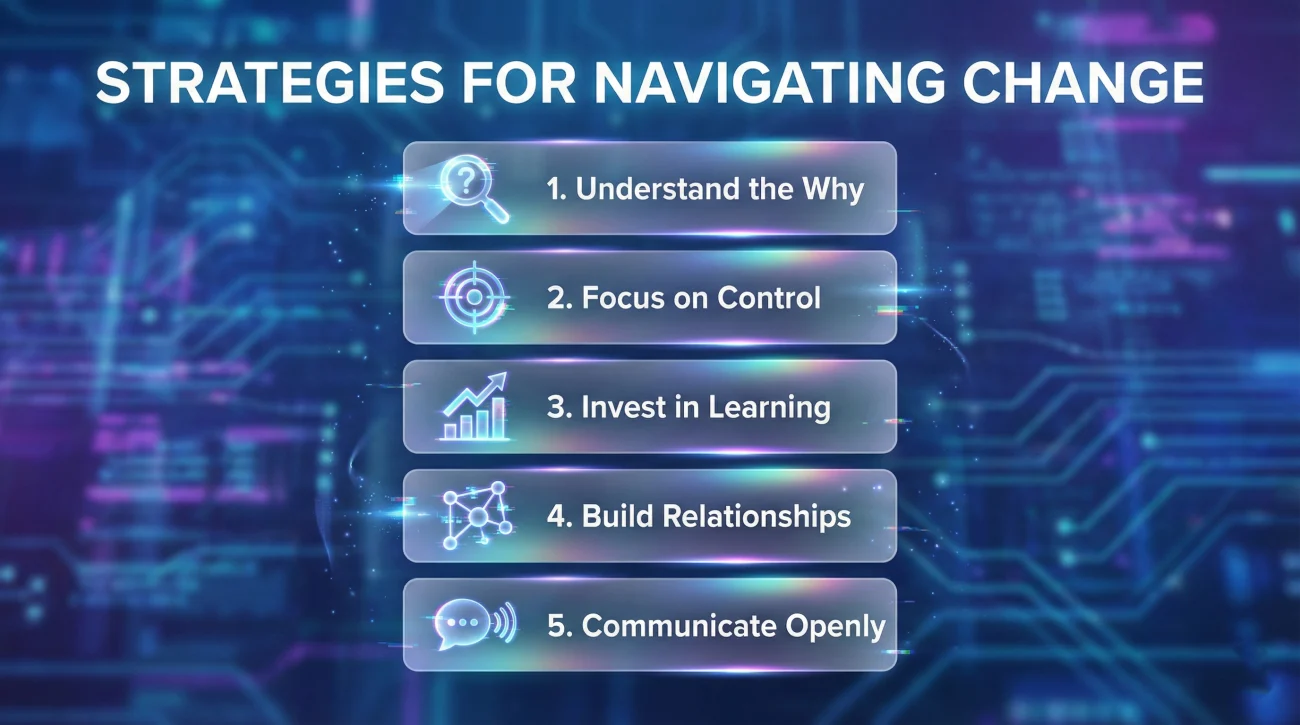
- 🔍 Understand the Why: Seek to understand reasons behind the change rather than just reacting to it
- 🎯 Focus on What You Control: Direct energy toward your response, not circumstances you cannot change
- 📚 Invest in Learning: Proactively build skills the new environment requires
- 🤝 Build New Relationships: Connect with people who will be important in the new structure
- 💬 Communicate Openly: Share your adjustment process and ask for feedback
For more guidance on proving your flexibility to employers, explore our detailed resources.
❓ FAQ
🎯 What if I struggled with a change initially?
Initial struggle followed by successful adaptation can be a strong story. Show self-awareness about your initial reaction and the steps you took to move forward. Growth through difficulty often demonstrates more adaptability than effortless transitions.
💼 Can I describe a change I disagreed with?
Yes, as long as you ultimately adapted and performed well. You can briefly mention concerns while emphasizing that you committed to making the change work. Disagreeing but adapting shows maturity.
⏰ Should I describe recent or older changes?
Recent changes show current adaptability. However, older examples work if the change was significant and you can clearly articulate the impact and your response. The key is demonstrating a pattern of successful adaptation.
📋 What if the change turned out badly for the organization?
You can acknowledge that the change did not achieve intended outcomes while still demonstrating your personal adaptability. Focus on how you navigated the transition professionally regardless of organizational results.
✨ How do I show adaptability without seeming like I have no opinions?
Adaptability is not the same as passive acceptance. You can describe voicing concerns during appropriate channels while ultimately committing to the direction chosen. Strong opinions loosely held demonstrates both conviction and flexibility.
Embrace What Comes Next
Questions about adapting to change reveal whether you will be an asset or obstacle during organizational transitions. By demonstrating positive attitude, proactive learning, and support for others through change, you show interviewers that hiring you means gaining someone who makes change easier rather than harder for everyone around them.
⚠️ Disclaimer: The interview strategies, sample answers, and negotiation tips provided in this guide are for educational purposes only. Hiring decisions are subjective and vary by company and industry. While these strategies are based on professional HR standards, they do not guarantee a specific job offer or result.