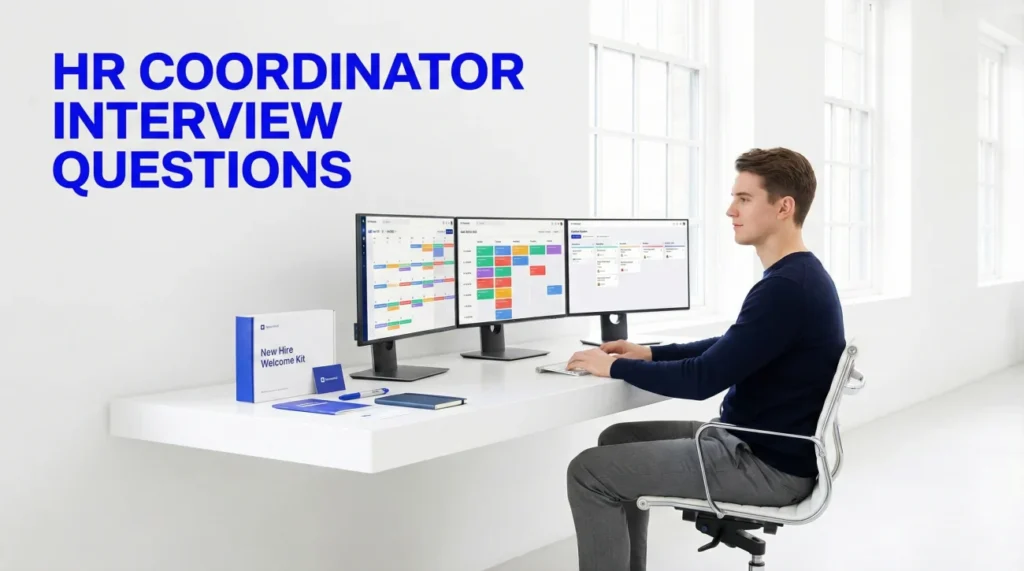
What HR Coordinator Interviews Really Measure
HR coordinator interview questions are less about fancy HR theory and more about whether you can keep the whole machine running when things get busy. Picture a Monday morning where a candidate is waiting for a Zoom link, a manager asks to move a panel interview, and a new hire cannot log into their laptop. In that moment, the HR Coordinator is the calm operator who fixes the details fast, protects confidentiality, and keeps the experience professional for everyone.
In this guide, you will see the role through four lenses: recruiting logistics, HR data accuracy, onboarding execution, and employee support. Aim to sound like someone who respects process, checks their work, and communicates clearly under pressure, because that is what prevents small mistakes from turning into payroll problems or a bad candidate impression.
Recruitment Coordination & Logistics
Scheduling is a logic puzzle. Interviewers need to know you can manage calendars across time zones without errors, ensuring a seamless candidate experience.
Q: How do you handle a scheduling conflict where a hiring manager cancels an interview last minute?
I act immediately to minimize the damage to the candidate experience. First, I call the candidate (email is too slow for last-minute changes) to apologize sincerely. I frame it as an “unexpected business conflict” rather than blaming the manager to maintain professionalism. I offer reschedule times immediately to keep the momentum. Then, I circle back to the manager to emphasize the importance of keeping the new slot, perhaps suggesting we block “interview buffers” on their calendar in the future to prevent recurrence. My goal is to make the candidate feel valued despite the disruption.
Q: What tools do you use to manage high-volume scheduling?
I rely on automation tools to eliminate the “email ping-pong.” I use tools like Calendly or the built-in scheduling features of the ATS (like Greenhouse or Lever) to allow candidates to self-select times. For complex panel interviews involving multiple stakeholders, I use the “Find Time” feature in Outlook or Google Calendar overlay to identify gaps. I always double-check time zones (e.g., EST vs. PST vs. GMT) and ensure I include a Zoom/Teams link in every invite so no one is scrambling for a dial-in number at the last minute.
Q: How do you ensure a candidate has a great experience even before they are hired?
I view myself as the candidate’s concierge. I send a comprehensive “Prep Email” ahead of the interview with the full schedule, names/bios of interviewers, and a link to test their video connection. If it is an in-person interview, I provide clear parking instructions and building entry details. During the process, I am hyper-responsive; my goal is to respond to logistical questions quickly and reliably. Transparency reduces anxiety, and a calm candidate performs better.
Q: How do you track the status of background checks?
I monitor our background check vendor portal regularly. If a check is “pending” longer than the typical turnaround, I proactively reach out to the vendor to identify the bottleneck (e.g., waiting on a county court record or employment verification). I communicate updates to the hiring manager (e.g., “We are still on track for the planned start date”) and checking in with the candidate if we need additional documentation to clear a flag. I never let a start date slip without a warning.
HR Operations & Data Integrity
Data integrity starts with you. If you enter the wrong salary or start date, it causes payroll errors downstream. Precision is your most valuable asset.
Q: Walk me through your process for entering a new hire into the HRIS.
I follow a strict “Check Twice, Enter Once” protocol. First, I gather all source documents (Signed Offer Letter, I-9, Direct Deposit form, Tax forms). I enter the data into the HRIS (e.g., Workday, BambooHR), paying special attention to effective dates and salary figures (checking for annual vs. hourly entry errors). After entry, I perform a “self-audit” by comparing the system profile against the offer letter line-by-line. Finally, I notify Payroll and IT that the record is created so they can trigger their downstream workflows. I treat every data entry as if it affects someone’s rent payment, because it does.
Q: How do you organize digital employee files for compliance?
I maintain strict folder hygiene to ensure compliance and searchability. I create a standardized folder structure for every employee (e.g., 01_Offer, 02_Performance, 03_Benefits, 04_Changes). Crucially, I keep medical information (like doctors’ notes for sick leave or ADA accommodations) in a completely separate, secure folder, distinct from the general personnel file, as required by privacy rules and company policy. I also audit these folders on a regular cadence and archive terminated employees’ records according to our record retention policy and applicable requirements.
Q: How do you handle a request for an employment verification letter?
I check our policy first. Often, we use a third-party service (like The Work Number) for automated verification, and I direct the verifier there. If I need to generate it manually (e.g., for a visa application or mortgage closing), I use a standard template that confirms only dates of employment and job title. I do not disclose salary information or reason for leaving unless I have a specific, signed release form from the employee authorizing that disclosure. Protecting employee privacy is my priority, and I avoid giving verification over the phone unless identity and authorization are clearly confirmed.
Q: Describe how you manage the I-9 verification process.
I understand the strict deadlines for I-9s. I make sure the employee completes their portion by the required deadline and that the employer verification step is completed within the required timeframe. For remote employees, I coordinate with an authorized representative (like a notary or a colleague in their location) to physically examine the documents, using methods that comply with the current rules for remote verification. I track expiring work authorizations on a calendar so re-verification happens on time. I keep our I-9 records organized and periodically review retention so we archive and purge records appropriately.
Employee Service & Onboarding Support
You are often the first face a new hire sees. Interviewers look for warmth, patience, and the ability to solve problems quickly to ensure a smooth “Day 1.”
Q: A new hire arrives on Day 1, but IT hasn’t set up their laptop. What do you do?
I take ownership of the problem so the new hire doesn’t feel unwelcome. I apologize for the delay and immediately walk over to IT (or ping them urgently) to escalate the ticket. While we wait, I pivot the schedule to non-digital tasks. I might give them a building tour, introduce them to the team for coffee, take their badge photo, or start reviewing the physical parts of the handbook. I ensure they feel productive and cared for, rather than sitting idly at an empty desk wondering if joining was a mistake.
Q: An employee asks a question about benefits that you don’t know the answer to. How do you respond?
I never guess, because giving wrong benefits advice has serious financial and health consequences. I say, “That is a great question. I want to make sure I give you the exact right answer, so let me research that with our Benefits Specialist and get back to you as soon as possible, ideally the same day.” I then find the answer and follow up as promised. This builds trust because they know I value accuracy over looking smart. I also add the answer to my own FAQ document so I know it next time.
Q: How do you prioritize answering the HR inbox?
I triage emails based on urgency and impact. Urgent/High Impact: Payroll errors (“I didn’t get paid”), harassment complaints, or safety issues get immediate attention. Medium: Time-sensitive requests like employment verification for a loan closing or benefits enrollment questions for a new hire. Low: General policy questions (“Where can I find the holiday calendar?”). I aim to acknowledge receipt of emails promptly, even if just to say “I’m looking into this,” so the employee knows they haven’t been ignored.
Q: How do you support the performance review cycle?
I act as the project manager for the cycle. I ensure the HRIS performance module is launched on time. I track completion rates and follow up with managers who are lagging (the “nudge” emails). I schedule calibration meetings and take notes. I also help distribute the final review documents for signature. My goal is to remove the administrative friction so managers can focus on the conversation quality, not the tool.
Behavioral Scenarios & Ethics
In these scenarios, interviewers are testing your discretion and ability to handle awkward situations gracefully.
You overhear sensitive information about a layoff while filing papers. A friend at work asks if their job is safe. What do you do?
I maintain absolute confidentiality. I would say, “I don’t have any information about that.” Even a hint (like “don’t worry” or “just be prepared”) is a breach of ethics. As an HR professional, my loyalty must be to the integrity of the department. Sharing privileged information not only risks my job but could cause panic and legal liability for the company. I would act normally and not treat the information as something I “know.” I would also ensure I lock any sensitive files immediately to prevent accidental leaks.
You made a mistake scheduling an interview (sent the wrong time to the candidate). How do you fix it?
I own it immediately. I call the candidate to apologize proficiently: “I am so sorry, I made an error in the calendar invite. The correct time is the time on the updated invite. Does that still work for you, or do we need to reschedule?” I take full blame so the candidate doesn’t think the company is disorganized. I then notify the interviewer so they aren’t waiting on a call that isn’t happening. I don’t make excuses. Afterward, I double-check my timezone settings and slow down my process to ensure I’m verifying details before hitting send next time.
A manager sends you an angry email because a new hire’s desk wasn’t ready. It was Facilities’ fault, not yours. How do you reply?
I don’t pass the buck. I reply professionally: “I apologize that the desk wasn’t ready. I know how important it is for the new hire to feel settled. I have contacted Facilities and they are bringing a chair now. I will follow up shortly to confirm it’s done.” I solve the problem first. Later, I will debrief with Facilities to improve our coordination process (e.g., sending the ticket earlier). Blaming another department makes HR look disjointed; solving it makes HR look capable.
HR Coordinator Skills Quiz
Test Your HR Ops Knowledge
1. The “I-9 Form” must be completed by the employee:
- Within 30 days
- On or before their first day of work
- Whenever they have time
- Before the interview
2. Which information should NEVER be stored in a general personnel file?
- Offer letter
- Medical records or doctors’ notes
- Performance reviews
- Resume
3. “ATS” stands for:
- Automatic Time Sheet
- Applicant Tracking System
- Admin Technical Support
- Annual Tax Statement
4. When scheduling across time zones, “EST” is how many hours ahead of “PST”?
- 3 hours
- 1 hour
- 5 hours
- They are the same
5. A “Background Check” typically requires:
- Just the candidate’s name
- Signed consent from the candidate
- A payment from the candidate
- A DNA sample
6. “Onboarding” refers to:
- Firing an employee
- The process of integrating a new hire into the organization
- Interviewing candidates
- Buying office furniture
7. “HRIS” is used for:
- Designing logos
- Managing employee data and records
- Posting on social media
- Fixing computers
8. If an employee asks for a copy of their pay stub, you should:
- Tell them to ask their manager
- Show them how to access the payroll portal (Self-Service)
- Print it and leave it on their desk
- Say no
9. “Confidentiality” means:
- Hiding mistakes
- Protecting sensitive employee and company information from unauthorized access
- Never talking to colleagues
- Working in a secret room
10. An “Offer Letter” typically includes:
- Start date, salary, and reporting manager
- The office wifi password
- A list of all coworkers
- The lunch menu
11. “Direct Deposit” setup usually requires:
- A credit card number
- Bank routing number and account number
- A driver’s license
- Cash upfront
12. “New Hire Orientation” is primarily for:
- Testing the employee’s skills
- Introducing company culture, policies, and benefits
- Assigning difficult work
- Evaluating the recruiter
13. “Offboarding” involves:
- Collecting company assets and terminating system access
- Taking the employee to lunch
- Giving a promotion
- Hiring a replacement immediately
14. Which is a common HR coordination task?
- Setting the CEO’s strategy
- Scheduling interviews and booking conference rooms
- Writing code for the website
- Sales forecasting
15. “FMLA” stands for:
- Free Meals and Lunch Act
- Family and Medical Leave Act
- Federal Money Lending Association
- Full Management Labor Agreement
16. “Candidate Experience” refers to:
- How a job seeker perceives the company throughout the hiring process
- The recruiter’s years of experience
- The salary offered
- The software used
17. A “Verification of Employment” (VOE) confirms:
- The employee’s political views
- Dates of employment and job title (and sometimes salary)
- Why the employee was fired
- The employee’s favorite color
18. “Probationary Period” is:
- A time when employees work for free
- An initial trial period for new hires
- A punishment for bad behavior
- A holiday break
19. “Compliance Posters” must be displayed:
- In the CEO’s office only
- In a visible common area (breakroom) where employees gather
- In the bathroom
- Nowhere, they are digital only
20. “Calendar Management” requires:
- Drawing on a paper calendar
- Attention to detail, time zones, and stakeholder availability
- Guessing when people are free
- Using a stopwatch
❓ FAQ
🧩 What does a typical HR Coordinator day look like?
It is a mix of scheduling, inbox triage, and keeping records accurate. One hour you may be coordinating interviews, the next you are updating the HRIS or fixing an onboarding detail. The best way to answer is to describe how you prioritize, confirm details, and communicate updates.
🔐 How do I prove I can handle confidential information?
Use a simple rule set in your answer: share on a need-to-know basis, document what you did, and never speculate. Mention that you keep sensitive files separated, verify recipients before sending, and escalate when you are unsure instead of guessing.
📅 I have not scheduled high-volume interviews. What should I say?
Talk about the method, not the volume. Explain how you confirm time zones, send clear agendas, include links and backup contacts, and double-check conflicts. If you have managed any complex calendar coordination, connect that experience directly to interview scheduling.
🧾 Do I need an HR certification to get hired?
Not always. Many teams care more about reliability, communication, and attention to detail. If you have a certification or coursework, mention it as support, but focus on examples where you kept processes clean and prevented mistakes.
🧠 What mistakes should I avoid in this interview?
Avoid sounding casual about errors or confidentiality. Also avoid vague answers like ‘I am organized’ without proof. Give one short story for accuracy, one for customer-style support, and one for fast scheduling changes, then explain the check you used to prevent a repeat problem.
How to Close the HR Coordinator Interview Strong
If you want to stand out on HR coordinator interview questions, answer like the person who keeps the rails straight. Own the details, explain your checks, and show that you can communicate quickly without creating drama. Hiring teams trust coordinators who are consistent, discreet, and calm.
Before you wrap up, make sure you can talk through one scheduling save, one data accuracy moment, and one employee support situation. If you want extra practice across roles, use browse the full interview question library and rehearse your answers out loud until they feel natural.
⚠️ Disclaimer: The interview strategies, sample answers, and negotiation tips provided in this guide are for educational purposes only. Hiring decisions are subjective and vary by company and industry. While these strategies are based on professional HR standards, they do not guarantee a specific job offer or result.