One Tray, Two Eyes, Zero Mistakes
At a jewelry counter, the smallest details carry the biggest consequences. A loose clasp is not a tiny flaw, it is a ruined gift. A missed security habit is not an oops, it is shrink. That is why jeweler interview questions are built to test three things at once: precision, composure, and trust.
You are not only selling sparkle. You are guiding someone through a decision that is emotional, expensive, and often rushed. They may not remember every spec you explained, but they will remember whether you made them feel safe, respected, and confident.
This guide helps you answer like a professional: clear gemology basics, clean luxury service, and strong security instincts, including handling high-value items safely without making the experience awkward.
Gemology & Technical Knowledge
Q: How do you explain the “4 Cs” of diamonds to a novice buyer?
I simplify the technical terms into value propositions.
1. Cut: I explain this is the most important “C” because it determines the sparkle. A well-cut diamond reflects light; a poorly cut one leaks it.
2. Color: I compare it to water. The clearer (whiter) the better, but I explain that near-colorless grades offer great value.
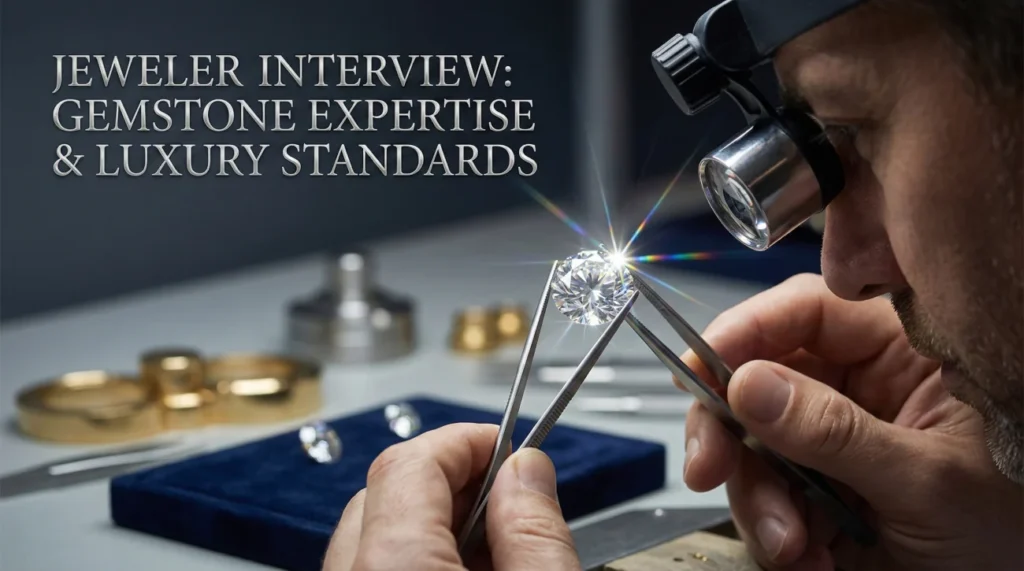
3. Clarity: I describe this as the diamond’s “fingerprint.” I show them inclusions under the loupe so they understand no two are alike.
4. Carat: I clarify that this is weight, not size, and show how cut impacts visual size. My goal is to empower them to decide which “C” matters most to their budget.
Q: What is the difference between 14k, 18k, and 24k gold, and which do you recommend?
I explain that “Karat” measures purity. 24k is 100% pure gold, but it is too soft for daily wear jewelry. 18k is 75% gold (richer color, more valuable), while 14k is 58.5% gold mixed with stronger alloys.
For an engagement ring or something worn every day, I typically recommend 14k or 18k for the balance of durability and beauty. I listen to their lifestyle; if they work with their hands, 14k is the safer, more robust choice.
Q: How do you handle the “Natural vs. Lab-Grown Diamond” debate?
I remain neutral and factual. I explain, “Chemically and physically, they are identical. Ice from a freezer is just as much ice as ice from a glacier.”
I highlight the pros of each: Lab-grown offers a bigger look for the budget and is conflict-free. Natural diamonds hold a romantic allure of being formed by the earth over billions of years and historically retain resale value better. I let the customer’s values dictate the choice, ensuring they feel good about either decision.
Q: Identify a sales scenario where you would recommend Platinum over White Gold.
If a client wants a setting that will remain “forever white” without maintenance, I recommend Platinum. I explain that White Gold is actually yellow gold mixed with alloys and dipped in Rhodium; over time, the Rhodium wears off and it turns warm/yellow, requiring re-dipping.
Platinum is naturally white and denser. Although it scratches (patina), it doesn’t lose metal like gold does. For a client with metal allergies (nickel sensitivity), Platinum is also the hypoallergenic choice.
The Art of Luxury Sales
Q: How do you sell to a couple where one partner is hesitant about the price?
I focus on “Cost per Wear.” I gently remind them that unlike a wedding dress worn once or a car that depreciates, an engagement ring is worn every single day for 50+ years.
I break it down: “$5,000 sounds like a lot, but over a lifetime, it’s pennies a day for an heirloom that gets passed down.” I also look for financing options (0% interest) to make the monthly cash flow manageable, removing the immediate sting of the price tag.
Q: How do you build a “Client Book” for long-term sales?
Jewelry is a relationship business. I capture every date: birthdays, anniversaries, graduations. Two weeks before an anniversary, I text my client: “Hey John, your 5th anniversary is coming up. I have a necklace that matches the earrings you bought last year.”
I become their personal shopper. I send handwritten thank-you notes after every purchase, no matter how small. Reliability builds trust, and trust builds a client for life.
Q: What is your strategy for “Add-On” sales?
I never treat it as an upsell; I treat it as “protection” or “completion.” When selling a ring, I immediately suggest a jewelry cleaner kit so it “always looks this sparkling.”
I suggest earring backs that lock so they don’t lose their new diamond studs. I introduce the matching band early in the engagement ring process so they see the full set. It feels like I am taking care of them, not just taking more money.
Q: How do you handle a customer who says “I’m just looking”?
I respect their space but stay present. I say, “That’s wonderful! Jewelry is meant to be looked at. My name is Sarah; let me know if you want to see anything out of the case.”
I then watch their eyes. If they linger on a piece, I offer a low-pressure fact: “That emerald just came in from Colombia; the color is incredible.” I try to transition from “looking” to “trying on,” because once it’s on their finger, the emotional connection happens.
Q: How do you sell custom design services?
I frame custom design as “The Ultimate Personalization.” If a client can’t find exactly what they want, I say, “Let’s build it.”
I explain the CAD (Computer-Aided Design) process: “You get to see a 3D rendering before we cast it, so there is no risk.” I highlight that custom doesn’t always mean more expensive; it means getting exactly what you want without paying for features you don’t. It makes them feel like the designer.
Q: A customer wants to buy a gemstone for “healing properties.” How do you respond?
I validate their interest without making scientific claims. I say, “Many people cherish Amethyst for the sense of calm it brings them. It certainly has a soothing color.”
I focus on the history and lore of the stone, which adds romance to the sale, while pivoting back to the quality and durability of the piece as a wearable item. I respect their belief system as part of the emotional value of the purchase.
Security & Loss Prevention
Q: What is the “Golden Rule” of showing jewelry?
One piece at a time. I never, ever have two items out of the case simultaneously. If a customer asks to compare two rings, I put the first one back or place it on my finger/tray before taking out the second.
This prevents “distraction theft” where a thief confuses the associate with multiple items. I also keep the key on my wrist or person at all times, never leaving it in the lock or on the counter. Control of the inventory is my primary responsibility.
Q: How do you handle a suspicious group entering the store?
I use “Aggressive Hospitality.” I greet them immediately, make eye contact, and engage them. Criminals hate attention; they want anonymity.
I use a code word or signal to alert my colleagues to be on the floor. We spread out (“zone defense”) so no area is unmonitored. I verify that the security guard is aware. I trust my gut; if something feels wrong, I prioritize safety over a potential sale and keep high-value items locked away.
Q: What are the procedures for opening and closing the store?
These are the highest-risk times. We follow the “Two-Person Rule.” One person unlocks and inspects the interior while the other waits safely outside or in a locked car with a phone ready to call 911.
We use distress codes if forced to open under duress. We lock the door behind us immediately upon entry/exit. Jewelry is moved from the display cases to the safe every night. I never cut corners on opening/closing procedures because patterns are what thieves watch for.
Q: How do you spot a fraudulent credit card transaction?
I look for behavioral cues: rushing the sale, not asking about price or size, buying high-value items indiscriminately (e.g., “I’ll take the three biggest Rolexes”).
I check the card features (hologram, chip). I verify ID and ensure the name matches perfectly. If the card doesn’t chip-read and they ask to key it in manually, I refuse or call the merchant bank for authorization. It is better to lose a sale than to lose the merchandise to fraud.
Service & Situational Judgement
A customer brings in a ring for repair and claims you swapped their diamond.
This is why “Take-In” procedures are critical. I remain calm and pull their original take-in receipt which includes the “diamond plot” (map of inclusions) we made together under the microscope.
I place the ring under the scope with them and show them the same unique inclusions we documented. “See this small feather near the prong? That is your diamond’s birthmark.” Transparency and documentation are the only defense against these accusations. I reassure them that their stone never left our secure chain of custody.
A client wants to return an engraved item.
I explain our policy gently but firmly. “Because this ring was personalized with ‘Forever Yours,’ it is now unique to you and cannot be resold. Therefore, it is final sale.”
However, I try to solve the underlying issue. If they are returning it because of fit, I offer resizing. If it’s a style issue, maybe we can reset the stone. I try to save the relationship even if I cannot accept the return, referring to the signed policy they agreed to at purchase.
You accidentally break a customer’s stone during a cleaning.
I own it immediately. I stop, inform my manager, and we document the damage. When the customer returns, I tell them the truth: “I am devastated to tell you this, but while cleaning your ring, the stone fractured. This sometimes happens with treated stones, but we take full responsibility.”
We offer to replace it with a stone of equal or better quality at our cost. Trying to hide it or blame the customer (“Your stone was already cracked”) destroys integrity. We make it right, no matter the cost.
Operations & Career Goals
Q: How do you handle inventory counts (cycle counts)?
I treat inventory with extreme seriousness. We do a morning count and an evening count. Every single piece must be accounted for before anyone leaves.
If a count is off, we stay until it is found or reconciled. I check the “show tray,” the repair envelopes, and the ultrasonic cleaner. I understand that shrinkage in a jewelry store isn’t just a loss; it’s often an inside job or a security breach, so accuracy is non-negotiable.
Q: What is your experience with visual merchandising in jewelry?
Jewelry is small, so lighting and spacing are everything. I ensure fingerprints are wiped off instantly. I group items by collection or color story to tell a narrative.
I avoid overcrowding the pads; negative space makes the diamonds pop. I check that the price tags are tucked away (hidden). The case should look like a treasure chest, not a garage sale. I rotate pieces to “hot spots” to see if a change in location sparks a sale.
Q: Why do you want to work in the jewelry industry?
I want to work in jewelry because I love being part of people’s happiest moments. Jewelry is durable emotion; it outlasts us. Whether it’s a promise ring or a retirement watch, I am helping people mark their legacy. I love the technical challenge of gemology combined with the emotional intelligence of sales. I want to be the expert they trust with their memories.
Jeweler Competency Quiz
Take the 20-Question Challenge
1. The “4 Cs” of diamonds are:
- Cost, Color, Clarity, Cut
- Cut, Color, Clarity, Carat
- Cleanliness, Carat, Cost, Color
- Crystal, Cut, Carbon, Clear
2. 18k gold contains what percentage of pure gold?
- 50%
- 75% (18 parts gold, 6 parts alloy)
- 100%
- 90%
3. The hardest gemstone on the Mohs scale is:
- Ruby
- Diamond (10)
- Sapphire
- Emerald
4. “Rhodium Plating” is used to:
- Turn gold yellow
- Make white gold look bright white and shiny
- Make silver softer
- Clean diamonds
5. A “Loupe” is:
- A type of necklace
- A handheld magnifying glass (usually 10x) used to inspect gems
- A loop earring
- A security camera
6. “Sterling Silver” is stamped with:
- 500
- 925 (92.5% silver)
- 750
- 100
7. Which gemstone is known for being soft and sensitive to chemicals (organic)?
- Diamond
- Pearl (or Opal)
- Ruby
- Topaz
8. A “Solitaire” setting features:
- Three stones
- A single center stone
- A halo of diamonds
- No stones
9. “Inclusions” are:
- Bonus gifts with purchase
- Internal characteristics (flaws) within a gemstone
- External scratches
- The price tag
10. Kimberley Process ensures:
- Diamonds are cheap
- Diamonds are conflict-free (not blood diamonds)
- Gold is pure
- Watches are waterproof
11. “Pavé” setting means:
- Paving the driveway
- Small stones set very close together, covering the metal like pavement
- A large bezel set stone
- A type of gold
12. The standard unit of weight for gemstones is:
- Gram
- Carat (0.2 grams)
- Karat
- Ounce
13. “Ultrasonic Cleaners” should NOT be used on:
- Diamonds
- Porous stones like Emeralds, Opals, Pearls, or Turquoise
- Gold
- Platinum
14. A “Tennis Bracelet” is:
- Made of rubber
- A flexible bracelet with a symmetrical line of diamonds/gemstones
- Worn only for sports
- A bangle
15. “GIA” stands for:
- Gold International Association
- Gemological Institute of America
- Global Insurance Agency
- Gem Investigation Authority
16. Which metal is naturally white and hypoallergenic?
- White Gold
- Platinum
- Silver
- Copper
17. “Shank” refers to:
- A weapon
- The band part of the ring that goes around the finger
- The prongs
- The gemstone
18. The birthstone for April is:
- Emerald
- Diamond
- Ruby
- Sapphire
19. To test if a pearl is real (old trick), you rub it against:
- Glass
- Your tooth (it should feel gritty, not smooth)
- Your hair
- Your finger
20. “Baguette” is a type of:
- Bread only
- Step-cut diamond shape (rectangular)
- Round diamond
- Setting tool
❓ FAQ
💎 What is the simplest way to sound knowledgeable without overexplaining?
Translate specs into impact. Instead of listing numbers, explain what the customer will notice: sparkle, durability, maintenance, and long-term wear. Then confirm their priorities so your recommendation feels tailored.
🧾 If I do not have a gemology background, what should I say?
Be honest and show a learning system. Mention any structured training you have started, how you practice with a loupe, and how you use certificates and store references to stay accurate. Confidence is good, guessing is not.
🛡️ What security habit do hiring managers care about most?
Control. You keep possession of the item, you keep the key on you, and you avoid having multiple pieces out at the same time. Strong answers sound routine, not heroic.
🧑🤝🧑 How do I handle couples when they disagree on budget?
Stay neutral and lower the temperature. I clarify what matters most, size, sparkle, brand, or durability, then show two or three options that respect the budget without shaming anyone. The goal is alignment, not pressure.
🧰 What should I say about repairs and take-in procedures?
Talk about documentation. You record details, confirm condition with the customer, and follow chain-of-custody steps. Clear take-in habits prevent misunderstandings and protect both the client and the store.
Final Thoughts
The goal of jeweler interview questions is simple: find the person who can protect the case and elevate the moment. Stores want someone who stays accurate under pressure, keeps security habits consistent, and still delivers a warm, luxury-level experience.
Close your interview with one tight story that proves trust: a high-value sale handled calmly, a security situation managed correctly, or a repair intake where your documentation prevented a dispute. That is the kind of professionalism that gets remembered.
⚠️ Disclaimer: The interview strategies, sample answers, and negotiation tips provided in this guide are for educational purposes only. Hiring decisions are subjective and vary by company and industry. While these strategies are based on professional HR standards, they do not guarantee a specific job offer or result.