
Picture Your First Monday
You’ve accepted the offer. You’ve shown up on day one. You’re sitting at your new desk. Now what? What does this job actually look like when you’re doing it?
Job descriptions tell you about responsibilities in abstract terms. Bullet points like “manage cross-functional projects” or “drive strategic initiatives” describe categories of work without revealing what fills your actual hours. The right questions about daily responsibilities transform vague descriptions into concrete pictures of how you’ll spend your time.
This matters more than most candidates realize. Two jobs with identical titles and similar descriptions can feel completely different depending on how the days actually unfold. One product manager might spend most of their time in meetings while another spends most of theirs analyzing data. Same title, different lives.
Why Job Descriptions Lie
Job descriptions are marketing documents, not operating manuals. They’re written to attract candidates, which means they emphasize exciting responsibilities and minimize tedious ones.
Aspirational vs. Actual
Some job descriptions describe what the role should ideally become, not what it currently is. “Lead strategic initiatives” might mean “inherit a mess and spend six months cleaning it up.” “Build a world-class team” might mean “desperately try to hire anyone while doing three jobs yourself.”
Copy-Paste Syndrome
Many job descriptions are recycled from previous postings with minimal updates. The role may have evolved significantly since the description was written. What you read might describe someone who left two years ago, not the job you’d actually be doing.
Hidden Time Sinks
Certain activities rarely appear in job descriptions because they’re not exciting to advertise: administrative work, internal politics navigation, meetings that could have been emails, and the various inefficiencies every organization pretends don’t exist.
Never assume the job description tells the complete story. That’s exactly what these questions are designed to uncover.
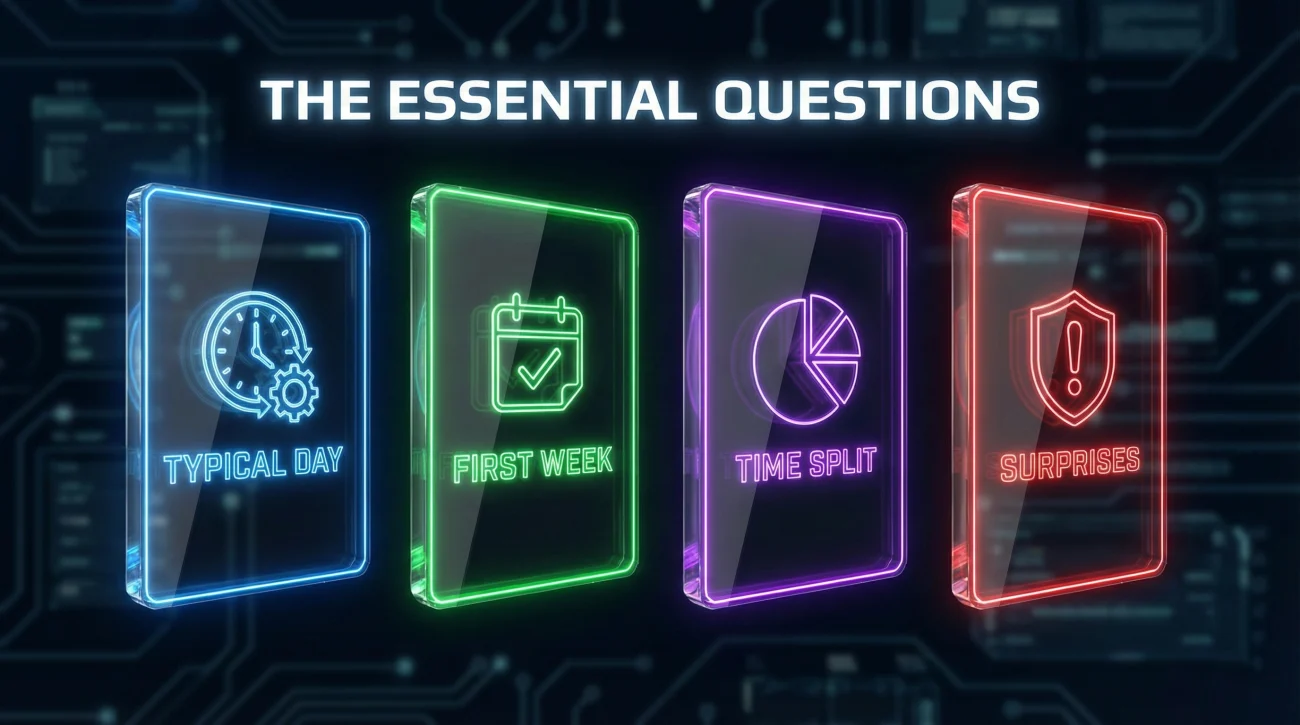
The Essential Questions
The Typical Day Question
“Can you walk me through what a typical day or week looks like in this role?”
This open-ended question invites the hiring manager to describe the actual rhythm of the work. Listen for specifics: meeting schedules, collaboration patterns, independent work time, and how priorities typically shift throughout the day.
Good answers include concrete details. “You’d probably spend your mornings on X, have a standing team meeting at noon, and use afternoons for Y.” Vague answers suggest they haven’t thought carefully about how the role actually functions.
The First Week Question
“What would my first week look like? What would I be working on right away?”
This reveals whether they have a plan for onboarding or expect you to figure it out yourself. It also hints at the immediate challenges you’d face. If they can describe your first week specifically, they’ve thought about the transition. If they can’t, expect a chaotic start.
The Time Split Question
“Roughly what percentage of time goes to meetings versus independent work? To strategic work versus tactical execution?”
Some roles are meeting-heavy by nature. Others allow long stretches of focused work. Neither is objectively better, but your preference matters enormously for job satisfaction. Get specific numbers rather than accepting “it varies.”
The Surprise Question
“What aspects of the day-to-day work might surprise someone who’s only read the job description?”
This directly invites them to share the hidden elements. Good hiring managers will be honest about the less glamorous parts of the role. Evasive answers suggest either they don’t know or they’re hiding something.
Decoding the Answers
What you hear tells you more than the literal content of their response.
| What They Say | What It Might Mean |
|---|---|
| “Every day is different!” | Chaotic environment, unclear priorities, or they haven’t thought about this |
| Very detailed, specific description | Structured environment, clear expectations, thought-through role |
| “You’ll figure it out as you go” | Sink-or-swim culture, limited onboarding support |
| Heavy meeting schedule described | Collaborative but potentially meeting-heavy culture |
| “Depends on what fires are burning” | Reactive rather than proactive environment |
None of these answers are automatically bad. What matters is whether the reality matches what you want. If you thrive in chaos, “every day is different” might be exactly right. If you need structure, it’s a warning sign.
Follow-Up Questions That Dig Deeper
After hearing their initial response, push for more specifics where needed.
On Meetings
- “What recurring meetings would I be expected to attend?”
- “How much of the meeting time involves presenting versus listening?”
- “Are there any meetings you think are unnecessary but happen anyway?”
On Collaboration
- “Which teams would I work with most closely?”
- “How do handoffs typically work between those teams?”
- “What does communication look like outside of meetings?”
On Focus Time
- “Would I have blocks of uninterrupted time for deep work?”
- “Is there a culture around protecting focus time?”
- “Where do people typically work when they need to concentrate?”
For more strategies on getting honest answers from interviewers, see our complete guide to interview questions.
Remote and Hybrid Considerations
If the role involves remote or hybrid work, daily rhythms become even more important to understand.
Synchronous vs. Asynchronous
“How much of the work happens in real-time meetings versus asynchronous communication?”
Remote roles can range from constant video calls to almost entirely async work with occasional check-ins. Your preference matters, and this varies wildly between companies.
Schedule Flexibility
“Is there flexibility in when I work, or are there core hours when everyone needs to be available?”
Some remote roles are genuinely flexible. Others require you to be online during specific hours regardless of your time zone or preference. Understand which before you commit.
In-Office Expectations
For hybrid roles:
“What typically happens on in-office days? Are they structured or just coworking?”
Some companies use office days for collaboration and meetings. Others just want bodies in seats. The answer affects how valuable those commute days actually are.
Adjusting for Role Level
Entry Level
Focus on learning opportunities and supervision: “How much guidance would I receive in my first few months? Who would I go to with questions?”
Mid Level
Balance between direction and autonomy: “How much of the work would I own independently versus collaborate on with senior team members?”
Senior Level
Strategic versus tactical split: “What percentage of my time would be spent on strategy and planning versus execution and delivery?”
Management
People versus projects: “How much of my time would go to managing people versus doing the actual work of the function?”
Warning Signs in Their Answers

Excessive Vagueness
If someone who should know the role well can’t describe a typical day, they either haven’t thought about it or don’t want to tell you. Neither is reassuring. A hiring manager should have clear expectations for what you’d be doing.
Constant Crisis Mode
Descriptions heavy on “putting out fires” and “handling whatever comes up” suggest reactive rather than proactive work environments. Some people thrive in chaos; others find it exhausting. Know which you are.
Meeting Overload
If the described day is mostly meetings with little time for actual work, that’s the job. You’ll spend your time in rooms with other people rather than executing independently. For some roles this makes sense; for others it’s a sign of organizational dysfunction.
Disconnect from Job Description
If the described daily activities barely overlap with the advertised responsibilities, something is off. Either the job description is aspirational, or the role has evolved significantly since it was written. Clarify which reality you’d be entering.
❓ FAQ
🎯 When in the interview should I ask these questions?
These work well toward the end of interviews when you’re given time for questions, or during conversations with potential direct managers. Save them for people who actually know the role’s day-to-day reality rather than HR screeners.
💼 What if they can’t describe a typical day?
This is information worth having. It might mean the role is genuinely variable, or it might mean they haven’t thought clearly about what they need. Ask follow-up questions to distinguish between intentional flexibility and organizational confusion.
⏰ How detailed should I expect their answer to be?
A good hiring manager should be able to describe at least the general rhythm of the role. They don’t need an hour-by-hour breakdown, but they should know what major activities fill the time and roughly how time is distributed.
📋 Should I take notes during their answer?
Yes, if you can do so without breaking eye contact for long stretches. What they describe is important information for your decision. Write down specifics you want to remember or follow up on later.
✨ What if the described day sounds terrible to me?
That’s exactly why you ask. Better to discover the role isn’t right for you now than after you’ve accepted. Trust your reaction. If the described daily experience sounds miserable, it probably will be.
Know Before You Go
The right questions about daily responsibilities reveal what your life would actually look like in this role. Job descriptions paint with broad strokes. Hiring managers can fill in the details if you ask the right questions. Learn the rhythm of the work, the meeting load, the collaboration patterns, and the hidden time sinks before you commit. A job that sounds perfect in abstract terms can feel wrong in practice if the daily reality doesn’t match how you work best.
⚠️ Disclaimer: The interview strategies, sample answers, and negotiation tips provided in this guide are for educational purposes only. Hiring decisions are subjective and vary by company and industry. While these strategies are based on professional HR standards, they do not guarantee a specific job offer or result.