What Scrum Master Interviews Test
Scrum Master interviews test facilitation skills and servant leadership philosophy over process enforcement. Companies probe how you facilitate Scrum ceremonies keeping teams focused, remove impediments blocking progress, coach teams embracing Agile principles, resolve conflicts maintaining collaboration, and enable self-organization without micromanagement. This article covers fundamentals tested in scrum master interview questions: Scrum framework understanding, ceremony facilitation techniques, servant leadership approach, conflict resolution strategies, and team coaching methods.
You’ll learn how to explain Scrum roles and artifacts, facilitate effective sprint ceremonies, demonstrate servant leadership distinguishing from traditional management, handle team conflicts constructively, and coach teams toward continuous improvement. Understanding technical interview fundamentals helps, but this focuses on Agile coaching and team dynamics applicable across industries implementing Scrum frameworks.
Scrum Framework and Roles
Mastering Agile ceremonies facilitation requires understanding Scrum framework components and their purposes.
Scrum Fundamentals
Q: Explain the Scrum framework and its key components.
Scrum is Agile framework for iterative product development. Three roles: Product Owner (defines what to build, prioritizes backlog), Scrum Master (facilitates process, removes impediments), Development Team (builds product increment). Five events (ceremonies): Sprint (1-4 week iteration), Sprint Planning (select work for sprint), Daily Scrum (15-minute sync), Sprint Review (demonstrate increment), Sprint Retrospective (reflect and improve). Three artifacts: Product Backlog (prioritized features), Sprint Backlog (selected work), Product Increment (potentially shippable deliverable). Scrum values: commitment, courage, focus, openness, respect. Framework enables transparency, inspection, adaptation.
Q: What is the role of a Scrum Master?
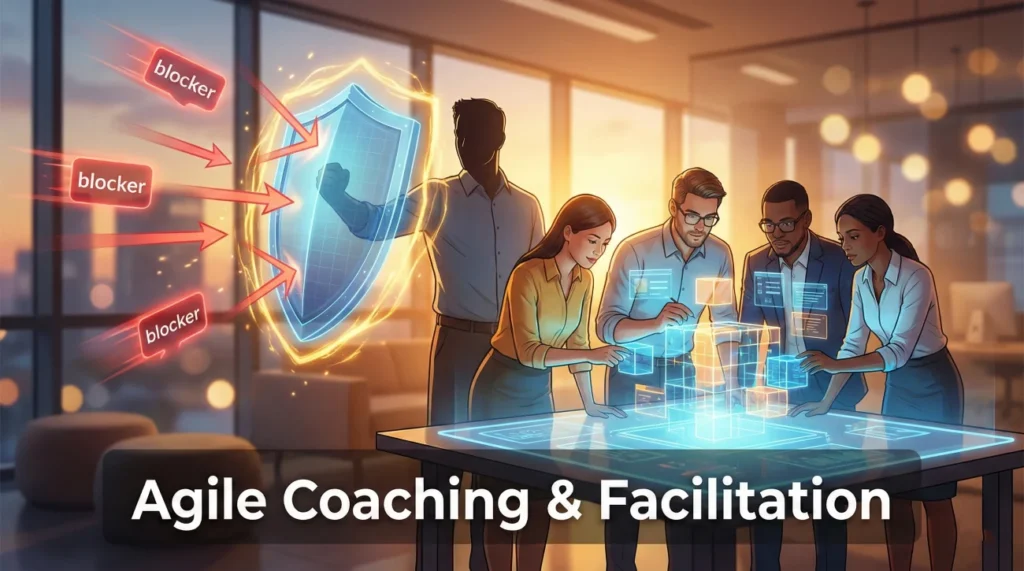
Scrum Master serves as servant-leader, not project manager. Facilitates Scrum events ensuring effectiveness. Removes impediments blocking team progress (technical issues, organizational barriers, resource constraints). Coaches team on Agile principles and self-organization. Protects team from external interruptions and scope changes during sprint. Helps Product Owner with backlog management. Guides organization in Scrum adoption. Does NOT: assign tasks, manage people, make technical decisions, control resources. Success measured by team’s ability to self-organize, not direct control. Think: gardener creating conditions for growth, not factory manager controlling output.
Q: How does Scrum Master differ from Project Manager?
Project Manager: controls scope, schedule, budget, assigns tasks, manages people, reports status, makes decisions. Authority-based role. Scrum Master: facilitates process, removes impediments, coaches team, enables self-organization, servant-leadership. Influence-based role. PM focuses on delivering project on time/budget. SM focuses on team effectiveness and continuous improvement. PM traditional command-and-control. SM empowers team to make decisions. Both valuable but fundamentally different philosophies. Scrum teams self-organize: team decides how to accomplish work. Some organizations combine roles but requires mindset shift from PM to SM approach.
Q: What are Scrum values and why do they matter?
Five Scrum values: Commitment (team commits to Sprint Goal), Courage (address difficult problems, speak truth), Focus (concentrate on sprint work), Openness (transparent about progress and challenges), Respect (trust each other’s capabilities). Values foundation for Scrum framework success. Without values: ceremonies become bureaucratic rituals, self-organization fails, collaboration suffers. Scrum Master models values and coaches team. Example: courage means raising impediments early, not hiding problems. Openness means admitting when estimates wrong. Respect means valuing different perspectives in retrospectives. Values create psychological safety enabling high performance.
Facilitating Scrum Ceremonies
Effective sprint planning techniques and ceremony facilitation keep teams focused and productive.
Ceremony Best Practices
Q: How do you facilitate an effective Sprint Planning meeting?
Sprint Planning timeboxed to 8 hours for 4-week sprint (proportionally shorter for shorter sprints). Two parts: Part 1 – What can be done (Product Owner presents prioritized backlog, team asks questions, team selects work achieving Sprint Goal). Part 2 – How work gets done (team breaks stories into tasks, identifies dependencies, commits to Sprint Backlog).
Facilitation techniques: ensure Product Owner prepared (refined backlog, clear priorities), keep discussions focused (table unrelated topics), protect team from overcommitment (use velocity/capacity), visualize work (board, burndown chart), achieve team consensus on Sprint Goal. Red flags: rushed planning (leads to unclear goals), Product Owner absent (team lacks clarity), no clear Sprint Goal (team unfocused). Outcome: Sprint Backlog team commits to, clear Sprint Goal everyone understands.
Q: What makes a Daily Scrum effective?
Daily Scrum (stand-up) 15-minute timebox, same time/place daily. Three questions: What did I complete yesterday? What will I complete today? What impediments block me? Purpose: synchronize team, identify blockers, NOT status report to Scrum Master. Team self-organizes around obstacles.
Common problems: meetings run long (enforce timebox, table detailed discussions), turns into status report (remind purpose: team coordination), people arrive late (start exactly on time regardless), side conversations (parking lot for follow-up). Scrum Master role: facilitate, observe patterns, note impediments, NOT lead meeting (team owns Daily Scrum). Some teams modify format: “what’s our progress toward Sprint Goal?” Focus on collaboration, not individual accountability.
Q: How do you run Sprint Retrospective for continuous improvement?
Retrospective occurs after Sprint Review, before next Planning. Timeboxed 3 hours for 4-week sprint. Team reflects: what went well, what needs improvement, what actions to take. Create safe environment: respect, openness, no blame. Retrospective Prime Directive: “everyone did best job possible given circumstances.”
Facilitation techniques: vary formats (avoid routine: Start-Stop-Continue, Mad-Sad-Glad, sailboat metaphor), focus on actionable improvements (not venting), limit action items (2-3 max, team can actually implement), track previous actions (accountability), celebrate successes (not just problems). Anti-patterns: skipping retrospectives (miss improvement opportunities), no actions taken (team loses trust), Scrum Master dominates (should facilitate, not dictate). Output: concrete improvement actions for next sprint.
Q: What’s the purpose of Sprint Review?
Sprint Review demonstrates completed increment to stakeholders. Timeboxed 4 hours for 4-week sprint. Team shows working software (not slides), stakeholders provide feedback, Product Owner discusses backlog changes, entire group collaborates on what to do next. Informal meeting fostering collaboration. NOT: formal status meeting, demo of incomplete work, approval gate. Scrum Master ensures: stakeholders invited and attend, team prepared, time managed, feedback captured. Outcome: updated Product Backlog reflecting stakeholder input, transparency about progress, stakeholder engagement in product direction.
Servant Leadership Philosophy
Practicing servant leadership scrum means empowering teams rather than controlling them.
Servant Leadership in Practice
Q: What does servant leadership mean for a Scrum Master?
Servant leadership prioritizes serving team over wielding authority. Scrum Master serves three groups: Development Team (remove impediments, coach, facilitate), Product Owner (backlog management, stakeholder collaboration), Organization (Scrum adoption, culture change). Leadership through influence, not control. Focus: how can I help team succeed? Not: how do I make team do what I want? Examples: developer blocked by slow build times – SM works with infrastructure to improve tools. Team conflicts with another department – SM facilitates communication. Product Owner overwhelmed – SM coaches on backlog refinement techniques. Success when team self-sufficient, not dependent on Scrum Master.
Q: How do you enable team self-organization?
Self-organization means team decides how to accomplish work without being told. Scrum Master creates conditions: psychological safety (safe to take risks, admit mistakes), clear goals (team understands Sprint Goal), appropriate autonomy (team controls their process), necessary resources (tools, training, time). Avoid: assigning tasks (let team volunteer), solving problems for team (coach them to solve), making decisions team should make. Guide with questions: “What are our options?” “What blockers exist?” “How might we improve?” Patience required: self-organization develops over time. Initial struggles normal. Resist urge to step in and direct. Team learns by doing.
Q: How do you remove impediments effectively?
Impediments block team progress: technical (slow builds, infrastructure), organizational (bureaucracy, dependencies), interpersonal (conflicts, communication). Scrum Master identifies (Daily Scrum, observation), prioritizes (impact on Sprint Goal), resolves. Some impediments team can handle – coach them. Others require Scrum Master intervention: organizational barriers, cross-team dependencies, resource allocation. Track impediments visibly (board, list), communicate regularly on status, escalate when stuck. Example: team needs database access – SM navigates approval process. Team debates technical approach – SM facilitates discussion but team decides. Don’t become blocker by trying to solve everything personally – delegate when appropriate.
Q: How do you coach teams in Agile principles?
Coaching happens through: facilitation (ask questions, don’t lecture), modeling (demonstrate Scrum values), teaching (workshops on Agile concepts), feedback (observations on team dynamics). Focus areas: empiricism (decisions based on observation), self-organization (team autonomy), continuous improvement (inspect and adapt). Techniques: Socratic method (questions prompting reflection – “Why do you think that happened?”), observations (“I noticed during retrospective…”), experiments (try approach for one sprint, evaluate). Avoid: being “Scrum police” (enforcing rules rigidly), telling team “right way” (coach discovery), doing work for them (building capability). Measure success: team’s Agile understanding grows, team self-corrects, team improves independently.
Conflict Resolution and Team Dynamics
Handling conflict resolution agile teams maintains collaboration and psychological safety.
Resolving Team Conflicts
How do you handle conflicts within the team?
Healthy conflict normal and productive (different perspectives improve solutions). Destructive conflict damages collaboration and morale. Address conflicts early before escalation. Approach: private conversation understanding both sides, facilitate discussion between parties (neutral mediator), focus on shared goals (Sprint Goal, team success), encourage empathy (understand other’s perspective), identify root cause (often miscommunication or unclear expectations).
Techniques: active listening (truly hear concerns), reframe (find common ground), retrospective format (structured discussion), team agreements (define collaboration norms). Example: developers disagree on architecture – facilitate technical discussion focusing on trade-offs, team decides based on criteria. Personality conflict – one-on-one coaching emphasizing respect, possibly mediate direct conversation. Preventive measures: establish team working agreements, build trust through team building, model respectful disagreement.
What do you do when team members resist Agile practices?
Resistance signals: skipping ceremonies, ignoring practices, vocal criticism, passive compliance without engagement. Understand root causes: lack of understanding (education needed), bad past experiences (address concerns), conflicting priorities (organizational alignment), comfort with status quo (change management). Approach: empathy first (listen to concerns), educate on benefits (why practices exist), start small (don’t force everything immediately), demonstrate value (quick wins building trust).
Example: developer thinks Daily Scrum waste of time – ask what they’d improve, try modified format, show how it helped unblock someone. Team resistant to estimation – explain purpose (capacity planning, not performance measurement), involve them in choosing technique. Organization resists Agile – educate leadership on benefits, pilot with willing team, share success metrics. Patience essential: mindset change takes time. Some resistance healthy – teams should adapt Scrum to their context, not follow blindly.
How do you deal with difficult stakeholders?
Difficult stakeholder patterns: constant interruptions (breaking sprint focus), unrealistic demands (ignoring team capacity), micromanagement (undermining self-organization), last-minute changes (destabilizing sprints). Strategies: set clear boundaries (sprint commitment sacred, changes wait for next sprint), educate on Scrum (explain why practices exist), involve appropriately (Sprint Review for feedback, not Daily Scrum), collaborate with Product Owner (stakeholder management their responsibility, SM supports).
Example: executive demanding feature mid-sprint – respectfully explain Sprint Backlog commitment, offer to discuss for next sprint, involve Product Owner in priority conversation. Stakeholder skips Sprint Reviews then complains – emphasize Review importance for alignment, personally invite and remind. Multiple stakeholders conflicting directions – facilitate prioritization session with Product Owner leading. Build relationships: understand stakeholder concerns, show how Scrum benefits them (transparency, faster feedback), celebrate successes together.
Scrum Master Quiz
20 Practice Questions
1. What is the maximum duration of a Daily Scrum?
- 30 minutes
- 15 minutes
- 10 minutes
- No time limit
2. Who owns the Sprint Backlog?
- Product Owner
- Scrum Master
- Development Team
- Stakeholders
3. What is servant leadership?
- Managing team tasks
- Serving team by removing impediments and coaching
- Reporting to management
- Controlling project scope
4. How long should Sprint Planning be for a 2-week sprint?
- 2 hours
- 4 hours
- 8 hours
- 1 hour
5. What are the Scrum values?
- Speed, quality, cost, time, scope
- Commitment, courage, focus, openness, respect
- Planning, executing, monitoring, closing
- Efficiency, effectiveness, collaboration
6. When does Sprint Retrospective occur?
- Before Sprint Planning
- During Daily Scrum
- After Sprint Review, before next Planning
- Middle of sprint
7. What is the purpose of Daily Scrum?
- Status report to Scrum Master
- Team synchronization and impediment identification
- Planning tomorrow’s work
- Code review
8. Who should attend Sprint Review?
- Only Development Team
- Scrum Team and stakeholders
- Only Product Owner
- Management only
9. How does Scrum Master differ from Project Manager?
- Same role, different title
- SM facilitates and coaches, PM controls and directs
- SM manages budget, PM manages people
- No difference
10. What should you do when stakeholder requests mid-sprint change?
- Accept immediately
- Explain Sprint Backlog commitment, discuss for next sprint
- Reject without discussion
- Cancel current sprint
11. Maximum recommended sprint length?
- 2 weeks
- 4 weeks (1 month)
- 6 weeks
- 8 weeks
12. What defines self-organization?
- Team chooses vacation days
- Team decides how to accomplish sprint work
- Team hires new members
- Team sets product vision
13. Product Owner responsibility?
- Assign tasks to developers
- Maximize product value, prioritize backlog
- Remove impediments
- Facilitate ceremonies
14. How many action items from Retrospective?
- As many as identified
- 2-3 actionable improvements team can implement
- Minimum 10
- One per team member
15. What is an impediment?
- Complex user story
- Obstacle blocking team progress
- Technical debt
- Low velocity
16. Three Scrum artifacts?
- Requirements, design, code
- Product Backlog, Sprint Backlog, Increment
- Burndown, velocity, capacity
- Plan, track, report
17. What is Sprint Goal?
- Complete all stories
- Objective providing coherence to sprint work
- Individual task assignments
- Velocity target
18. How to handle team member not participating in ceremonies?
- Force attendance
- One-on-one coaching to understand and address concerns
- Ignore it
- Report to management
19. Who can cancel a Sprint?
- Scrum Master
- Product Owner
- Development Team
- Stakeholders
20. What makes a good Sprint Retrospective?
- Long list of problems identified
- Safe environment, actionable improvements, team commitment
- Scrum Master presenting solutions
- Blaming individuals for failures
❓ FAQ
🎯 Do I need technical background to be a Scrum Master?
Technical understanding helps but not required. More important: facilitation skills, coaching ability, conflict resolution, Agile mindset. Technical Scrum Masters understand development challenges better but non-technical backgrounds succeed through strong people skills. Focus on servant leadership, team dynamics, organizational change. Can learn sufficient technical context on job.
💼 Is Scrum Master certification necessary?
Certifications (CSM, PSM) validate foundational knowledge and improve resume visibility. Many organizations require or prefer certification. However, certification alone insufficient – practical experience facilitating teams, handling conflicts, coaching matters equally. Prepare for interviews: study Scrum Guide thoroughly, practice behavioral examples, understand servant leadership philosophy beyond certification curriculum.
⏰ How do I demonstrate servant leadership in interviews?
Use SOAR method: Situation, Obstacles, Actions, Results. Share examples where you empowered team rather than directed: “Team struggled with estimates. Instead of setting deadlines, I coached them on story points, facilitated estimation sessions, they improved accuracy.” Emphasize removing impediments, asking questions versus giving answers, celebrating team successes. Avoid phrases suggesting control: “I made team do X.”
📋 What if I haven’t been Scrum Master professionally?
Leverage transferable experiences: facilitating meetings, coaching colleagues, resolving conflicts, managing change. Volunteer as Scrum Master on small projects or open source teams. Study real-world cases, practice facilitation techniques. In interviews, acknowledge limited Scrum Master experience but demonstrate understanding of principles, facilitation skills, servant leadership mindset. Enthusiasm and learning orientation matter.
✨ How important are metrics for Scrum Masters?
Understand common metrics: velocity (work completed per sprint), burndown charts (remaining work), cycle time, team happiness. Use metrics to facilitate conversations, identify improvement areas, not judge team performance. Avoid: velocity as productivity measure (encourages gaming), comparing teams (different contexts), individual metrics (undermines collaboration). Focus on trends, impediments, flow improvements.
Final Thoughts
Modern scrum master interview questions test facilitation skills and servant leadership over process enforcement. Master Scrum framework understanding roles and artifacts clearly, ceremony facilitation techniques keeping teams focused and productive, servant leadership philosophy empowering self-organization, conflict resolution strategies maintaining collaboration, and team coaching methods building Agile capability. Success requires practicing facilitation where you guide teams without controlling them, remove impediments enabling progress, coach through questions not directives, handle conflicts constructively, and demonstrate servant leadership distinguishing Scrum Master from traditional management applicable across industries adopting Agile methodologies.
⚠️ Disclaimer: The interview strategies, sample answers, and negotiation tips provided in this guide are for educational purposes only. Hiring decisions are subjective and vary by company and industry. While these strategies are based on professional HR standards, they do not guarantee a specific job offer or result.