The Counter Between the Wrench and the Wallet
A service advisor lives in the middle of a tense triangle: the customer wants certainty, the technician wants time, and the shop needs decisions. That is why service advisor interview questions focus on more than car knowledge. They test whether you can earn trust fast, translate tech notes into plain English, and keep the day moving when the service drive is packed.
In the real world, problems rarely arrive neatly labeled. A customer comes in for a quick oil change and leaves with a warning light, a recall, and a quote that feels like a punch. Interviewers want to hear how you control the conversation without sounding pushy, how you communicate delays before anger builds, and how you protect integrity when the numbers get uncomfortable.
This guide helps you answer like someone who has worked the lane: clean walk-arounds, honest recommendations, and proactive updates that keep CSI strong. If you can explain your process with calm confidence, you will stand out as the person who makes chaos feel organized.
Diagnostics & Technical Translation
Q: How do you explain a complex repair to a customer who knows nothing about cars?
I use analogies. If a customer needs a new timing belt, I don’t just talk about valves and pistons. I say, “Think of the timing belt like the chain on a bicycle. If it snaps while you are riding, the pedals spin but the wheels stop, and it can damage the whole bike frame. It’s cheaper to replace the chain before it breaks than to fix the bike after.”
I avoid jargon. Instead of “OEM specs,” I say “factory-original parts.” I show them the old part if possible, or use a diagram. My goal is to educate them so they feel empowered to say yes, not pressured.
Q: A technician recommends a repair, but you doubt it’s necessary. What do you do?
I verify before I sell. I go into the bay and ask the technician to show me the failure (e.g., the leak or the play in the wheel). I ask, “Is this a safety issue right now, or something to watch for next time?”
I protect my credibility with the customer. If I sell a repair that turns out to be unnecessary, I lose that customer for life. I build a relationship with my techs where I respect their expertise but verify the “Why” so I can explain it confidently.
Q: How do you handle the “Ever Since You…” customer?
This is the customer who says, “Ever since you changed my oil, my radio doesn’t work.” I listen without getting defensive. I explain, “I understand it feels connected, and that is frustrating.”
I offer a free diagnostic check to see if there is a correlation. Usually, there isn’t, but by offering to look, I show I stand behind our work. If it is our fault, we fix it for free. If it’s a coincidence, I explain the technical separation clearly but kindly.
Q: How do you prioritize repairs for a customer on a tight budget?
I use the “Red/Yellow/Green” system. Red is Safety/Immediate (brakes, tires). Yellow is Maintenance/Future (fluid flush, filters). Green is Cosmetic/Optional.
I tell them, “Mrs. Smith, the brakes are a safety issue, so we must do those today. The transmission flush is important, but we can wait until your next oil change if that helps your budget.” This builds trust because I am helping them manage their money, not just emptying their wallet.
Customer Experience & CSI Scores
Q: What is CSI and why does it matter?
CSI (Customer Satisfaction Index) is the report card from the manufacturer. It determines the dealership’s bonus money and allocation of inventory. For me, it is a measure of my professional integrity.
High CSI means customers trust me and will return. I manage CSI by setting realistic expectations upfront. It is better to under-promise on time and over-deliver than to promise a 2 PM pickup and miss it.
Q: How do you conduct an “Active Walk-Around”?
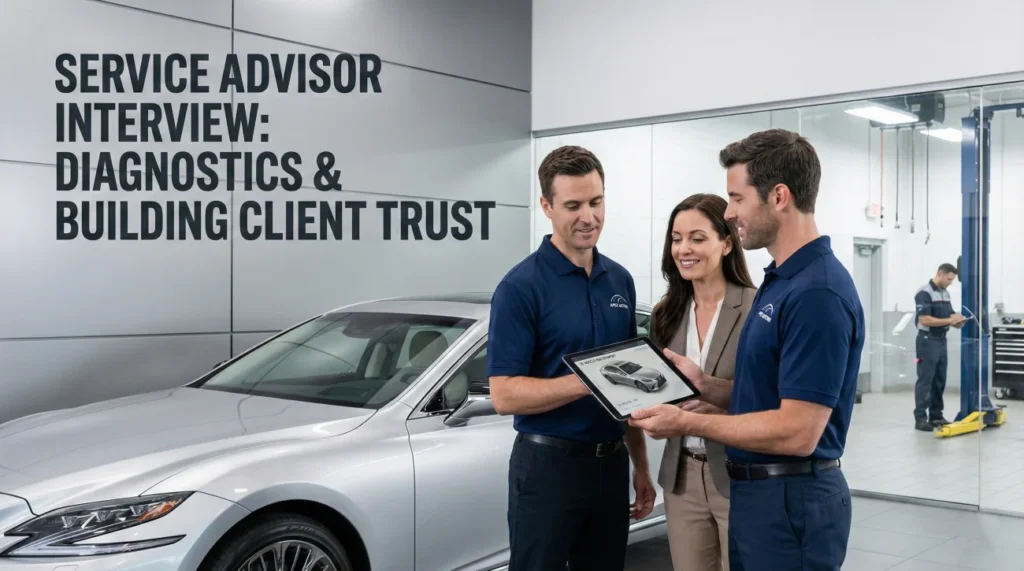
I meet the customer at their car, not at my desk. I walk around the vehicle with them, checking for body damage, tire tread depth, and wiper blade condition before we write the repair order.
This does two things: it identifies upsell opportunities visually (like a bald tire) and it protects the dealership from false damage claims later. It shows the customer I am attentive to detail.
Q: A customer is screaming because their car isn’t ready on time.
I take the heat. I don’t blame the tech or the parts department. I say, “I apologize. I dropped the ball on updating you. The part was delayed, and I should have called you sooner.”
I offer a solution immediately: a loaner car, a ride share, or a discount on the bill. I focus on what I can do now to fix the inconvenience. Most anger comes from lack of communication, not the delay itself.
Q: How do you sell preventative maintenance without being pushy?
I frame it as “Insurance.” I explain, “Changing your transmission fluid now costs $200. Replacing a transmission later costs $4,000. It’s like going to the dentist; cleaning is cheaper than a root canal.”
I rely on the manufacturer’s maintenance schedule, not my opinion. “Toyota recommends this at 30,000 miles to keep your warranty valid.” This makes the manufacturer the authority, removing the pressure from me.
Q: How do you handle a warranty dispute?
I act as the customer’s advocate with the warranty company. I gather all the evidence – photos, diagnostic logs, service records.
If the claim is denied (e.g., due to outside influence like hitting a pothole), I explain it clearly to the customer. “The warranty covers defects, not damage. Unfortunately, the bent rim is considered damage.” I try to find a coupon or alternative part to lower the cost for them.
Q: How do you ensure you don’t miss any customer updates?
I live by my status list. I check the status of every car on my RO (Repair Order) list every 2 hours. I have a policy: “No customer calls me.”
I call them first. Even if there is no news, I call to say, “We are still diagnosing it; I haven’t forgotten you.” Proactive communication prevents the angry “What is going on with my car?” phone calls that ruin CSI.
Sales & Situational Judgement
A customer declines a critical safety repair (e.g., brakes metal-on-metal).
I document it heavily. I write on the invoice: “Customer declined safety repair. Vehicle is unsafe to drive.” I ask them to sign acknowledging they were informed.
I explain, “I am worried about your safety. If you can’t do it today, please be extremely careful and get it done as soon as possible.” Sometimes seeing the “unsafe” waiver scares them into doing the repair. I protect the shop from liability while trying one last time to save the sale for their safety.
You gave a quote for $500, but the final bill is $800.
This is the cardinal sin of advising. I never let this happen. If a bolt breaks or we find more damage, I call the customer for authorization before proceeding.
If I failed to call, I have to eat the cost. I cannot charge a customer for work they didn’t authorize. I would go to my manager and say, “I messed up; we need to write off the difference.” It’s a painful lesson, but integrity is worth more than $300.
A technician is consistently slow, making you miss promise times.
I talk to the tech directly, not the manager first. “Hey, I promised Mrs. Jones her car at 4. Is there anything holding you up?”
I ask if I can help – getting parts, getting approval. If it continues, I adjust my promise times for that specific tech (padding the time). I need the tech on my side; throwing them under the bus creates a toxic shop environment where cars get fixed even slower.
Operations & Career Goals
Q: How do you handle the morning rush (7 AM – 9 AM)?
I prep the night before. I print the appointments, check for recalls, and pre-write the ROs. When the doors open, I am ready to greet, not typing data.
I acknowledge every customer within 30 seconds, even if I’m with someone else. “Good morning! I’ll be right with you.” I move the cars out of the drive quickly to keep the lane clear. Speed and organization are the only way to survive the morning wave.
Q: What is your strategy for selling tires?
Tires are the retention tool. If they buy tires elsewhere, they get their oil changed elsewhere. I check tread depth on every car.
I use the “Good, Better, Best” menu. I price match competitors because the profit isn’t in the tire; it’s in the alignment and the future visits. I explain that our tires are “OEM spec” which match the ride quality the engineers designed for the car.
Q: Why do you want to be a Service Advisor?
I love the fast pace and the problem-solving. I get satisfaction from taking a stressed customer with a broken car and turning their day around. I enjoy the technical side of cars but prefer the human interaction side of the business. I want to build a loyal client base that asks for me by name because they trust I will take care of them and their family’s safety.
Service Advisor Competency Quiz
Take the 20-Question Challenge
1. “CSI” stands for:
- Car Service Inspection
- Customer Satisfaction Index
- Customer Service Investigation
- Cost Service Invoice
2. An “RO” is a:
- Repair Option
- Repair Order (legal document authorizing work)
- Right Offer
- Return Order
3. The primary purpose of a “Walk-Around” is:
- To get exercise
- To document vehicle condition and identify sales opportunities visually
- To impress the boss
- To find lost change
4. “Upselling” in service means:
- Selling a new car
- Recommending additional legitimate maintenance or repairs beyond the initial request
- Raising the price secretly
- Selling used parts
5. A “Recall” is:
- A coupon
- A safety defect identified by the manufacturer, repaired for free
- A returned part
- Calling the customer back
6. “Labor Time” or “Book Time” refers to:
- Time to read a manual
- The standard estimated time to complete a specific repair job
- The time the shop opens
- Lunch break
7. “OEM” parts are:
- Old Equipment Manufacturer
- Original Equipment Manufacturer (Factory Parts)
- Optional Equipment Maintenance
- Over Eaten Meals
8. If a customer declines a safety repair, you should:
- Hold their keys
- Document the decline on the invoice and have them sign it
- Fix it anyway
- Call the police
9. The “Three Cs” of a repair order description are:
- Cost, Cash, Credit
- Concern, Cause, Correction
- Car, Customer, Complaint
- Check, Change, Charge
10. “Warranty Pay” vs. “Customer Pay”:
- Warranty pays more
- Warranty usually pays a lower labor rate/time than retail Customer Pay
- They are the same
- Customer Pay is free
11. A “Multi-Point Inspection” (MPI) is:
- A sales pitch
- A comprehensive health check of the vehicle’s major systems
- A test drive
- Cleaning the car
12. “Menu Pricing” helps by:
- Listing lunch options
- Providing transparent, flat-rate pricing for common services (e.g., brakes, fluids)
- Hiding the cost
- Charging by the minute
13. “Shop Supplies” charge covers:
- The advisor’s bonus
- Consumables like rags, cleaner, grease, and disposal fees
- New tools for the tech
- Electricity bill
14. To explain a “Check Engine Light,” you clarify:
- The engine is missing
- It indicates a fault code in the computer system requiring diagnosis
- The oil is low
- The gas cap is loose only
15. “Sublet” work is:
- Done by a trainee
- Work outsourced to a third party (e.g., windshield, glass, body work)
- Free work
- Work done in the parking lot
16. The most effective way to update a customer is:
- Smoke signals
- Their preferred method (Text, Call, or Email) done proactively
- Waiting for them to call
- Sending a letter
17. “Comebacks” (returns for same issue) hurt:
- Only the technician
- CSI scores, advisor credibility, and shop efficiency
- Nobody
- The sales department
18. “ELR” stands for:
- Effective Labor Rate
- Effective Labor Rate (Total Labor Sales / Billed Hours)
- Engine Light Reset
- Early Lunch Recess
19. When a part is on “Backorder,” it means:
- It is in the back of the shop
- It is out of stock nationally/regionally with a delayed ETA
- It is broken
- It is free
20. The Service Advisor’s primary goal is:
- To fix cars
- To build trust and facilitate the repair process between customer and technician
- To sell cars
- To wash cars
❓ FAQ
🛠️ Do I need to be a mechanic to be a strong service advisor?
No, but you need enough mechanical understanding to ask smart follow-up questions and explain the “why” behind a recommendation. In interviews, prove you can translate symptoms, clarify severity, and summarize repairs without hiding behind jargon.
💵 How should I talk about commission and sales without sounding shady?
Lead with ethics. Explain that you recommend based on safety, manufacturer schedules, and documented inspection findings. Then connect sales to value: reducing breakdown risk, protecting warranty requirements, and preventing repeat visits for the same issue.
⏳ What is the best way to handle delays when a part is late?
Call early, give a realistic new time, and offer options. Customers get angriest when they feel ignored, not when a delay happens. A simple proactive update and a clear plan can save the relationship.
🧾 What should a great repair order write-up include?
Clear concern details, what you observed during the walk-around, and the exact customer request. Add key context like noises, when it happens, and any warnings on the dash. Clean write-ups reduce comebacks and protect everyone when disputes happen.
😤 How do I respond to “ever since you worked on it” complaints?
Do not argue. Acknowledge the frustration, offer a quick check, and keep your tone neutral. If it is related, own it and fix it. If it is not, explain the separation clearly and show evidence so the customer feels respected instead of dismissed.
Final Thoughts
To win interviews, you do not need to sound like a walking repair manual. You need to sound like a trusted guide. Your answers to service advisor interview questions should show a repeatable rhythm: verify, explain in plain language, present options, document clearly, and update before the customer has to chase you.
When you combine calm communication with honest recommendations, you protect CSI and profit at the same time. That balance is what separates a decent advisor from the one a dealership builds its service lane around.
⚠️ Disclaimer: The interview strategies, sample answers, and negotiation tips provided in this guide are for educational purposes only. Hiring decisions are subjective and vary by company and industry. While these strategies are based on professional HR standards, they do not guarantee a specific job offer or result.