Luxury Is Felt Before It Is Bought
luxury sales associate interview questions are built to detect one thing: can you create an experience that feels effortless while still protecting the brand, the product, and the sale. In high-end retail, people do not come in only for an item. They come in for certainty, for taste, for the feeling that the decision is already correct.
That is why interviews lean into situations, not slogans. How do you host a VIP while the floor is busy? How do you guide an aspirational shopper with dignity, not judgment? How do you hold the line on pricing without sounding defensive? The best answers show calm control, discreet clienteling habits, and storytelling that connects craftsmanship to value.
This guide helps you speak like a true brand ambassador: refined service, strong follow-up, and the discipline to keep standards high all day.
The Art of Clienteling & Relationship Building
Q: Define “Clienteling” and give an example of how you do it.
Clienteling is the proactive management of customer relationships to drive long-term loyalty. It is moving beyond “May I help you?” to “I saw this and thought of you.” For example, if a client buys a winter coat, I make a note in the CRM.
Six months later, when the matching gloves arrive for the new season, I text them a personalized photo: “These just arrived and would look perfect with the coat you bought last fall.” It shows I remember them and value their style, turning a past transaction into a future opportunity.
Q: How do you build a “Client Book” from scratch?
I treat every walk-in as a potential VIP. I engage in genuine conversation to find connection points (travel, pets, hobbies). I always ask for contact information naturally: “I’d love to send you a lookbook of the new collection launching next month.”
I also leverage my network and follow up religiously. After a purchase, I send a handwritten thank-you note (not an email). In luxury, the personal touch is the differentiator. I aim to capture data on 80% of my transactions to ensure I have a pool of people to contact during quiet periods.
Q: How do you handle a client who has “ghosted” you?
I don’t take it personally, but I persist gently. I change the channel; if they ignore emails, I try a text (if opted in) or a physical card. I change the content; instead of “Buy this,” I send “Happy Birthday” or “Saw this article about [their interest].”
I use the “soft touch” approach. I might say, “No pressure to buy, but I just wanted you to be the first to see this rare piece.” If they still don’t respond after 3 attempts, I rest the relationship for a few months to avoid being a nuisance, but I keep them on the holiday list.
Q: What information do you record in your CRM after a sale?
Beyond the purchase history, I record the “Human Data.” What is their partner’s name? When is their anniversary? Do they prefer silver or gold? Did they mention a vacation to Italy?
Knowing these details allows me to be a consultant, not a clerk. Next time they come in, asking “How was Italy?” builds immediate rapport and proves they are more than just a credit card number to me.
Brand Storytelling & The Ceremony of Selling
Q: How do you justify the high price point of a luxury item?
I pivot from price to Value and Heritage. I explain the craftsmanship: “This bag takes a single artisan 40 hours to stitch by hand.” I explain the materials: “We use full-grain leather from a specific tannery in France.”
I tell the story of the brand’s history. When clients understand the labor and legacy behind the object, the price becomes a reflection of artistry, not just a markup. I sell it as an investment piece that lasts generations.
Q: Describe the “Ceremony of Selling” for a high-end product.
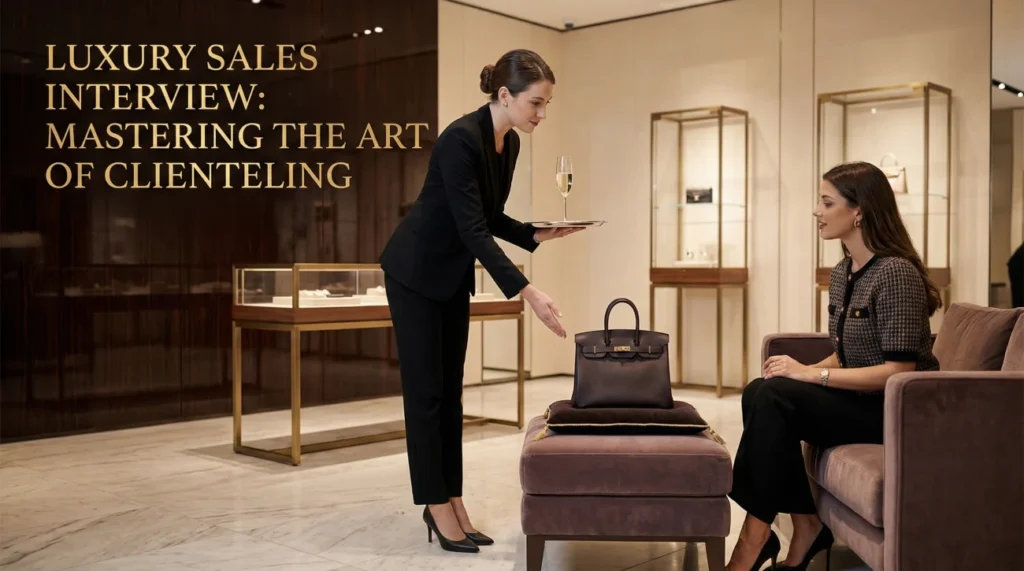
I treat the product with reverence. I use gloves if appropriate (watches/jewelry). I present the item on a velvet tray, never just handing it over the counter.
I invite the client to sit. I offer a beverage (champagne/espresso). I unwrap the packaging slowly to build anticipation. Every movement should communicate that this object is precious. By elevating the ritual, I elevate the perceived value of the product.
Q: How do you handle a client comparing your brand to a competitor?
I never disparage the competition; that is low-class. I acknowledge them: “Yes, Brand X makes lovely shoes.” Then I pivot back to our Unique Selling Proposition (USP).
“However, what sets our shoe apart is the patented arch support and the fact that we own our own factories, ensuring ethical control.” I focus on what we do best, allowing the client to draw their own conclusion that our quality is superior.
Q: How do you sell to an “Aspirational” shopper who may not afford it yet?
I treat them with the same respect as a billionaire. Today’s window shopper is tomorrow’s CEO. I give them the full tour and story.
I might guide them to “entry-level” luxury items (like a wallet, perfume, or scarf) to let them buy into the brand universe without breaking the bank. Creating a positive memory now ensures that when they do have the money, they will come back to me.
Q: What do you do if you don’t have the specific item a client wants?
I never say “No, we don’t have it” and stop there. I say, “That piece is currently unavailable, but let me check our global inventory to see if I can transfer it for you.”
While I search, I present alternatives: “While I look, have you seen this new arrival? It has a similar silhouette but features our new hardware.” I try to bridge the gap or secure a pre-order. The goal is to keep the conversation going.
Q: How do you stay updated on fashion trends and brand knowledge?
I study. I read Vogue, WWD, and Business of Fashion daily. I memorize the lookbooks for the current season.
I need to know not just what we are selling, but what the client is seeing on the runway and on social media. If a client mentions a “micro-trend,” I need to speak their language. Being a trusted advisor means being an expert in the industry, not just the store.
Handling Difficult VIPs & Situations
A VIP client enters while you are helping a new walk-in customer.
This is a delicate juggling act. I acknowledge the VIP immediately with eye contact and a warm smile (“Mrs. Smith, so good to see you!”). I do not abandon the current customer abruptly.
I ask a colleague to offer the VIP a drink and seat them in a private area. I finish my thought with the current customer and ask for a moment to hand the VIP off to a senior colleague, or I ask the current customer’s permission: “Do you mind if I just say hello quickly?” Ideally, I get a teammate to take over one of the interactions smoothly.
A client’s credit card is declined.
I handle this with extreme discretion. I never say “Declined” loudly. I whisper or write it down. I normalize it: “It looks like the bank might have put a security hold on this due to the amount; this happens all the time with large purchases.”
I offer to let them use a phone to call the bank in private, or ask if they have another card. My goal is to save face for the client so they don’t feel embarrassed, which would kill the sale and the relationship.
A customer wants a discount, but your brand never goes on sale.
I stand firm on brand integrity. “We don’t offer discounts because we believe in maintaining the value of the piece for our collectors. You can be confident that the price you pay today is the true value.”
I might offer a “value-add” instead if authorized, like free monogramming, complimentary shipping, or a gift with purchase (e.g., leather care kit). I explain that luxury pricing ensures fair wages for the artisans, reinforcing the quality narrative.
Metrics & Professionalism
Q: What KPIs (Key Performance Indicators) are you used to tracking?
I track my UPT (Units Per Transaction), ADS (Average Dollar Sale), and Conversion Rate. In luxury, ADS is critical. I also track my “Data Capture Rate” (getting client emails/numbers).
I set personal goals daily. If my traffic is low, I focus on outreach (calls/emails) to drive appointments. I view my sales targets as a floor, not a ceiling, and I analyze my numbers weekly to see where I need to improve (e.g., selling more accessories to boost UPT).
Q: How do you maintain energy and poise during a slow day?
In luxury, there is always work to be done. If there are no clients, I am “working the book” – contacting clients. I am restaging the visual merchandising to ensure perfection.
I am role-playing selling scenarios with colleagues or studying the product manuals. I maintain an alert, welcoming posture (never leaning or on my phone) because a VIP could walk in at any second. My professionalism doesn’t depend on the crowd size.
Q: Describe your personal style and grooming standards.
I believe I am part of the store’s visual presentation. I adhere strictly to the dress code (usually black/neutral, tailored). I ensure my grooming is impeccable – neat hair, clean nails (essential for showing jewelry/watches), and polished shoes.
I wear the brand’s products if I own them, or neutral styles that complement the collection. I understand that clients judge the brand by looking at me, so I must reflect the elegance I am selling.
Q: Why do you want to work for [Brand Name] specifically?
I admire [Brand Name]’s commitment to [Specific Value, e.g., sustainability, timeless design]. I have followed your recent collection [Name] and was impressed by the innovation in [Material/Design]. I resonate with the brand’s heritage of [History]. I want to sell a product I believe in, and I believe this brand represents the pinnacle of the industry. I want to build my career here.
Luxury Retail Competency Quiz
Take the 20-Question Challenge
1. “UPT” stands for:
- Units Per Time
- Units Per Transaction (Add-on selling metric)
- Unpaid Transaction
- Upsell Price Total
2. “Clienteling” is best described as:
- Cleaning the store
- Building long-term, 1-on-1 relationships with customers to drive loyalty
- Checking clients out at the register
- Handling complaints only
3. A “Trunk Show” in luxury retail is:
- Selling luggage
- An exclusive event presenting a new collection (often pre-order) to VIPs
- A clearance sale
- A staff meeting
4. “ADS” stands for:
- Advertising Daily Sales
- Average Dollar Sale (Total Sales / Number of Transactions)
- Annual Discount Structure
- After-Day Service
5. The “Silent Seller” refers to:
- A shy employee
- Visual Merchandising (displays that sell the product without words)
- The price tag
- Online ads
6. “Bespoke” means:
- Spoken loudly
- Custom-made to the buyer’s exact specifications
- Ready-to-wear
- Imported from Europe
7. “Pret-a-Porter” translates to:
- Pretty Porter
- Ready-to-Wear (standard sizing, not couture)
- Made to Measure
- Cheap clothing
8. A “Mystery Shopper” is:
- A thief
- An evaluator hired to assess customer service standards anonymously
- A lost customer
- A celebrity in disguise
9. “Omnichannel” retailing means:
- Selling only in store
- Seamlessly integrating store, online, and mobile shopping experiences
- Selling only one brand
- Using a microphone
10. “CRM” stands for:
- Customer Return Management
- Customer Relationship Management (software/strategy)
- Cash Register Machine
- Client Retail Marketing
11. “White Glove Service” implies:
- Selling gloves
- Impeccable, detailed, and personalized care/delivery
- Cleaning the store
- Winter sales only
12. A “Loss Leader” is:
- A manager who gets fired
- A product sold at a low price to attract customers to buy other expensive items
- A stolen item
- A discount coupon
13. “Horology” is the study of:
- Stars
- Time and timekeeping (Watches)
- Leather goods
- Diamonds
14. “Patina” on leather is:
- A defect
- The sheen/darkening developed through age and use (desirable in luxury)
- A type of paint
- Mold
15. “Consignment” goods are:
- Counterfeit
- Items sold by a retailer but owned by a third party until sold
- Imported illegally
- Damaged goods
16. The “Golden Quarter” in retail is:
- Q1 (Jan-Mar)
- Q4 (Oct-Dec) – Holiday Season
- Q2 (Apr-Jun)
- The lunch hour
17. “Cross-Selling” involves:
- Selling to angry customers
- Suggesting complementary items (e.g., belt with shoes)
- Selling competitor products
- Returning items
18. “Maison” is a French term often used in luxury to mean:
- Mansion
- House (The Fashion House/Brand)
- Store Manager
- Masonry work
19. “Flagship Store” is:
- A store on a boat
- The most important, largest, or original store of the brand
- An outlet store
- A temporary pop-up
20. “Inventory Shrinkage” is mostly caused by:
- Washing clothes in hot water
- Theft (internal/external) and administrative error
- Sales discounts
- Return policies
❓ FAQ
🧥 Do I need a luxury background to get hired?
No, but you need luxury-level habits. If you come from hospitality, fine dining, or premium retail, highlight discretion, detail, and consistent service standards. The brand can teach product, but it wants someone who already understands polish.
💰 How should I talk about commission and targets?
Keep it professional and numbers-aware. Mention that you are comfortable with goals, tracking your pipeline, and using outreach to create appointments. If you have examples of building repeat clients, that is more impressive than saying you like commission.
🌍 Is a second language important?
It can be a major advantage in tourist-heavy locations, but it is not always required. If you speak another language, position it as service: faster trust, smoother needs discovery, and fewer misunderstandings on details and after-sales steps.
👔 What should I expect for uniform and grooming rules?
Expect structure. Many brands provide a uniform, a wardrobe allowance, or strict guidelines on styling. The simplest way to answer is that you enjoy working inside a clear aesthetic and you keep your presentation consistent every day.
🎫 Do employee discounts exist, and how do I mention them?
Some brands offer them with limits. In interviews, keep the focus on the client, not the perk. A clean line is: you are excited to represent the product authentically and you understand policies should protect the brand.
Final Thoughts
To win the role, your answers to luxury sales associate interview questions should sound like someone who can host, sell, and protect the house standard at the same time. Luxury hiring is a trust decision.
Close with one short story that proves it: a VIP saved, a price objection reframed without discounting, or a follow-up that turned into a repeat appointment. That is how you show you can sell the dream and deliver the reality.
⚠️ Disclaimer: The interview strategies, sample answers, and negotiation tips provided in this guide are for educational purposes only. Hiring decisions are subjective and vary by company and industry. While these strategies are based on professional HR standards, they do not guarantee a specific job offer or result.