The Account Manager Who Disqualified Herself
She was the strongest candidate for the client-facing role. Great resume, excellent references, impressive interview. Then I asked about weaknesses. She said: “I can be impatient with people who don’t understand things as quickly as I do.”
She meant it to sound like high standards. For a role requiring patience with confused clients, she had just disqualified herself. I moved to the next candidate.
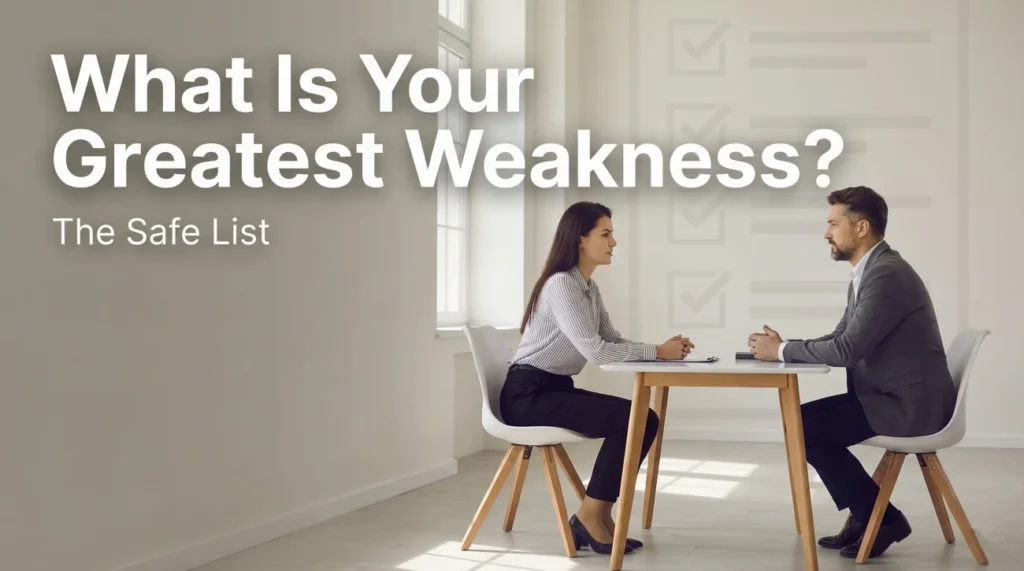
When interviewers ask what is your greatest weakness, they’re testing self-awareness and judgment. The wrong answer, even from a qualified candidate, ends interviews. The right answer admits a real limitation that doesn’t contradict the job’s core requirements.
The Safe Weakness Categories
These weaknesses are generally safe because they’re common, understandable, and don’t disqualify you from most roles:
| Safe Category | Example | Why It Works |
|---|---|---|
| Public speaking anxiety | Nervousness with large audiences | Common fear, clearly improvable, rarely core to job |
| Delegation struggles | Difficulty letting go of tasks | Implies high standards, manageable with awareness |
| Saying no | Taking on too much | Shows helpfulness, learnable boundary |
| Self-criticism | Being too hard on yourself | Indicates high standards, manageable issue |
| Specific technical gap | A tool you’re actively learning | Shows self-awareness, directly addressable |
Even safe weaknesses require improvement stories. “I’m bad at public speaking” alone is incomplete. Add what you’re doing about it.
Fatal Flaws That Kill Offers
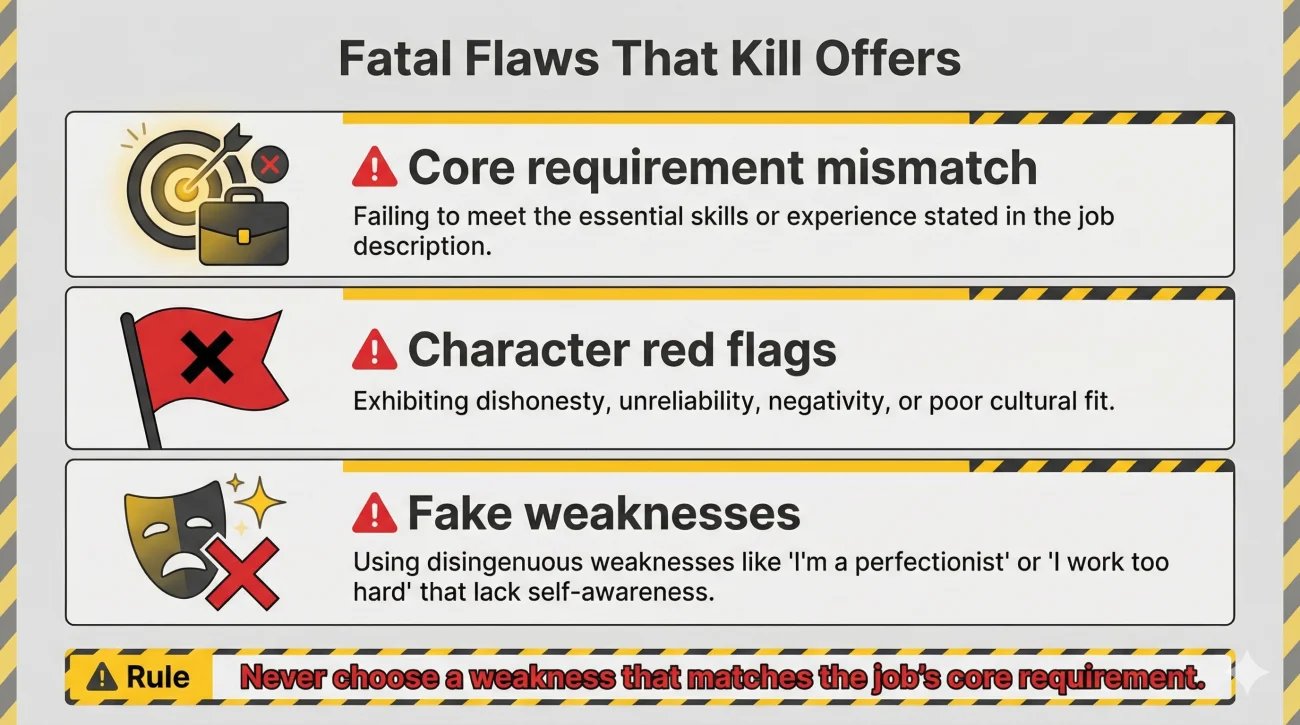
Core Job Requirements
If the job requires teamwork, don’t mention difficulty working with others. If it requires client patience, don’t mention impatience. If it requires attention to detail, don’t mention overlooking specifics. Your weakness cannot be what the job fundamentally needs.
Character Concerns
Some weaknesses raise red flags about fundamental character: difficulty with deadlines, problems accepting feedback, conflicts with authority, integrity issues. These aren’t safe weaknesses. They’re disqualifying concerns.
Fake Weaknesses
“I’m a perfectionist” or “I work too hard” when delivered as humble brags.
Interviewers immediately reject these. They suggest dishonesty or lack of self-awareness. Either is disqualifying.
The Three-Part Answer
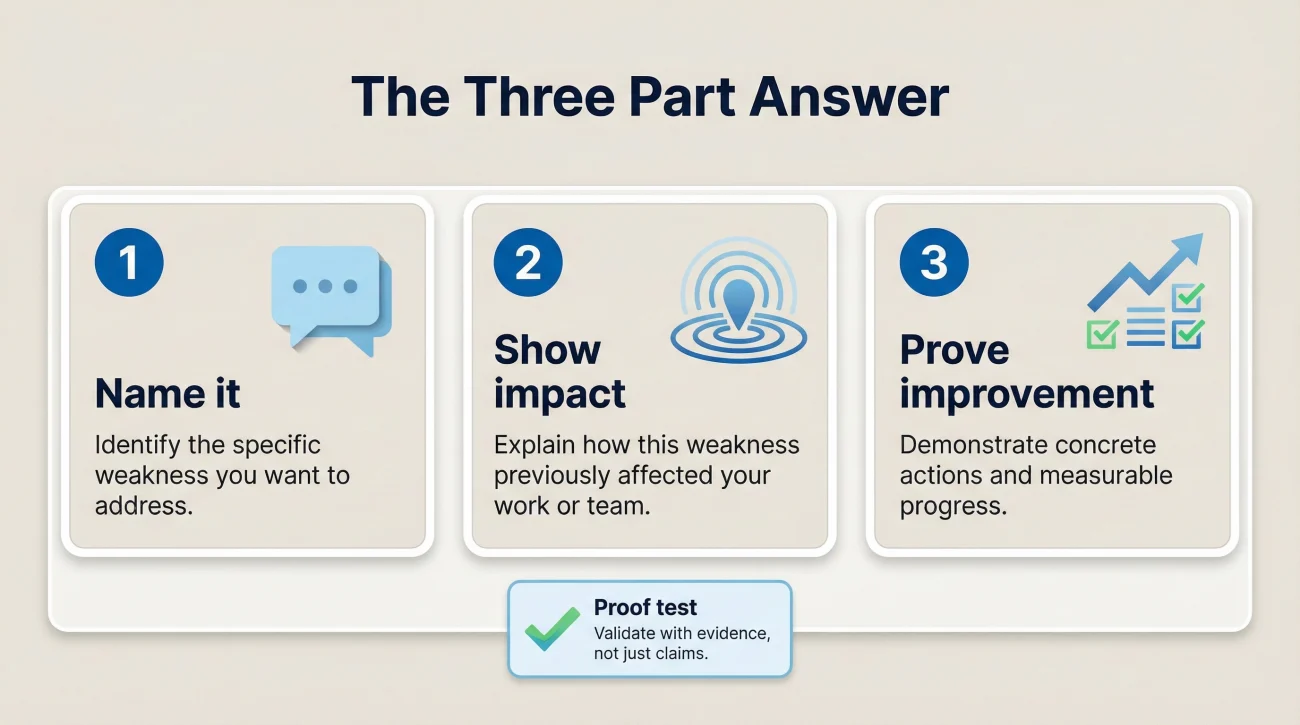
Part One: Acknowledge the Weakness
State it directly without excessive qualification. A clear acknowledgment demonstrates the self-awareness interviewers are testing.
Part Two: Show Impact Awareness
Briefly explain how this weakness has affected you or could affect work. This proves you understand why it matters, not just that you can name something.
Part Three: Describe Active Improvement
Share specific steps you’re taking to address it. Courses, new habits, feedback systems, or tools you’ve adopted. Concrete and ongoing, not vague intentions.
Proof test: Your improvement efforts should be specific enough that an interviewer could verify them. “I’m working on it” is weak. “I’ve completed twelve Toastmasters speeches this year” is strong.
Sample Answers That Work
Public Speaking
“My greatest weakness is presenting to large groups. I’m confident in small meetings and one-on-one, but larger audiences trigger nervousness that affects my delivery. I joined Toastmasters a year ago and have given fifteen speeches. I also volunteer for team presentations I could avoid. I can now handle department meetings of thirty people effectively. Conference-level presentations still challenge me, but I’ve made significant progress.”
Delegation
“My greatest weakness is difficulty delegating when I know I could do something faster myself. This creates bottlenecks and doesn’t develop my team. I’ve adopted a rule: if someone can do it at eighty percent of my quality, I delegate and invest in coaching instead. Two of my direct reports have been promoted partly because I gave them stretch assignments I previously would have kept.”
Saying No
“My weakness is taking on too many commitments because I want to be helpful. This has sometimes affected my core deliverables. I now pause before accepting requests and evaluate against my priorities. I’ve also practiced specific phrases: ‘I can’t take that on right now, but here’s who might help.’ It’s still uncomfortable, but I’m more protective of my capacity.”
For more on authentic self-presentation, explore our behavioral interview resources.
❓ FAQ
🎯 What if my real weakness would disqualify me?
If your greatest weakness truly contradicts the job’s core requirements, either the role isn’t right for you or you need to address the weakness before interviewing. For the interview, choose a different real weakness that won’t disqualify you.
💼 How honest should I actually be?
Completely honest about a strategically chosen weakness. Pick something genuine, just pick wisely. You should be telling the truth about a real limitation that doesn’t sabotage your candidacy.
⏰ Should I mention a fully overcome weakness?
Current weaknesses you’re actively addressing are more effective. Fully resolved weaknesses suggest you can’t identify current growth areas.
📋 Can I use the same answer for every interview?
Check that your weakness doesn’t conflict with each role’s specific requirements. A safe weakness for one position might be fatal for another.
✨ What if they push for more weaknesses?
Have two or three prepared from safe categories. Maintain the same structure: acknowledge, show impact awareness, describe improvement.
Strategic Honesty Wins
Answering what is your greatest weakness is a test of judgment as much as self-awareness. Choose something real but not disqualifying. Show you understand its impact. Describe concrete improvement efforts. When interviewers see genuine reflection paired with active growth, they trust you’ll continue developing in their organization. That’s the answer that gets offers.
⚠️ Disclaimer: The interview strategies, sample answers, and negotiation tips provided in this guide are for educational purposes only. Hiring decisions are subjective and vary by company and industry. While these strategies are based on professional HR standards, they do not guarantee a specific job offer or result.