Standing at the Crossroad
You’ve built something real in one field. Skills refined over years. Reputation established through consistent work. Maybe a title that took a decade to earn. And now you’re sitting in an interview room, applying for something entirely different, waiting for the question you know is coming.
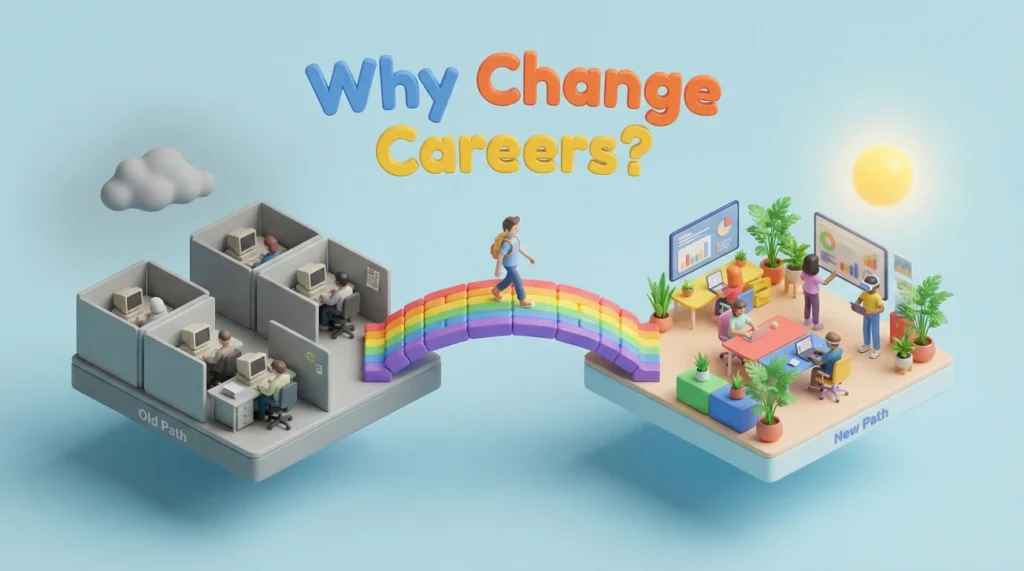
Why do you want to change careers?
The question sounds simple. Five words. But the answer is treacherous. Get it wrong and you sound flaky, unfocused, or like you’re running from failure in your previous field. Get it right and you sound intentional, self-aware, and exactly the kind of person who brings fresh perspective to established problems.
This is the pivot story. It’s the narrative that makes your career change not just understandable but actually compelling. It explains why leaving behind everything you built makes perfect sense, and why this new direction is where you belong.
Why Bad Answers Fail
Before building your pivot story, understand the approaches that backfire. These patterns doom candidates because they raise more concerns than they address.
The Escape Narrative
I was burned out in my old field and needed something completely different.
This answer screams reactive rather than intentional. It tells the interviewer you’re running away from something rather than running toward something. Worse, it raises the obvious concern: what happens when you burn out here too? If exhaustion drives your career decisions, you’re not a stable bet for any employer.
The Whim Narrative
I always thought this industry seemed interesting so I figured I’d give it a try.
This suggests you haven’t done serious thinking about one of the most significant decisions a professional can make. “Seemed interesting” is what you say about a hobby, not a career. Interviewers hear this and wonder whether you’ll lose interest just as casually when the new job gets difficult.
The Victim Narrative
My old industry is dying and there’s no future there anymore.
Even if this is true, leading with it positions you as fleeing decline rather than pursuing growth. You sound like someone whose hand was forced rather than someone making a deliberate choice. Employers want people who choose them specifically, not refugees who had nowhere else to go.
The Money Narrative
The compensation in this field is much better than what I was making.
Maybe true, but this tells the interviewer you’ll leave for whoever pays more. Your motivation is transactional rather than genuine interest. And if money is your driver, they’ll wonder what happens when the next industry offers even better compensation.
Building the Bridge
The strongest pivot stories connect where you’ve been to where you’re going. They reveal the logic that links your past experience to your future direction. They make the change feel like evolution rather than revolution.
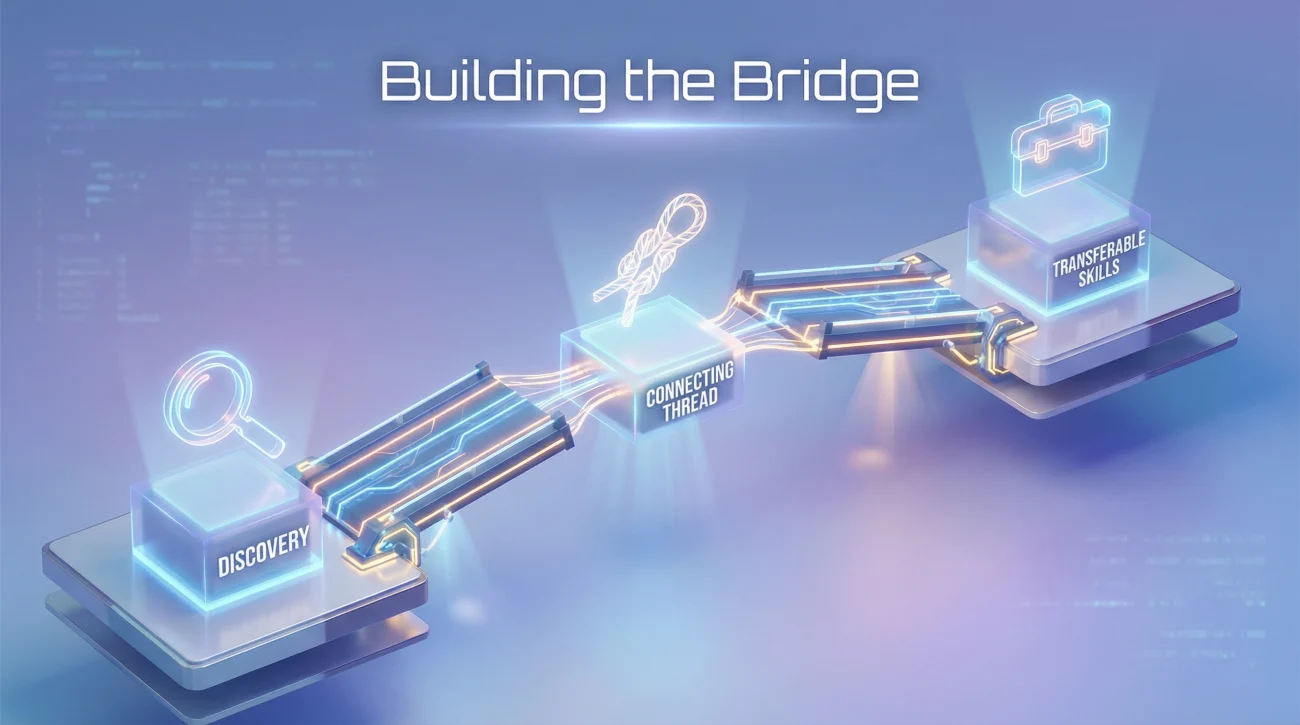
The Discovery Moment
What made you realize you wanted this change? Was there a specific project where you noticed your energy came alive? A conversation that clarified your thinking? An experience that revealed what you actually care about versus what you thought you should care about?
The discovery creates the inciting incident of your story. It explains when you knew, not just what you knew.
“While managing technical projects, I noticed I spent my best energy on the user experience questions, not the engineering decisions. That pattern kept appearing across multiple projects until I finally recognized what it meant about where I should focus my career.”
The Connecting Thread
What links your old work to your new direction? Often there’s a theme running through both that you only recognized looking back. Finding that thread and making it visible transforms your career change from random pivoting to logical progression.
“Looking back at my finance career, my most satisfying work was always the client-facing elements. I loved helping people understand complex situations and make informed decisions. Financial planning is really about that same core work applied in a different context.”
The thread doesn’t have to be obvious to outsiders. Your job is to make it visible and logical by explaining what you see.
The Transferable Foundation
What from your previous career prepares you for success in this one? Skills, knowledge, and perspectives don’t disappear when you change fields. They become your competitive advantage if you can articulate how they transfer.
Project management skills apply across industries. Client relationship experience transfers to any business development role. Teaching capabilities translate to training, marketing, or management. Analysis skills work in any context where data informs decisions.
Show how your foundation accelerates your new path rather than leaving it behind as irrelevant history.
The Framework in Action
Here’s how a complete pivot story comes together using the STAR structure to show the journey from recognition to action.
Situation
I spent eight years in management consulting, eventually leading engagement teams for operations improvement projects. By external measures, it was a successful career. Strong reviews, regular promotions, interesting clients. But I kept noticing something that bothered me: the work I looked forward to most was always the talent and organizational design components, not the process optimization that was supposed to be my specialty.
Task
I needed to figure out whether this was just a phase or a genuine signal about what I should be doing with my career. I didn’t want to abandon a successful path on a whim, but I also didn’t want to spend another decade in work that didn’t fully engage me. The task was understanding myself well enough to make the right decision.
Action
I approached this like any consulting problem: with research. I did informational interviews with HR leaders across industries. I took evening courses in organizational psychology. I volunteered to lead the people-related workstreams on my consulting projects to test whether my interest held up under sustained focus. I completed an HR certification while still working full-time.
Every step confirmed the direction. The more I learned about HR strategy, the more I wanted to do it professionally. Meanwhile, I recognized that the consulting skills I’d built gave me a foundation most HR professionals don’t have: analytical rigor, executive presence, and experience driving organizational change.
Result
I’m pursuing this HR leadership role because I’ve done the work to confirm this is right for me. I bring a consulting perspective to talent strategy that’s different from traditional HR career paths. I’m not running from consulting because it was hard or unsuccessful. I’m running toward work that energizes me and where I believe I can have greater long-term impact.
For guidance on presenting your complete background effectively, see our self-introduction framework.
Evidence of Genuine Commitment
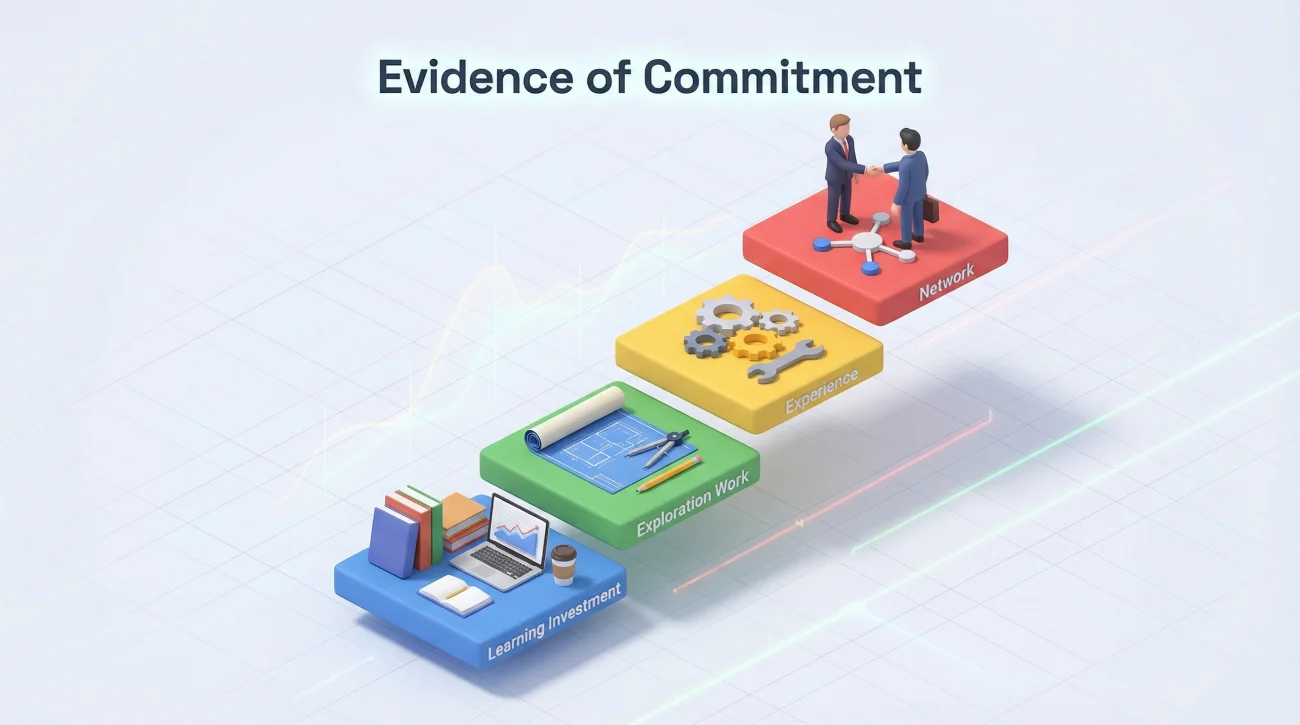
Words claim interest. Actions prove it. Your pivot story gains credibility when you show what you’ve already done to pursue this new direction before anyone offered you a job in it.
Learning Investment
Courses, certifications, degrees, or intensive self-study in the new field. These represent time and often money invested in a direction that might not pay off. That investment signals serious commitment.
Exploration Work
Informational interviews with people in the new field. Industry events attended. Professional associations joined. Books read. Podcasts consumed. This research shows you understand what you’re getting into rather than having a fantasy about it.
Relevant Experience Gathered
Side projects, volunteer work, freelance gigs, or any way you’ve gotten actual experience in the new field. Even small amounts of real-world exposure demonstrate that your interest survives contact with reality.
Network Building
Connections made with people already in the field. Mentors identified. Professional relationships established. Your network in the new field shows you’re already becoming part of that community.
- 📚 Completed coursework or certifications
- 🔍 Informational interviews and deep research
- 🛠️ Side projects demonstrating relevant skills
- 🤝 Professional relationships in the new field
- 📖 Industry knowledge beyond surface level
Each piece of evidence demonstrates that your interest is serious, not speculative. Someone who has already invested significantly in a new direction is much more credible than someone who just decided to apply and see what happens.
❓ FAQ
🎯 How do I explain a dramatic career change that seems completely unrelated?
Find the connecting thread. Even dramatic changes usually have logical links if you look carefully. Perhaps both fields involve problem-solving, communication, or creativity applied differently. Perhaps your personal values connect the two. Identify transferable skills and explain the discovery process that led you to recognize this new direction.
💼 What if the real reason for my change is money or lifestyle?
Those factors can be part of your reasoning but shouldn’t be the headline of your answer. Lead with genuine interest in the work and field, even if compensation or work-life balance also influenced your decision. Practical considerations are valid but don’t make compelling interview answers on their own.
⏰ How much should I criticize my previous career path?
Very little to none. Focus on moving toward something new rather than away from something old. You can acknowledge that certain aspects of your previous field weren’t right for you without criticizing the field itself or the people in it. Negativity about past choices raises questions about your judgment.
📋 Will my lack of direct experience in the new field hurt my candidacy?
It can, but transferable skills and demonstrated commitment offset this significantly. Career changers who’ve prepared seriously often bring fresh perspectives that make them more valuable than candidates with conventional backgrounds. Your different viewpoint is an asset if you can articulate its value.
✨ What if I’m still not completely certain this change is right?
Some uncertainty is normal for career changers facing major decisions. But during interviews, project confidence in your direction. You’ve done enough research to know this interests you deeply. Final confirmation comes from doing the work, not from endless deliberation beforehand.
The Story That Makes Sense
Answering why do you want to change careers persuasively requires building a narrative bridge between your past and your future. Show the discovery moment that sparked your interest in this new direction. Identify the connecting thread that links your previous experience to where you’re heading now. Demonstrate the preparation and commitment you’ve already invested. Frame the change as moving toward something meaningful rather than fleeing something unpleasant. When your pivot story makes sense and shows genuine preparation, career change becomes evidence of self-awareness and courage rather than instability or confusion.
⚠️ Disclaimer: The interview strategies, sample answers, and negotiation tips provided in this guide are for educational purposes only. Hiring decisions are subjective and vary by company and industry. While these strategies are based on professional HR standards, they do not guarantee a specific job offer or result.