Account Executive (AE) Interview Questions: What Interviews Really Test
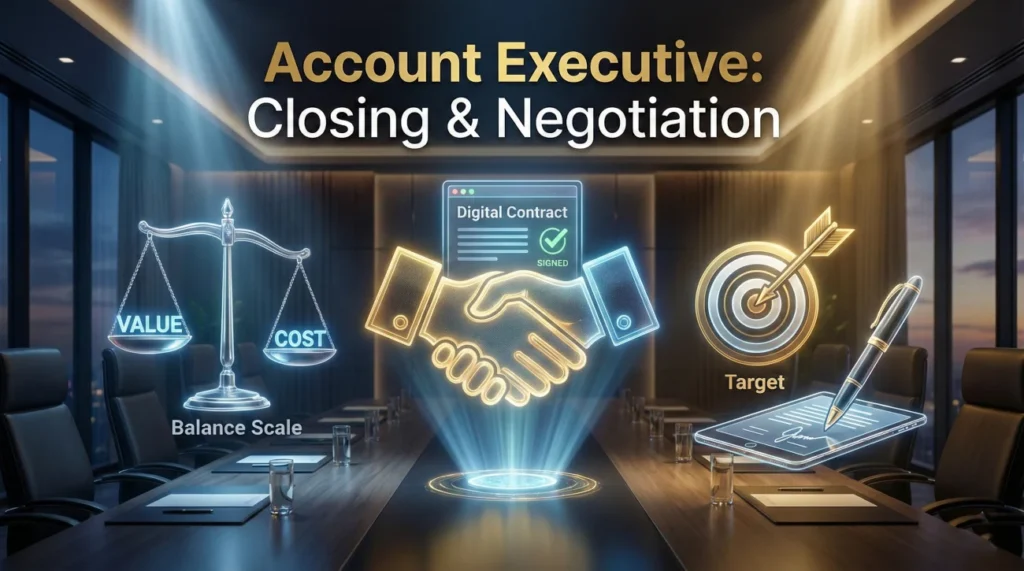
Account executive interview questions assess your ability to close complex B2B deals, negotiate contracts, and manage enterprise sales cycles. Unlike SDR roles focused on prospecting, AE interviews evaluate deal qualification skills, stakeholder management across buying committees, value articulation, objection handling during late-stage negotiations, and quota attainment track record. Expect role-plays simulating discovery calls, negotiation scenarios, and detailed questions about your pipeline management methodology.
This guide covers closing techniques, negotiation strategies, deal qualification frameworks, stakeholder management, and performance metrics. Strengthen your preparation with B2B sales career resources.
Closing Strategies and Deal Execution
Q: Walk me through how you close a complex B2B deal.
Complex deals require systematic progression through defined stages. Discovery establishes business pain, quantifies impact, and identifies all stakeholders involved in the decision. Qualification uses frameworks like MEDDIC to assess Metrics, Economic Buyer, Decision Criteria, Decision Process, Identified Pain, and Champion throughout the cycle rather than just at the beginning.
Value demonstration connects your solution to specific business outcomes through customized demos, ROI models, and proof-of-concept pilots where appropriate. Consensus building engages all stakeholders, so I multi-thread early and tailor value to each role in the buying committee. Final negotiations address contract terms, implementation timeline, and pricing while maintaining deal value. Post-verbal commitment, I stay engaged through legal review and procurement processes since silence doesn’t mean the deal is dead, it means it’s under review.
Q: Describe a deal you lost. What happened and what did you learn?
Choose a genuine loss that demonstrates self-awareness and growth. Structure your answer around situation, analysis, and learnings. Describe the deal context including size, timeline, and competitive landscape. Explain what went wrong honestly, whether you failed to identify the economic buyer early, underestimated a competitor, lost your champion to a role change, or misjudged timeline.
Detail your analysis process: Did you debrief internally? Request feedback from the prospect? Review your qualification at each stage? Share specific changes you implemented, perhaps adding champion validation steps, adjusting discovery questions, or changing how you multi-thread into accounts. Conclude with how subsequent deals benefited from these learnings. Interviewers want to see you take ownership without excessive self-criticism and demonstrate genuine growth from setbacks.
Q: How do you create urgency without being pushy?
Authentic urgency comes from business impact, not artificial deadlines. Connect to prospect pain by quantifying cost of inaction: “Based on our analysis, every month without this solution costs tens of thousands in manual processing. Is there a reason to delay capturing those savings?” This frames urgency around their situation, not your quota.
Event-driven urgency ties to real business milestones like product launches, fiscal year planning, regulatory deadlines, or competitive threats. Limited availability creates genuine urgency when implementation resources, promotional pricing, or pilot slots are actually constrained. Mutual action plans establish shared timelines working backward from their desired go-live date. Avoid manufactured urgency like “this discount expires Friday” unless genuinely true since sophisticated buyers recognize pressure tactics and they erode trust quickly.
Q: What closing techniques do you use?
Effective closing matches technique to situation rather than applying one approach universally. The assumptive close works when buying signals are strong: “I’ll send over the contract for review. Do you prefer digital signature or hard copy?” This maintains momentum without creating decision anxiety.
The summary close recaps agreed value before asking for commitment: “We’ve confirmed the solution addresses your data integration challenges, fits your budget, and your IT team approved the security requirements. What’s our next step to move forward?” The alternative close offers choices rather than yes/no: “Would you like to start with the pilot program or proceed directly to full implementation?” For hesitant buyers, the takeaway close removes pressure: “It sounds like timing isn’t right. Should we reconnect next quarter?” This counterintuitively often prompts prospects to commit rather than lose the opportunity.
Negotiation and Deal Structure
Pricing and Contract Discussions
Q: How do you handle discount requests?
Lead with value before discussing price. When prospects request discounts, first ensure they understand the full value proposition and ROI. Ask what’s driving the request: Is it budget constraints, competitive pricing, internal approval thresholds, or simply testing your flexibility? Understanding motivation shapes your response.
Never give without getting. Any discount should be anchored to a concession: longer contract term, case study participation, faster signature date, larger initial deployment, or reference calls. Example: “I can explore additional flexibility on pricing if we can commit to a three-year term instead of annual. Would that work for your budgeting process?” This approach maintains deal value while showing flexibility. Track your discounting over time; if you’re routinely giving deep discounts, it can signal pricing misalignment or a value articulation gap.
Q: Describe a challenging negotiation you navigated successfully.
Structure using situation, challenge, approach, and outcome. Choose an example demonstrating strategic thinking rather than just persistence. Describe the context: deal size, stakeholders involved, what made it challenging such as competitive pressure, budget constraints, legal requirements, or timeline demands.
Detail your approach: How did you prepare? What research informed your strategy? How did you identify the other party’s priorities and constraints? Explain specific tactics like creating alternative options, finding creative solutions to objections, involving executives strategically, or restructuring the deal terms. Quantify the outcome: final contract value, how it compared to initial offer, timeline to close, and relationship quality post-negotiation. Emphasize win-win thinking since the best negotiations leave both parties satisfied and set up successful long-term partnerships.
Q: How do you navigate procurement and legal review processes?
Paper processes kill more deals than competitors. Understand procurement timelines early by asking: “What does your typical vendor approval process look like? Who’s involved and how long does it usually take?” This surfaces potential delays before they derail your timeline.
Build relationships beyond your champion. Legal and procurement teams have legitimate concerns around security, compliance, liability, and payment terms. Address these proactively by providing security documentation, compliance certifications, and standard contract redlines before they’re requested. When redlines come back, triage quickly: What’s standard versus deal-specific? What requires your legal team versus what you can address directly? Stay engaged throughout review rather than disappearing after verbal commitment. Weekly check-ins keep momentum and surface issues early. Executive sponsorship from your champion helps prioritize your contract in their queue.
Q: What’s your approach when a prospect says your solution is too expensive?
Price objections typically mask other concerns. Probe to understand: “Too expensive compared to what? Your budget, competitors, or the perceived value?” This reveals whether you face a budget constraint, competitive disadvantage, or value articulation gap, each requiring different responses.
For budget constraints, explore phased implementations, different product tiers, or creative payment structures. For competitive comparisons, shift focus to total cost of ownership, implementation risk, and long-term value rather than license price alone. For value gaps, return to business impact: “Help me understand what ROI you’d need to see to justify this investment.” Then build an ROI model together using their numbers. If price truly exceeds their budget and no alternatives exist, qualify out gracefully rather than pursuing a deal that won’t close or will create an unhappy customer.
Deal Qualification and Discovery
What sales methodology do you use for qualifying opportunities?
MEDDPICC provides comprehensive B2B qualification. Metrics quantify the business impact your solution delivers. Economic Buyer identifies who controls budget and makes final decisions. Decision Criteria clarifies what factors determine vendor selection. Decision Process maps approval steps, stakeholders, and timeline. Paper Process addresses procurement, legal, and security review requirements. Identify Pain uncovers specific business problems driving the initiative. Champion finds internal advocates who actively sell on your behalf. Competition assesses alternatives including status quo.
I validate these elements continuously rather than checking boxes once. For example, champions can leave companies or change roles mid-deal, economic buyers can shift during reorganizations, and decision criteria evolve as stakeholders join the evaluation. Weekly opportunity reviews assess gaps in my MEDDPICC knowledge and generate specific actions to address them before they stall deals.
How do you identify and engage the economic buyer?
Economic buyers control budget allocation and make final purchase decisions. They’re often executives one or two levels above your primary contact. Identification starts in discovery: “Who ultimately approves investments of this size? What’s the approval threshold that requires executive sign-off?” Research on LinkedIn reveals organizational structure and reporting relationships.
Engagement requires different value conversations than technical buyers. Economic buyers care about business outcomes, competitive advantage, risk mitigation, and strategic alignment rather than features. Earn access through your champion by helping them build an internal business case: “What would your CFO need to see to approve this? Let me help you build that case.” When meeting economic buyers directly, lead with business impact, industry trends, and peer company examples rather than product details. Respect their time since these meetings are typically shorter and more outcome-focused.
How do you multi-thread into accounts to reduce single-point-of-failure risk?
Deals dependent on single contacts are fragile. Multi-threading builds relationships across the buying committee to survive champion departures, role changes, or shifting priorities. Start by mapping all stakeholders: decision makers, influencers, technical evaluators, end users, and potential blockers.
Engage each stakeholder with role-appropriate value. Technical evaluators want deep product discussions. End users care about day-to-day experience and training. Finance focuses on ROI and payment terms. Executives need strategic alignment and competitive positioning. Use your champion to facilitate introductions: “It would help me tailor our proposal if I could understand IT’s security requirements directly. Would you introduce me to your CISO?” Document all relationships in your CRM with notes on each stakeholder’s priorities, concerns, and disposition toward your solution. Aim for minimum three engaged contacts in enterprise deals.
Performance and Pipeline Management
Q: How do you consistently hit quota?
Quota attainment requires pipeline discipline, accurate forecasting, and balanced time allocation. Pipeline coverage often needs to be a few times quota in active opportunities since not every deal closes. I track coverage weekly and accelerate prospecting when pipeline thins rather than waiting until it’s critical.
Deal velocity analysis identifies where opportunities stall. If deals consistently slow at technical evaluation, I front-load technical resources. If legal review delays closings, I engage procurement earlier. Time allocation balances new business development with progressing existing opportunities. I protect prospecting time even when busy closing deals since today’s pipeline generates next quarter’s revenue. Weekly reviews with my manager surface at-risk deals early when intervention can still help rather than explaining misses after the fact.
Q: Walk me through your current pipeline.
Know your numbers cold. Be prepared to discuss total pipeline value, stage distribution, expected close dates, and weighted forecast. For your top 3-5 opportunities, articulate deal size, current stage, key stakeholders, next steps, and potential risks.
Demonstrate analytical thinking: “My pipeline is currently $2.1M against a $500K quarterly quota, giving me 4.2x coverage. About 40% sits in late stages with close dates this quarter. My three largest opportunities are [Company A] at $400K in contract negotiation with close expected by month-end pending legal review, [Company B] at $350K in technical evaluation where we’re scheduled for final demo next week, and [Company C] at $300K in early discovery where I’m working to identify the economic buyer.” This level of detail demonstrates pipeline mastery and forecasting capability.
Q: What CRM hygiene practices do you follow?
Accurate CRM data enables forecasting, coaching, and compensation accuracy. I update opportunities immediately after every meaningful interaction rather than batching updates weekly. Stage changes happen based on verified buyer actions, not optimism. Close dates reflect realistic timelines validated with prospects, not hope.
Documentation captures context beyond checkboxes: stakeholder sentiment, competitive intelligence, risks identified, and specific next steps with dates. This helps me pick up deals after vacation, enables my manager to provide targeted coaching, and creates institutional knowledge if accounts transfer. I review my pipeline weekly to update stale opportunities, mark lost deals, and ensure stage criteria are genuinely met. Clean data isn’t administrative burden; it’s the foundation for accurate forecasting and strategic decision-making.
Q: How do you prioritize which opportunities to focus on?
Not all pipeline deserves equal attention. I prioritize based on deal size, close probability, strategic value, and time sensitivity. Large deals with high probability and near-term close dates get primary focus. Strategic accounts like logo wins in target verticals may warrant extra investment even if smaller.
I deprioritize or qualify out deals with unclear decision processes, missing economic buyer access, weak champion engagement, or poor ICP fit regardless of stated interest. Time blocking ensures balanced attention: mornings for new business development, afternoons for progressing active deals, specific days for administrative tasks. Regular pipeline reviews with my manager help calibrate prioritization and identify blind spots where I might be over-investing in unlikely deals or under-investing in winnable opportunities.
B2B Sales Mastery Assessment
Test Your AE Knowledge
1. What does MEDDIC stand for?
- Metrics, Economic Buyer, Decision Criteria, Decision Process, Identify Pain, Champion
- Marketing, Engagement, Delivery, Data, Integration, Closing
- Management, Evaluation, Due Diligence, Documentation, Implementation, Contract
- Not a real framework
2. In complex B2B deals, buying decisions often involve:
- 1-2 people
- 3-4 people
- 6-10 people
- 15+ people
3. What is the “Economic Buyer” in sales qualification?
- The person who uses the product daily
- The person who controls budget and makes final purchase decisions
- The procurement department
- The technical evaluator
4. What is a “Champion” in B2B sales?
- The sales rep who closes the most deals
- An internal advocate who actively sells on your behalf
- The CEO of the prospect company
- Your sales manager
5. What does “multi-threading” mean in enterprise sales?
- Sending multiple emails simultaneously
- Building relationships with multiple stakeholders in an account
- Working on multiple deals at once
- Using multiple CRM systems
6. As a rule of thumb, many sales teams aim for pipeline coverage of:
- Less than quota
- About quota
- A few times quota
- Always 10x quota
7. The “assumptive close” is best used when?
- At the very first meeting
- When buying signals are strong and objections are resolved
- When the prospect says no
- Never appropriate in B2B sales
8. What’s the best response to “your solution is too expensive”?
- Immediately offer a discount
- Probe to understand: too expensive compared to what?
- Defend your pricing aggressively
- Walk away from the deal
9. What is a “Paper Process” in MEDDPICC?
- Printing contracts
- Procurement, legal, and security review requirements
- Documentation formatting
- Marketing collateral
10. When giving a discount, you should:
- Give it freely to close faster
- Anchor it to a concession like longer term or faster signature
- Never give discounts under any circumstances
- Only discuss with procurement
11. What’s the primary difference between SDR and AE roles?
- SDRs make more money
- SDRs prospect and qualify; AEs close deals
- AEs only handle inbound leads
- No meaningful difference
12. How should you engage an Economic Buyer differently than technical buyers?
- More product feature discussions
- Focus on business outcomes, competitive advantage, and strategic alignment
- Longer meetings with more detail
- Same approach for everyone
13. What does “qualify out” mean?
- Getting the prospect to say yes
- Determining a deal won’t close and stopping pursuit
- Passing to another rep
- Adding more stakeholders
14. When should you update CRM opportunity data?
- Weekly batch updates
- Monthly reviews only
- Immediately after every meaningful interaction
- Only when deals close
15. “Decision Criteria” in MEDDIC refers to:
- Your criteria for pursuing deals
- Factors the buyer uses to determine vendor selection
- Industry standards
- Competitive pricing
16. What’s a “mutual action plan” in sales?
- Internal sales team planning document
- Shared timeline with prospect outlining steps to close
- Marketing campaign calendar
- Legal contract template
17. The “takeaway close” works by:
- Offering more features
- Removing pressure, which often prompts commitment
- Taking away discount offers
- Leaving the meeting early
18. How many engaged contacts should you aim for in enterprise deals?
- Just one strong champion
- Minimum three contacts across the buying committee
- Everyone in the company
- Only C-level executives
19. Many B2B buyers describe their purchase process as:
- Straightforward and quick
- Mostly simple with a few steps
- Complex or difficult
- Impossible to complete
20. When a deal goes silent during legal review, you should:
- Assume it’s dead and move on
- Call daily demanding updates
- Stay visible with weekly check-ins and value-add touches
- Escalate to their CEO immediately
❓ FAQ
📊 What quota attainment should I highlight in interviews?
Discuss your track record honestly with context. Share percentage to quota over multiple periods, not just your best quarter. If you’ve missed quota, explain circumstances and what you learned. Highlight consistency over occasional spikes. Mention ranking among peers if favorable, average deal size, and any over-achievement recognition. Be prepared to explain how you achieved results, not just the numbers themselves.
🎭 Should I expect a role-play during the AE interview?
Yes, most AE interviews include role-plays simulating discovery calls, demos, negotiation scenarios, or objection handling. Research the company’s product, target customers, and value proposition beforehand. Practice common scenarios: handling price objections, navigating multi-stakeholder conversations, and creating urgency appropriately. Focus on asking good questions and listening rather than pitching aggressively. Debrief well by explaining your approach after the role-play.
💼 How do I explain a gap or transition from another industry?
Emphasize transferable skills: negotiation, relationship building, complex problem-solving, and hitting targets. Research the industry you’re entering and demonstrate genuine interest. Highlight any relevant exposure through customers, partners, or personal projects. Frame the transition positively: “My experience in [previous industry] taught me [specific skills] that apply directly to complex B2B sales cycles.” Show you’ve done homework on their specific market and customers.
🎯 What questions should I ask the interviewer?
Ask about sales methodology and tools used, typical deal size and sales cycle length, territory or account assignment process, ramp time expectations and quota relief, team structure and collaboration with SDRs, and what differentiates top performers. Questions about product roadmap, competitive landscape, and customer success metrics show strategic thinking. Avoid asking only about compensation or vacation in early rounds.
📈 How do I demonstrate enterprise sales readiness without enterprise experience?
Highlight complex deals from your current role even if smaller in absolute value. Discuss experience managing multiple stakeholders, navigating procurement processes, or handling extended sales cycles. Demonstrate knowledge of enterprise frameworks like MEDDIC through research and practice. Show you understand the differences: longer cycles, more stakeholders, formal processes, and strategic selling. Mention any exposure to enterprise customers through demos, partnerships, or supporting senior reps.
Closing Your Next AE Opportunity
Succeeding with account executive interview questions requires demonstrating closing expertise, negotiation skills, deal qualification rigor, and consistent quota attainment. Prepare specific examples showcasing complex deals you’ve closed, negotiations you’ve navigated, and losses you’ve learned from. Know your numbers cold: pipeline details, win rates, average deal size, and sales cycle length.
Research the company’s product, target market, competitive landscape, and sales methodology before interviewing. Practice role-play scenarios including discovery, objection handling, and negotiation. Prepare thoughtful questions demonstrating strategic thinking about their business. Approach the interview itself like a sales process: qualify whether it’s the right opportunity for you while demonstrating you’re the right candidate for them. For comprehensive preparation strategies, explore advanced sales career resources to close your next career opportunity and accelerate your path to top-performer status.
⚠️ Disclaimer: The interview strategies, sample answers, and negotiation tips provided in this guide are for educational purposes only. Hiring decisions are subjective and vary by company and industry. While these strategies are based on professional HR standards, they do not guarantee a specific job offer or result.