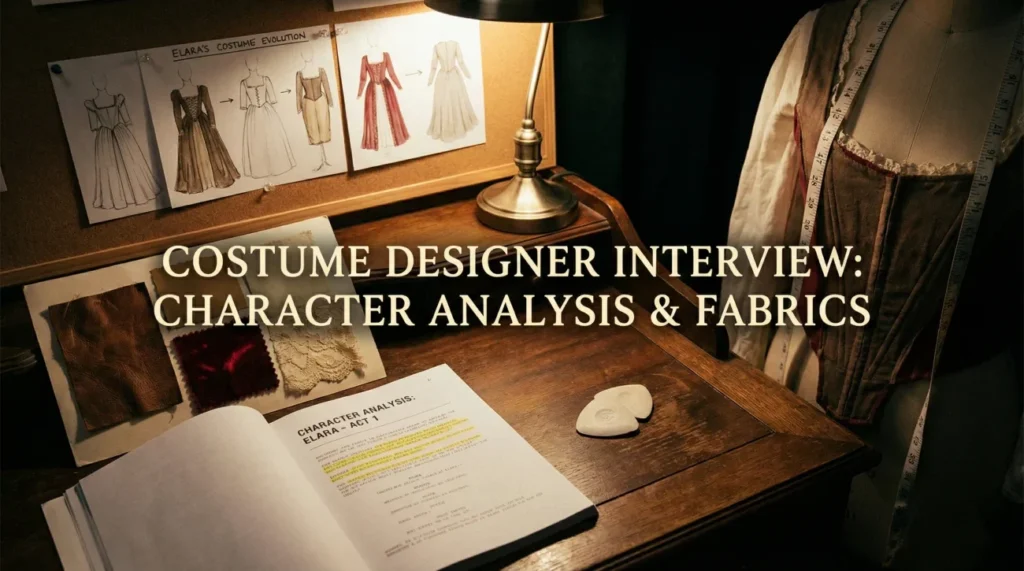
Costume Is Character, Not Clothing
Picture the first day of shooting. The call sheet is late, the director wants a last-minute rewrite, and an actor steps into wardrobe and says, “This doesn’t feel like me.” In that moment, nobody cares how stylish the rack looks. They care whether you can protect the story, the schedule, and the person wearing the work.
Costume designer interview questions are built to find a designer who can do all of it: read the script like a detective, translate psychology into silhouette and texture, and still run the logistics of a department that touches every scene. The best costume work is invisible in the right way. The audience believes the character and never thinks about the zipper.
This guide focuses on the parts that earn trust on set: clean breakdowns, continuity discipline, practical problem-solving, and collaboration that keeps everyone calm when the day gets messy.
Design Process & Character Analysis
Q: Walk me through your process from receiving the script to the first fitting.
I start with the “Script Breakdown.” I read the script once for the story, then a second time to highlight every costume change, day change, and stunt requirement. I create a “Costume Plot” (a scene-by-scene chart).
Then I move to research. I build “Mood Boards” for each character, pulling images not just of clothes, but of textures, lighting, and historical context. I meet with the Director to align our visions. Only then do I start sketching or sourcing. I present the concepts, get approval, and then begin the shopping or fabrication process for the fittings.
Q: How do you use costume to establish a character’s arc?
I use visual cues to mirror the internal journey. If a character starts repressed and becomes free, their costumes might shift from tight, structured, high-necked silhouettes to loose, flowing fabrics.
I also use color palettes. A character descending into madness might have a palette that becomes increasingly chaotic or dark. I plant “Easter Eggs” in the costume details (like a locket or a specific color) that payoff later in the story. Every button tells a story.
Q: How do you balance Historical Accuracy with Narrative Truth?
I know the rules so I can break them intentionally. I research the period exhaustively to understand the silhouette and etiquette of the time.
However, my loyalty is to the story. If a historically accurate bonnet covers the actor’s face and hides their emotion, I modify it. If the period colors are too dull for the film’s tone, I heighten them. I aim for “Period Plausibility” rather than museum-level accuracy, unless it is a documentary. The costume must serve the character, not just the history book.
Q: How do you approach a contemporary script (modern dress)?
Contemporary design is harder because everyone has an opinion on jeans and t-shirts. It requires subtle sociology. I ask: Where does this character shop? How much money do they make?
I don’t just buy off the rack; I tailor everything to fit the character’s psychology. A depressed character might wear clothes that are slightly too big; an arrogant character might wear clothes that are too tight. I curate a closet that feels “lived in,” avoiding the look of a catalog model.
Technical Skills & Fabrication
Q: What is “Aging and Distressing” (breakdown)?
It is the process of making new clothes look old and worn. I use sandpaper, cheese graters, and wire brushes to fray edges.
I use spray paints, dyes, and “dirt powders” (like Schmere) to add stains and sweat marks. A hero in a zombie movie shouldn’t have a pristine white shirt; it needs to tell the story of their struggle.
Q: How do you avoid the “Moiré Effect” on camera?
Moiré creates a strobing, vibrating pattern on digital screens when tight patterns (like houndstooth or narrow stripes) interfere with the camera sensor.
I test fabrics on camera before approving them. I avoid tight grids or fine herringbones. If I must use them, I work with the DOP to test lighting or focus depth to mitigate the effect.
Q: What is a “Costume Bible”?
It is the master binder (or digital file) containing the script breakdown, continuity photos, budget tracking, and cast measurements.
It includes the “Continuity Log” showing exactly what each actor wore in every scene (jewelry, tie knot style, dirt stains). It is the brain of the department and ensures that Day 1 and Day 20 match perfectly.
Q: How do you handle “Doubles” (Multiples)?
If a character gets shot, falls in mud, or has a stunt double, I need multiples of the same costume. I calculate this during the breakdown.
I might need a “Clean” version, a “Stage 1 Dirt” version, and a “Stage 2 Blood” version. I label them clearly. I buy enough fabric upfront to make duplicates because dye lots can change.
Q: Explain “Dyeing” in costume design.
Dyeing allows complete color control. I often buy white fabrics and dye them to the specific palette of the film.
I use “Techinique Dyeing” (ombre, shibori) for texture. I also use “Tea Staining” or “Over-dyeing” to knock back bright white fabrics that look too harsh on camera (camera white vs. creamy white).
Q: What goes into a “Set Kit”?
The kit is for emergencies on set. It contains safety pins, double-stick tape (Topstick), sewing needles/thread, stain remover, lint rollers, and warmers.
It also has comfort items like breath mints or specialized undergarments. Being able to fix a ripped seam in 30 seconds between takes is a mandatory skill.
Collaboration & Fittings
An actor refuses to wear a costume because “it doesn’t feel like the character.”
I listen. The actor has to inhabit the role, so their comfort is key. I ask, “What specifically feels wrong? Is it the silhouette? The weight?”
I explain my reasoning: “I chose this stiff collar to help you feel the repression of the character.” Often, explaining the psychology helps. If they still hate it, I collaborate on a compromise that satisfies both the visual needs and their acting process.
The Director hates the costume during the camera test.
I don’t panic. That is what tests are for. I ask for specific feedback: “Does it blend into the set too much? Is the color distracting?”
I have “Options” ready. I never go into a fitting or test with just one choice. I pull out my backup jacket or scarf to alter the look on the spot. I show flexibility and problem-solving speed, proving I am a partner in their vision.
You have a limited budget and need to dress a huge crowd scene.
I use the “Foreground/Background” strategy. I spend the money on the 10 people closest to the camera (Hero Background). They get the full period-accurate detail.
For the deep background (the blur), I use simpler shapes and colors that read correctly from a distance but are cheaper. I might ask extras to bring their own base items (e.g., black pants) if appropriate, and I augment with accessories (hats/scarves) to unify the look.
Logistics & Budgeting
Q: How do you create a costume budget?
I break it down line by line. I estimate costs for: Purchases, Fabric/Notions (for custom builds), Rentals, Alterations, Dry Cleaning, and Labor (if hiring extra stitchers).
I always add a contingency (10-15%) for last-minute script changes or reshoots. I track every receipt digitally. Managing the money is as important as designing the look; going over budget can get you fired.
Q: How do you handle “Returns” effectively?
Returns are a huge part of the job (buy 10 shirts, pick 1, return 9). I keep receipts organized by store. I know the return policies (14 days vs 30 days).
I keep tags on until the moment the garment is approved for camera. I treat the merchandise with respect. I develop good relationships with store managers so they don’t ban us for high-volume returns.
Q: What is the “Union” for Costume Designers?
In the US, it is the Costume Designers Guild (CDG, IATSE Local 892) for designers, and Motion Picture Costumers (Local 705) for the crew.
I understand the rules regarding hours, kits, and roles. Even on non-union jobs, I adhere to professional standards to build my reputation and eligibility for future union entry.
Q: Why do you want to be a Costume Designer?
I am fascinated by human behavior. Clothes are the armor we wear to face the world, and they tell the truth about who we are even when we lie. I love the detective work of breaking down a script and the artistic joy of building a character from the shoes up. I want to help actors find their character the moment they zip up the dress or button the jacket.
Costume Design Competency Quiz
Take the 20-Question Challenge
1. A “Breakdown” involves:
- Crying on set
- Analyzing the script to list every costume needed per scene
- Destroying the set
- Taking a break
2. “Continuity” ensures:
- The movie is long
- Costume details match perfectly from shot to shot and scene to scene
- The actors are happy
- The budget is low
3. “Distressing” a costume means:
- Upsetting the actor
- Artificially aging or damaging the fabric to look worn
- Returning it late
- Ironing it perfectly
4. A “Fitting” is for:
- Exercise
- Trying clothes on the actor to check fit and character look
- Fitting equipment in the truck
- Meeting the director
5. “Moiré” is:
- A type of silk
- A visual interference pattern (strobing) caused by tight grids/stripes on camera
- A French designer
- A hat style
6. “Doubles” or “Triples” are needed for:
- Twins
- Stunts, photo doubles, or scenes involving mess (blood/mud)
- Extra warmth
- Reselling later
7. The “Costume Plot” helps track:
- The movie plot twists
- Which character wears what costume in which scene (timeline)
- The location of the truck
- The lunch order
8. A “Lookbook” is:
- A mirror
- A collection of images showing the proposed style for each character
- A book about eyes
- The script
9. “Pulling” clothes means:
- Tearing them
- Borrowing/Renting items from a costume house or store for consideration
- Putting them on
- Sewing them
10. “Dyeing” is used to:
- Kill the fabric
- Change the color or tone of the fabric
- Dry the clothes
- Cut the clothes
11. A “Set Costumer” works:
- In the office
- On set, maintaining the costumes and continuity during filming
- At the store
- At home
12. “Sourcing” involves:
- Adding sauce
- Finding and acquiring the necessary clothes/fabrics
- Making magic
- Editing the film
13. “Topstick” is:
- A hat
- Double-sided tape used to secure clothing to skin
- A cane
- A glue gun
14. A “Period Piece” requires:
- Modern clothes
- Historical research to recreate a specific era accurately
- Short filming time
- Lots of punctuation
15. The “Hero” costume is:
- A cape
- The primary, pristine version of the outfit worn by the main actor
- The cheapest one
- The stunt version
16. “Fitting Photos” are taken to:
- Post on Instagram
- Show the Director/Producers for approval and document the fit
- Sell the clothes
- Remember the actor’s face
17. “Aging” a costume can involve:
- Waiting years
- Sandpaper, cheese graters, and paint
- Buying it new
- Ironing it
18. “Wardrobe Malfunction” means:
- The closet is locked
- An accidental exposure or breaking of the costume on camera
- Ugly clothes
- Lost shoes
19. A “Muslin” fitting uses:
- Cheap fabric
- A prototype garment made of cheap cotton (muslin) to test the pattern
- Muscle suits
- Music
20. The Costume Designer reports to:
- The actor
- The Director (Creative) and Producer (Budget)
- The camera operator
- The makeup artist
❓ FAQ
🧷 What do interviewers mean by “continuity,” in plain terms?
It means matching details across takes and scenes, even when filming is out of order. You track everything that reads on camera: layers, jewelry, dirt levels, scuffs, buttons, hair accessories, and how the garment sits on the body.
🧠 How do I show character thinking without sounding pretentious?
Use simple evidence. Explain one choice and its purpose: “He wears the same jacket because he is stuck,” or “Her palette shifts as she gains control.” One clear example beats a paragraph of theory.
📷 What should I bring to prove my process?
Bring a tight set of breakdown pages, a few mood boards, fitting photos with notes, and one continuity example. Hiring managers want to see that you can move from script to approvals to on-set execution.
🧪 How do I talk about fabric issues on camera?
Talk about testing. Mention that you camera-test patterns and textures, watch for unwanted shimmer or vibration, and adjust with alternates, lining choices, or wardrobe tweaks so the image stays stable.
🧰 What belongs in a set kit?
Fast fixes and quiet insurance: safety pins, needles and thread, tape, stain remover, lint tools, small scissors, extra closures, skin-tone solutions, and comfort basics. The goal is a repair that nobody notices.
Final Thoughts
The strongest candidates sound like calm leaders, not shoppers with taste. When you answer costume designer interview questions, show that you can turn a script into a system: breakdowns, continuity, multiples, fittings, and clear communication with direction and camera.
If your examples prove you can protect the character and keep the department organized under pressure, you come across as the person a production can trust when time is short and the stakes are visible on screen.
⚠️ Disclaimer: The interview strategies, sample answers, and negotiation tips provided in this guide are for educational purposes only. Hiring decisions are subjective and vary by company and industry. While these strategies are based on professional HR standards, they do not guarantee a specific job offer or result.