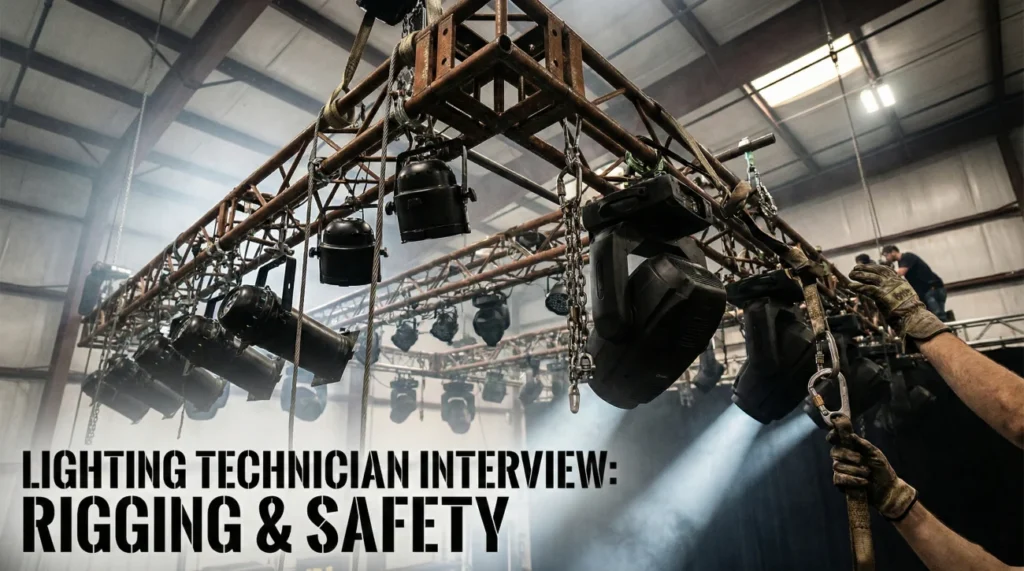
Illuminating the Vision
Lighting technician interview questions are designed to find the candidate who can safely handle high-voltage power while delicately shaping shadows. A lighting technician (or electric) is not just someone who plugs in lamps; they are the hands that paint with light. Hiring managers – whether for film sets, theater stages, or live events – are looking for candidates who understand the physics of electricity, the mechanics of rigging, and the artistry of color temperature. They need someone who can climb a truss, troubleshoot a DMX signal, and execute the Director of Photography’s (DP) vision without causing a blackout.
In 2024 and 2025, the industry is transitioning rapidly to LED technology and wireless control. Interviewers will ask: How do you calculate the load on a circuit to prevent tripping a breaker? Can you explain the difference between a Fresnel and a PAR can? How do you handle a situation where a light fixture falls or sparks? Your answers must prove that you are a disciplined technician who prioritizes safety above all else, while still delivering the aesthetic quality the production demands.
This comprehensive guide helps you power up your interview. We explore the critical math of calculating amperage, the protocols for safe rigging, and the soft skills required to work in the high-pressure environment of a film set or live concert. Whether you are applying to be a Gaffer, a Best Boy Electric, or a Stagehand, these strategies will help you shine.
Electrical Safety & Power Distribution
Q: How do you calculate the maximum load for a circuit (Paper Amps)?
I use the West Virginia Formula: W = V x A (Watts = Volts x Amps). To find Amps, I divide Watts by Volts.
In the US (120V), I use a safety margin by rounding down to 100V for quick calculation (“Paper Amps”). So, a 1000W light draws roughly 10 Amps (1000/100). If the circuit is 20 Amps, I know I can safely plug in two 1k lights, but not three. This buffer prevents blown breakers and fires.
Q: What is “Three-Phase Power” and how do you connect to it?
Three-phase power provides three alternating currents (Hot legs: Black, Red, Blue) plus a Neutral (White) and Ground (Green). It is used for heavy loads like large distribution boxes (distros).
I follow the strict connection order: “Green, White, then the Colors.” (Ground, Neutral, Hots). I disconnect in reverse order. This ensures the system is always grounded first and neutral-bonded to prevent sending 240V to 120V equipment, which would destroy it.
Q: How do you secure cables on a busy set?
Cable management is a safety priority. I run cables along walls or designated paths, avoiding high-traffic areas. I use “Cable Crossings” (Yellow Jackets) for heavy traffic.
For loose cables, I use gaffer tape to secure them flat to the floor (“dressing the cable”). I leave slack at the fixture (“service loop”) so if the cable is pulled, it doesn’t pull the light down. Tripping hazards are the most common injury on set, so I am meticulous.
Q: What do you do if you find a frayed cable?
I take it out of service immediately. I do not try to tape it up and use it. I tag it with “Lockout/Tagout” or red tape to indicate it is dangerous.
I report it to the Best Boy or Gaffer. Using damaged electrical gear is a fire and shock hazard. I would rather delay the shoot for 5 minutes to find a replacement cable than risk an electrical fire.
Technical Lighting Skills
Q: What is DMX512?
DMX (Digital Multiplex) is the standard protocol for controlling lighting fixtures. It sends data signals to tell the light what to do (dim, change color, move).
A single DMX “Universe” has 512 channels. I address each fixture ensuring they don’t overlap. I use terminators at the end of the chain to prevent signal reflection.
Q: Explain the difference between Tungsten and Daylight (Color Temp).
Tungsten is warm, orange light, typically 3200 Kelvin. Daylight is cool, blue light, typically 5600 Kelvin.
I must match the lights to the ambient environment. If shooting indoors with windows, I use Daylight LEDs or gel my Tungsten lights with CTB (Color Temperature Blue) to match the sun, otherwise the camera sees mixed colors.
Q: What is a “Fresnel” lens?
A Fresnel lens has concentric rings that focus the light beam. It allows the light to be “spotted” (narrow beam) or “flooded” (wide beam).
It creates a soft-edged beam that blends well with other lights, unlike a PAR can which is harsh. It is the workhorse of traditional film lighting.
Q: How do you use “Scrims” and “Nets”?
Scrims are wire mesh screens placed in the light head to reduce intensity without changing color temperature. A Single (Green) cuts 0.5 stop; a Double (Red) cuts 1 stop.
Nets are flags placed on stands in front of the light to cut intensity in specific areas (e.g., to darken a background wall without darkening the actor).
Q: Explain “CRI” (Color Rendering Index) in LEDs.
CRI measures how accurately a light source reveals the colors of objects compared to natural light (100). Low CRI LEDs make skin look green or dead.
I only use high-CRI (95+) LEDs for film/video to ensure skin tones look natural. Cheap LEDs might be bright, but if the CRI is low, the footage is unfixable.
Q: How do you rig a “Menace Arm” or boom?
A Menace Arm booms a light out over the set. Safety is critical. I use a counterbalance (sandbags) on the back end that exceeds the weight of the light.
I use a ratchet strap from the back of the arm to the bottom of the stand to create tension/triangulation. I always add a safety chain (safety bond) to the light fixture itself in case the mounting fails.
Troubleshooting & On-Set Scenarios
A light fixture suddenly turns off during a take.
I communicate “Fixture down!” quietly to the Gaffer. I check the power first: Is it plugged in? Did the breaker trip? Did the lamp (bulb) burn out?
If it’s an LED, did it overheat or lose DMX signal? I swap it out immediately with a backup if it can’t be fixed in seconds. I troubleshoot the broken one off-set to avoid delaying production.
The DP wants a light in a position that is unsafe to rig.
I never compromise safety. I say, “I can’t put the stand there because it blocks the fire exit/is unstable.”
I offer an alternative solution: “We can’t use a stand, but we can boom it in from the side, or clamp it to the grid above.” I am the guardian of safety; if I say it’s unsafe, it doesn’t happen. My “No” protects the crew.
You are experiencing “Flicker” on the monitor from the lights.
This is usually a sync issue between the light’s frequency and the camera’s shutter/frame rate. I check if the light has a “Flicker-Free” or high-speed mode (common in HMI/LED).
I ask the camera department what their shutter angle is. I adjust the dimmer (sometimes dimming causes flicker in cheap LEDs). If needed, I swap the unit for a tungsten fixture which is continuous voltage and never flickers.
Rigging & Grip Collaboration
Q: What is the difference between a Grip and an Electrician?
Electricians (Juicers) handle the power and the light fixture itself (the source). We plug it in and turn it on.
Grips handle the shaping of the light (shadows) and the support (stands/rigging). They set the flags, diffusers, and C-stands. We work in tandem; I provide the photons, they tell the photons where to go (and where not to go).
Q: How do you safely secure a C-Stand?
I follow the “Righty Tighty” rule: the knuckle should be on the right side so gravity tightens it, not loosens it. I place the “Big Leg” (highest leg) pointing toward the load.
I always place a sandbag on the big leg. I ensure the stand is balanced before walking away. An unsecured stand is a weapon waiting to fall.
Q: What is a “Safety Bond” or “Safety Chain”?
It is a steel cable that secures the light fixture to the grid/truss. If the primary clamp fails, the safety bond catches the light so it doesn’t fall on an actor’s head.
I attach the safety first when rigging up, and remove it last when rigging down. It is a non-negotiable step for any overhead equipment.
Q: Why do you want to be a Lighting Technician?
I love the duality of the job. It is physically demanding technical work, but the result is pure art. I enjoy the adrenaline of set life and the satisfaction of solving complex power puzzles. I want to be the person who makes the scene look cinematic, ensuring the DP’s vision is technically possible and safe.
Lighting Technician Competency Quiz
Take the 20-Question Challenge
1. “CTB” gel converts:
- Daylight to Tungsten
- Tungsten (3200K) to Daylight (5600K)
- Red to Blue
- Green to Magenta
2. A “Stinger” is:
- A bee on set
- A single extension cord (usually black)
- A small light
- A sharp tool
3. The “Gaffer” is the head of:
- The Camera Department
- The Electric Department
- The Grip Department
- The Art Department
4. Watts divided by Volts equals:
- Ohms
- Amps (Amperes)
- Frequency
- Resistance
5. A “Barn Door” is used to:
- Close the studio
- Shape/cut the beam of light attached to the front of the fixture
- Hold gels
- Cool the light
6. “DMX” signal cables typically have:
- 3 pins (audio XLR)
- 5 pins (though 3-pin is sometimes used improperly)
- 2 pins
- HDMI connectors
7. A “Lunchbox” in lighting is:
- Food storage
- A portable power distribution box (usually 100A to multiple 20A circuits)
- A small light
- A tool kit
8. “Striking” is yelled when:
- Fighting
- Turning on a large/bright light (especially HMI) to warn crew
- Leaving set
- Dropping something
9. A “Cookie” (Cucoloris) creates:
- Snacks
- A patterned shadow (like leaves or blinds)
- Soft light
- Color changes
10. “Practical” lights are:
- Useful tools
- Light sources visible in the shot (lamps, neon signs)
- Battery powered
- Easy to rig
11. A “Ballast” is required for:
- Tungsten lights
- HMI and Fluorescent/some LED lights to regulate current
- Extension cords
- Cameras
12. “Ghost Load” is used to:
- Scare people
- Add resistance to a generator to keep it running smoothly with small loads
- Hide cables
- Test dimmer packs
13. The “Best Boy Electric” is:
- The nicest person
- The Gaffer’s second-in-command, handling logistics/inventory/truck
- The best lighting operator
- A PA
14. “Hard Light” produces:
- Soft shadows
- Sharp, defined shadows
- No shadows
- Blue light
15. A “Scrim” reduces light intensity without changing:
- The shape
- The color temperature or hardness quality
- The voltage
- The direction
16. “Cam-Lok” connectors are used for:
- Cameras
- High-amperage feeder cables (Distro power)
- Microphones
- DMX data
17. “Kelvin” measures:
- Brightness
- Color Temperature
- Heat output
- Weight
18. A “C-Stand” leg should be positioned:
- Anywhere
- With the highest leg (Big Leg) under the load/weight
- Flat on the ground
- Pointing away from the load
19. “Diffusion” material (like Opal or 216) makes light:
- Harder
- Softer and larger
- Brighter
- Redder
20. “Dimmer Beach” is:
- A vacation spot
- The area where the lighting console/dimmer racks are located on set
- A dark scene
- A sandy location
❓ FAQ
📜 Do I need an electrical license?
Not usually for set lighting, but you need deep knowledge of electrical safety. However, for tying into building power (tie-ins), a licensed electrician is often legally required. Certifications (ETCP) are a huge bonus.
👞 What gear do I need?
Essentials: Multimeter, C-wrench (Adjustable wrench), Leather gloves (hot lights!), Multi-tool, Flashlight, and Headlamp. Wear rubber-soled boots for electrical safety.
💡 LED vs. Tungsten/HMI?
LEDs (SkyPanel, Aputure) are dominating because they are cool, dimmable, and color-changing. But Tungsten/HMI are still used for raw power and punch. You must know both.
💻 Do I need to know lighting consoles?
Yes. Basic knowledge of a board (GrandMA, ETC, or iPad apps like Blackout) is essential. You don’t need to be a master programmer, but you need to know how to patch a light and bring up a fader.
🏋️♂️ Is it physically hard?
Yes. You are lifting heavy feeder cable (banded 4/0 is heavy!), climbing ladders, and rigging lights overhead. Strength and stamina are required. Back safety (lifting with knees) is critical.
Final Thoughts
To secure a position, your answers to lighting technician interview questions must show that you are a safe pair of hands. Gaffers need technicians who can execute complex plots quickly without endangering the crew. By highlighting your knowledge of power distribution, your rigging safety protocols, and your ability to troubleshoot under pressure, you prove that you are the bright spark they need on their team.
⚠️ Disclaimer: The interview strategies, sample answers, and negotiation tips provided in this guide are for educational purposes only. Hiring decisions are subjective and vary by company and industry. While these strategies are based on professional HR standards, they do not guarantee a specific job offer or result.