
The Marketing Director Who Gave a Forgettable Answer
Last month I interviewed a marketing director with fifteen years of experience. When I asked what is your greatest strength, she said: “I’m a strategic thinker who’s also great with execution.” I nodded politely. An hour later, I couldn’t remember her answer because it sounded exactly like the previous three candidates.
She didn’t get the offer. Not because she lacked capability, but because she failed to differentiate herself. The candidate who won described her strength as “turning around marketing teams that have lost their creative edge.” She told a specific story about reviving a demoralized team that had been producing mediocre work for two years. That answer stuck because it positioned her as the solution to our exact problem.
Your Strength as a Unique Selling Point
Think of your answer like a product’s unique selling proposition. What do you offer that qualified competitors probably don’t? Generic strengths like “hard worker” or “team player” are table stakes. Every candidate claims them. Your job is finding the specific capability that makes you memorable.
Expert insight: Before any interview, research the role’s biggest challenge. Your strength should directly address that pain point.
A data analyst interviewing at a retail company struggling with inventory told me her strength was “finding patterns in messy data that explain unexpected business problems.” She backed it with a story about discovering that inventory shrinkage wasn’t theft but a supplier miscounting issue. That insight saved her company four hundred thousand dollars annually. She got the offer because her strength matched the company’s need perfectly.
Another candidate, a project manager, claimed “attention to detail” as his strength. That answer disappeared into the pile of identical responses. He could have said “catching scope creep before it derails timelines” and backed it with a story about saving a project that was heading toward a six-figure overrun. Same underlying skill, completely different impact.
The Three-Filter Test
Run every potential strength through these filters before choosing:
- 🎯 Relevance: Does this directly connect to what the job needs most?
- 🏆 Differentiation: Would most other qualified candidates also claim this?
- 📊 Provability: Can I back this with a specific, compelling story?
If your strength passes all three, use it. If it fails any filter, find something else.
“I’m detail-oriented” fails differentiation. Everyone claims it.
“I catch errors in financial models that other analysts miss” passes all three filters.
Applying the Filters
Consider a software engineer interviewing for a startup that’s scaling rapidly. She might consider these strengths:
| Potential Strength | Relevance | Differentiation | Provability | Verdict |
|---|---|---|---|---|
| Good at coding | ✅ | ❌ | ✅ | Too generic |
| Team player | ✅ | ❌ | ❌ | Cliché |
| Building systems that scale 10x without rewriting | ✅ | ✅ | ✅ | Use this |
The third option wins because it speaks directly to the startup’s scaling challenge, few engineers can genuinely claim it, and she can prove it with her previous company’s growth story.
Answers That Won Jobs
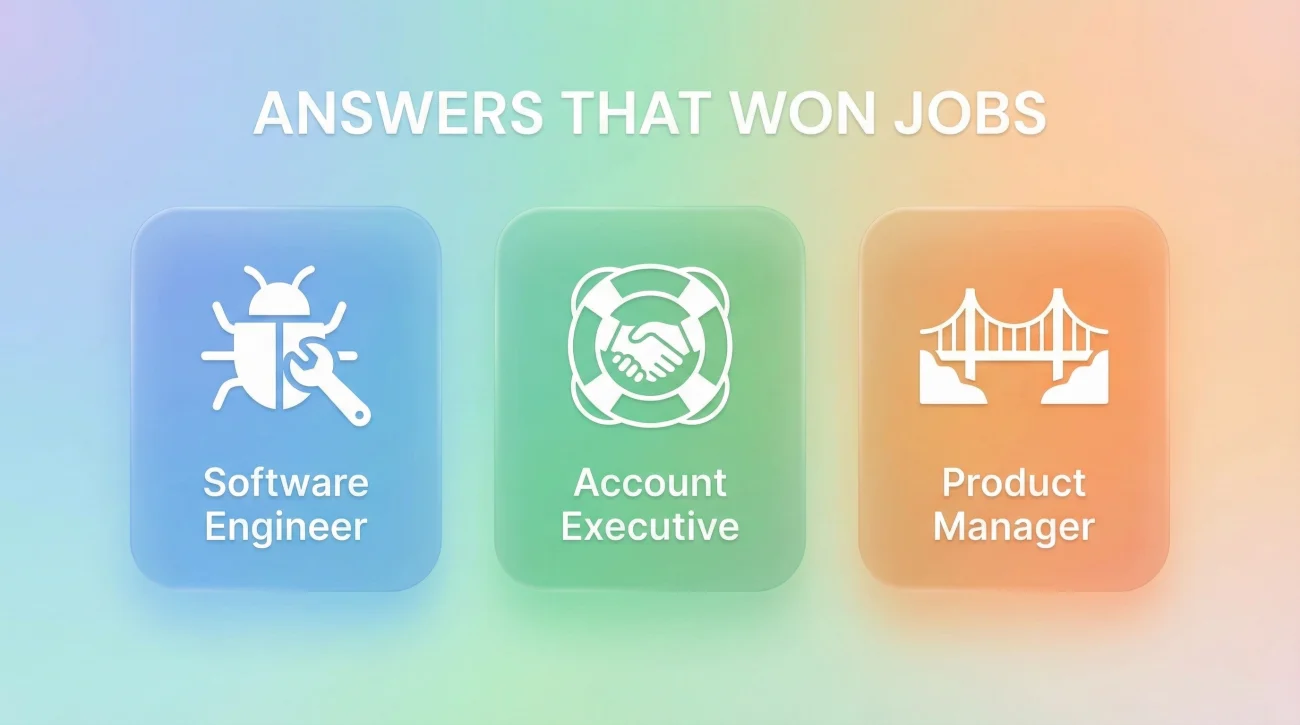
Software Engineer: Debugging Complex Systems
“My greatest strength is solving production issues that have stumped senior engineers. I have a systematic approach to isolating root causes that others miss. Last quarter, I resolved an outage that three engineers spent two days on. Found the caching edge case in four hours. My manager now assigns me the ‘impossible’ bugs because I’ve built a reputation for cracking them.”
Account Executive: Saving At-Risk Clients
“I turn frustrated clients into advocates. When clients are ready to leave, I stay calm and focus entirely on solving their problem rather than defending our company. I’ve saved four accounts that were about to churn by being the person who finally listened and took ownership. Two of those clients expanded their contracts afterward.”
Product Manager: Translating Between Teams
“My strength is bridging the gap between technical and business teams. Engineers trust me because I understand their constraints. Executives trust me because I translate technical complexity into business impact. I’ve prevented three major miscommunications that would have wasted months of development time by catching disconnects early in the planning process.”
Notice all three answers are specific, backed by evidence, and position the candidate as solving a real business problem. For more on presenting yourself effectively, see our behavioral interview guide.
❓ FAQ
🎯 Should I mention more than one strength?
Lead with one. Listing multiple dilutes your message and suggests you can’t prioritize. Have backups ready if specifically asked for more.
💼 What if my real strength seems irrelevant to this job?
Reframe it in terms of the job’s needs. Almost any genuine strength can be positioned relevantly with the right angle and supporting example.
⏰ How long should my answer be?
Sixty to ninety seconds. State the strength clearly, give a brief proof story, summarize the quantified result.
📋 Can I use the same answer for every interview?
Customize for each role. Different positions value different strengths. Research what each employer needs most and adjust accordingly.
✨ What if I genuinely struggle to identify my strengths?
Ask colleagues what they see as your distinctive abilities. Review past performance feedback. Think about tasks that feel easy to you but seem hard for others.
Be the Solution, Not Another Candidate
Answering what is your greatest strength is your chance to position yourself as the solution to the hiring manager’s specific problem. Choose something that passes all three filters: relevant to the role, differentiated from other candidates, and provable with a compelling story. Generic claims disappear from memory within minutes. Distinctive strengths backed by real outcomes get job offers.
⚠️ Disclaimer: The interview strategies, sample answers, and negotiation tips provided in this guide are for educational purposes only. Hiring decisions are subjective and vary by company and industry. While these strategies are based on professional HR standards, they do not guarantee a specific job offer or result.