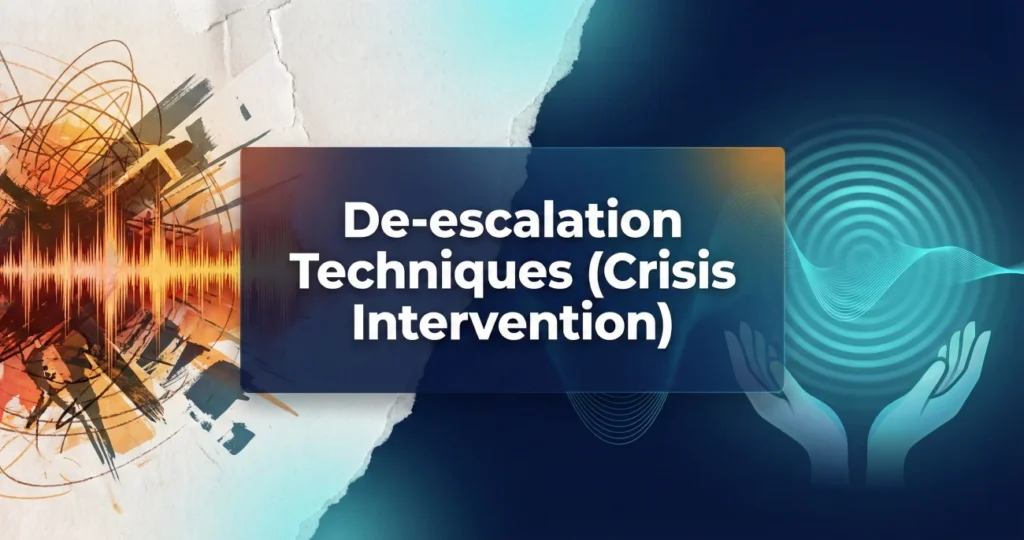
- Purpose: De-escalation reduces emotional intensity, restores rational thinking, and prevents situations from turning violent.
- Verbal skills: Use calm tone, slower pace, simple words, validation, and collaborative phrasing, avoid commands, blame, threats, and “calm down.”
- Physical safety: Keep safe distance, use open non-threatening posture, never block exits, scan environment, and create space before trying to solve anything.
- Listening method: Reflect, clarify, validate feelings without agreeing to bad behavior, use silence, then offer limited choices to regain control.
- Framework and judgment: Assess danger fast, escalate response in levels, call backup when needed, and explain your process clearly in interviews.
Managing High-Stakes Situations
Effective de-escalation techniques prevent volatile situations from escalating to violence by reducing emotional intensity, restoring rational thinking, and creating paths toward peaceful resolution. Professionals across law enforcement, social work, healthcare, education, and public safety require de-escalation competency managing individuals experiencing emotional crisis, behavioral disturbance, or threatening situations.
This guide establishes foundational crisis intervention skills. You’ll learn verbal de-escalation communication strategies, physical safety positioning and distance protocols, active listening techniques calming distressed individuals, choice-giving frameworks preserving autonomy, and recognizing when de-escalation efforts require additional support or authority.
Verbal De-escalation Communication
How you speak during crisis situations dramatically impacts whether situations calm or intensify.
Voice Tone and Delivery
Vocal quality conveys emotional state more powerfully than words themselves, requiring conscious regulation.
| Vocal Element | De-escalation Approach | Why It Works |
|---|---|---|
| Volume | Speak softly, lower volume as person’s volume increases (don’t match yelling) | Soft voice requires listening to hear, models calm, avoids competition, reduces perceived threat |
| Pace | Slow, deliberate speech with natural pauses allowing processing time | Calm pace reduces urgency feeling, allows rational brain to engage, prevents overwhelming agitated person |
| Pitch | Lower, even tone avoiding high-pitched or strained voice indicating stress | Low pitch conveys confidence and calm, high pitch signals anxiety escalating situation |
| Cadence | Steady, rhythmic speaking without sudden changes or harsh emphasis | Consistency creates predictability reducing fear, erratic speech signals instability |
Strategic Language Selection
Word choice either diffuses or inflames situations requiring careful selection during high emotions.
- ✅ Use simple language: Short sentences, concrete words, avoiding jargon or complex explanations
- ✅ Neutral phrasing: “Let’s talk about this” not “Calm down” (which invalidates emotions)
- ✅ Collaborative language: “We can work this out together” emphasizes partnership
- ✅ Validation statements: “I can see you’re upset” acknowledges feelings without agreeing with actions
- ❌ Avoid commands: “You need to stop right now” triggers defiance and power struggle
- ❌ Skip absolutes: “You always/never” generalizations escalate defensiveness
- ❌ No blame language: “This is your fault” shuts down productive dialogue
- ❌ Eliminate threats: “If you don’t stop, I’ll…” creates adversarial dynamic
💡 Pro tip: The phrase “Calm down” rarely calms anyone and often escalates situations because it dismisses emotions as illegitimate. Instead try: “I can see this is really frustrating for you. Let’s talk about what’s happening.” Validation before redirection enables emotional regulation by acknowledging feelings without endorsing problematic behavior.
Expert advice: Your calm presence matters more than perfect words. People experiencing crisis often don’t remember exact phrases you used but always remember how you made them feel: respected or diminished, heard or dismissed, safe or threatened. Authentic calm and genuine concern communicate through tone and demeanor beyond verbal content. If you’re anxious or angry, person picks up emotional state regardless of scripted de-escalation phrases.
Physical Positioning and Safety Protocols
Body language and spatial positioning significantly impact crisis dynamics requiring conscious safety-oriented choices.
Maintaining Safe Distance
Appropriate physical distance balances engagement with personal safety and threat reduction.
| Distance Zone | Description | De-escalation Application |
|---|---|---|
| Intimate (0-1.5 feet) | Reserved for close relationships, highly threatening when violated by strangers | Avoid entirely during crisis unless providing medical assistance or physical restraint unavoidable |
| Personal (1.5-4 feet) | Normal conversation distance with known individuals | Too close during crisis, person feels cornered or threatened, maintain greater distance |
| Social (4-12 feet) | Professional interaction distance, comfortable for most interactions | Optimal de-escalation distance: close enough to communicate, far enough to feel safe |
| Public (12+ feet) | Formal distance, minimal personal connection | Initial approach distance or when weapon present, reduces threat but limits rapport |
Non-Threatening Body Language
Physical demeanor communicates intentions and emotional state requiring conscious non-threatening presentation.
- Open posture: Arms uncrossed, hands visible, body relaxed not rigid or aggressive
- Angle positioning: Stand at slight angle rather than directly face-to-face reducing confrontational feel
- Lower stance: Sit if person sitting, crouch if possible, avoid looming over person
- Hand placement: Hands at waist level or lower, palms visible, never pointing or gesturing aggressively
- Eye contact moderation: Some eye contact shows engagement, but constant staring feels threatening
- Exit access: Never block person’s path to exit, give escape route reducing trapped feeling
Environmental Safety Considerations
Physical environment impacts safety requiring assessment and strategic positioning.
- 🚪 Exit awareness: Know your escape route, position yourself closer to exits than agitated person
- ⚠️ Weapon availability: Remove or secure potential weapons (pens, staplers, chairs in extreme cases)
- 👥 Audience consideration: Minimize observers if possible, crowds often escalate situations through embarrassment
- 🔊 Noise reduction: Lower environmental stimulation (TV, music, intercom) helping person focus
- 💡 Lighting and space: Well-lit open areas feel safer than dark confined spaces triggering claustrophobia
Trust your instincts about safety: if situation feels dangerous, it probably is. No de-escalation obligation requires accepting unreasonable risk to your safety. Create distance, call for backup, leave environment if threat level exceeds your training and capability. Successful de-escalation sometimes means recognizing when you cannot de-escalate alone and getting appropriate help.
Active Listening and Empathic Engagement
Genuine listening often de-escalates situations more effectively than any other technique by addressing underlying need to feel heard.
Core Active Listening Techniques
Active listening requires full attention and demonstrable understanding beyond passive hearing.
| Listening Technique | How to Apply | Example |
|---|---|---|
| Reflection | Repeat back key points showing you heard without judgment | “So what I’m hearing is that you feel disrespected when…” |
| Clarification | Ask questions ensuring accurate understanding, showing genuine interest | “Help me understand what happened when your supervisor…” |
| Validation | Acknowledge feelings as understandable given their perspective | “That would be frustrating. I can see why you’re upset.” |
| Summarization | Periodically recap entire situation demonstrating comprehension | “Let me make sure I have this right: you came in expecting X, but instead Y happened…” |
| Empathic statements | Express understanding of emotional experience without necessarily agreeing | “This situation sounds really overwhelming. Anyone would feel stressed.” |
Validation Without Agreement
Critical distinction: validating feelings differs from agreeing with behavior or factual claims.
- Validate emotions: “I understand you’re angry” acknowledges feeling legitimacy
- Don’t endorse actions: Never say “You’re right to threaten people” even if understanding anger
- Separate feeling from behavior: “It’s okay to feel frustrated, but we need to find different way to express that”
- Acknowledge their truth: “I believe this is how you experienced it” without confirming factual accuracy
- Show respect: Treating person with dignity regardless of behavior or disagreement with claims
Collaborative Problem-Solving
Once emotional intensity decreases through listening, shift toward practical solutions collaboratively.
- 🎯 Identify needs: “What would help right now?” explores underlying concerns beyond surface complaints
- 💡 Generate options: “What if we tried…” or “Would it help if…” offers possibilities rather than directives
- ⚖️ Limited choices: Provide 2-3 acceptable options giving autonomy within boundaries
- 🤝 Collaborative language: “Let’s figure this out together” emphasizes partnership not authority
- ✅ Small agreements: Build momentum through small concessions or compromises before major issues
Expert advice: Silence is powerful de-escalation tool often underutilized. After asking question or making empathic statement, pause and let person respond rather than filling every silence. Quiet creates space for person to think, process emotions, and respond meaningfully. Many crisis workers talk too much from anxiety about silence, actually preventing emotional regulation that silence facilitates.
Crisis Intervention Frameworks
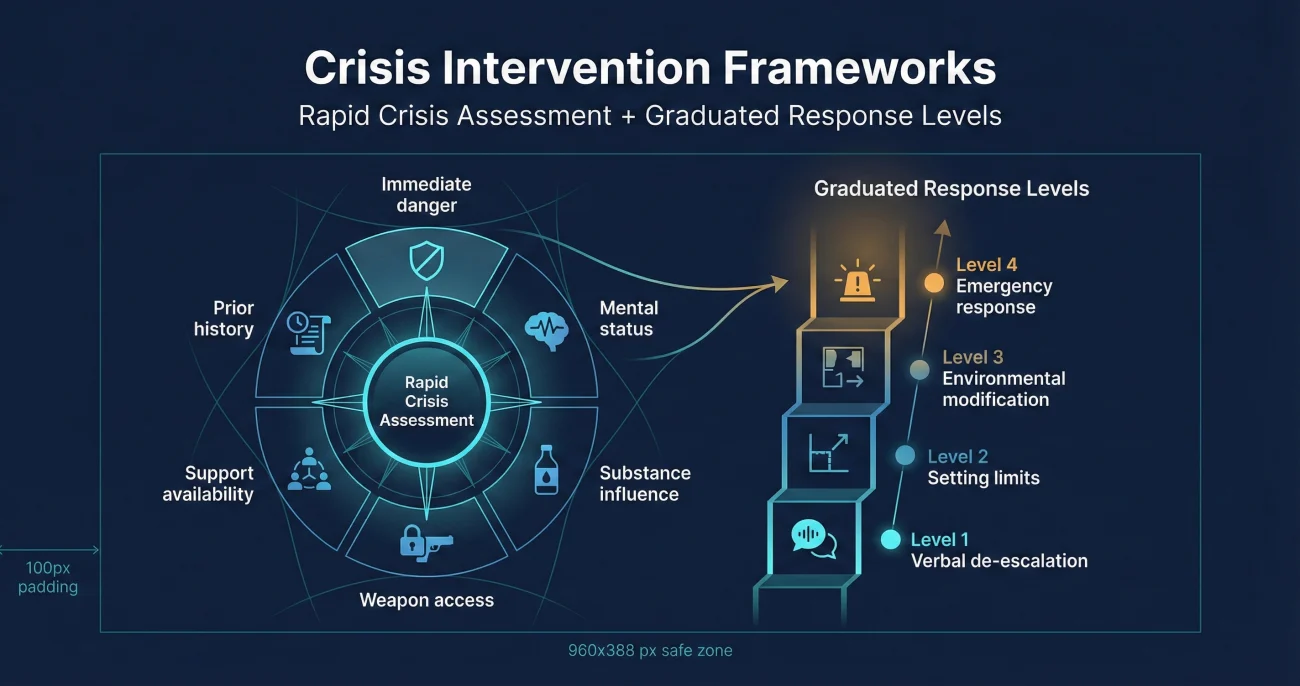
Systematic crisis intervention models provide structure for assessing situations and determining appropriate interventions.
Rapid Crisis Assessment
Quick evaluation determines intervention priorities and safety measures needed.
- Immediate danger: Is anyone in imminent physical danger requiring immediate action or evacuation?
- Mental status: Is person oriented, coherent, able to process information rationally?
- Substance influence: Is intoxication or withdrawal affecting judgment and impulse control?
- Weapon access: Are weapons present or accessible requiring removal or distance?
- Support availability: Are helpful others present or can they be contacted for assistance?
- Prior history: Is there history of violence, mental health crisis, or similar situations?
Graduated Response Levels
Match intervention intensity to situation severity, starting least intrusive and escalating as needed.
- 🟢 Level 1 – Verbal de-escalation: Calm communication, active listening, choice-giving, collaborative problem-solving
- 🟡 Level 2 – Setting limits: Clear boundaries, natural consequences explained, increased firmness while maintaining respect
- 🟠 Level 3 – Environmental modification: Remove triggers, create safety through space/distance, involve additional support
- 🔴 Level 4 – Emergency response: Call police/mental health crisis team, protective custody, involuntary intervention when necessary
Demonstrating De-escalation Skills in Interviews
Interviews assess crisis intervention competence through scenario questions and methodology discussion.
- Describe your de-escalation process step-by-step showing systematic approach not just instinct
- Share specific example: agitated individual, what you observed, techniques used, how situation resolved
- Discuss how you assess danger level and when you call for backup
- Explain how you stay calm during crisis, personal regulation strategies
- Address mistake or failed de-escalation attempt, what you learned, what you’d do differently
- Describe training received and continued skill development (CPI, de-escalation certification, practice scenarios)
For comprehensive crisis intervention frameworks and behavioral scenario practice, explore our detailed emergency response career guides.
❓ FAQ
🎯 What if the person won’t calm down despite my best efforts?
Not every situation de-escalates through verbal intervention alone. Some people are too intoxicated, psychotic, or emotionally dysregulated for conversation to work. Recognize when de-escalation isn’t working: person escalating despite appropriate techniques, becoming more agitated, threatening violence, or you feel increasingly unsafe. At that point, create distance, call for backup (supervisor, security, police), and prioritize safety over resolution. Failed de-escalation doesn’t mean you’re incompetent: some situations require different interventions beyond your scope.
💼 How do I stay calm when someone is yelling at me?
Practice self-regulation techniques: deep breathing (slow exhale activates parasympathetic nervous system), grounding (notice physical sensations keeping you present), remind yourself “this isn’t personal” (they’re in crisis, not attacking you specifically), focus on professional role not ego. Develop pre-crisis calming rituals and post-crisis debriefing releasing stress. Regular supervision discussing difficult encounters prevents accumulation. Some anxiety is normal and healthy, maintaining alertness. Seek additional training or therapy if crisis situations trigger overwhelming anxiety preventing effective response.
⏰ Should I ever use physical intervention?
Physical intervention should be absolute last resort after verbal de-escalation failed, only when: (1) someone in imminent danger of serious harm, (2) you have proper training in safe restraint techniques, (3) sufficient staff available to restrain safely, and (4) your organization authorizes physical intervention in your role. Untrained physical intervention often escalates situations, causes injuries, and creates liability. Most professional roles require calling trained responders (police, security, crisis team) rather than personally restraining. Know your organization’s policy clearly before employment.
📋 What if person has weapon?
Weapon presence fundamentally changes situation: maintain maximum distance (15+ feet minimum), keep obstacles between you and armed person, call police immediately, evacuate others if possible, don’t attempt to disarm unless immediate life threat and properly trained. Never approach armed individual for de-escalation conversation: communicate from safe distance or through barriers. If they’re threatening suicide not others, focus on keeping them talking until police arrive with crisis negotiators. Your safety takes absolute priority over de-escalation success when weapons involved.
✨ How do I demonstrate de-escalation skills without appearing violent or aggressive myself?
Frame examples emphasizing your calm presence, empathy, patience, and communication skills rather than dramatic confrontations. Discuss your systematic approach: assessing situation, choosing appropriate techniques, adapting when initial approach didn’t work. Emphasize successful outcomes through talking rather than force: “Person eventually felt heard and we worked out solution together.” Mention safety awareness showing you understand risks without fixating on danger. Demonstrate confidence through competence description not bravado about handling dangerous people.
Final Thoughts
Mastering de-escalation techniques requires conscious communication regulation, strategic physical positioning, genuine empathic listening, and systematic crisis assessment frameworks. Effective de-escalation prioritizes safety, validates emotions without endorsing problematic behavior, and creates collaborative solutions preserving dignity while establishing necessary boundaries.
⚠️ Disclaimer: The interview strategies, sample answers, and negotiation tips provided in this guide are for educational purposes only. Hiring decisions are subjective and vary by company and industry. While these strategies are based on professional HR standards, they do not guarantee a specific job offer or result.