The Architect of Relationships
Marriage and Family Therapists (MFTs) occupy a unique space in the mental health field. Unlike individual therapists who focus on the internal psyche, MFTs view problems through the lens of relationships and systems.
You are the architect who helps families redesign their blueprints for interaction, communication, and trust. Hiring managers are looking for clinicians who can hold the weight of multiple competing narratives in the room simultaneously without taking sides.
They need to know that you can de-escalate a shouting match between spouses, navigate the delicate ethics of “secrets” in couple work, and apply rigorous systems theory to create lasting change. To secure this role, you must be ready to answer marriage and family therapist interview questions that test your ability to think systemically, manage high-conflict dynamics, and foster connection in the face of deep division.
Systems Theory and Clinical Models
Q: Explain “Systems Theory” and how you apply it in practice.
Systems Theory posits that an individual cannot be understood in isolation from their family unit. The family is an emotional unit where members are intensely connected; a change in one person affects the whole system. In practice, this means I don’t just treat the “identified patient” (e.g., the acting-out child). I look at the feedback loops maintaining that behavior. Is the child acting out to distract from the parents’ marital conflict? I intervene to change the pattern of interaction between members, rather than just trying to “fix” the individual. I help the family see their circular causality rather than linear blame.
Q: How do you differentiate between Structural Family Therapy and Bowenian Family Therapy?
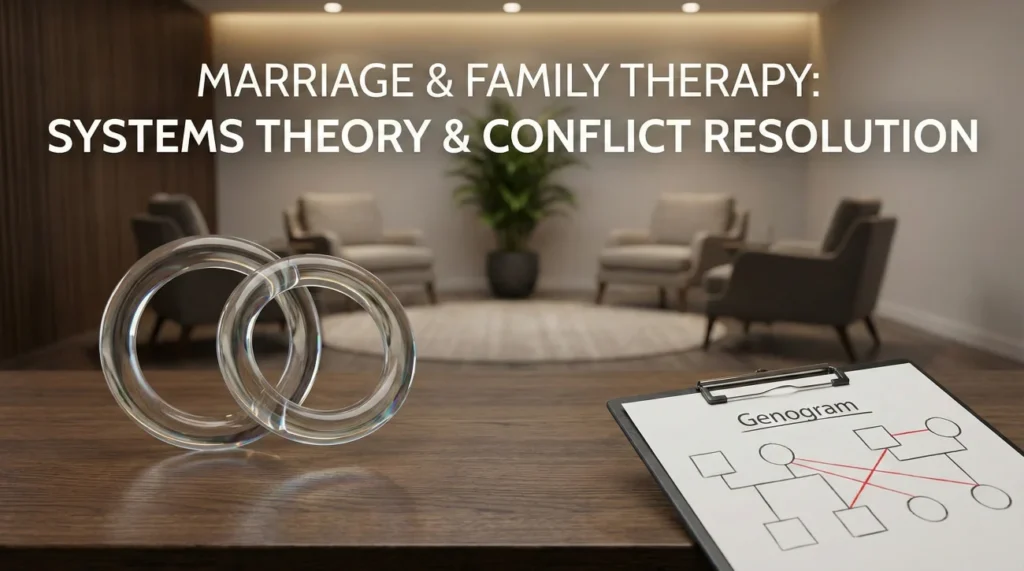
Structural Family Therapy (Minuchin) focuses on the “here and now.” I look at the family structure, boundaries, and subsystems. I might actively intervene in the session to “enact” a conflict and restructure boundaries (e.g., getting parents to unite so the child stops parenting the parent). Bowenian Therapy is multigenerational. It focuses on differentiation of self and anxiety transmission across generations. I would use a genogram to map patterns and help individuals separate their own emotions from the family “fusion.” Structural is more directive and action-oriented; Bowenian is more insight-oriented and historical.
Q: What is your approach to Emotionally Focused Therapy (EFT) with couples?
EFT is my go-to for couples because it targets the attachment bond. I view marital distress as an attachment panic. One partner usually pursues (seeking connection) while the other withdraws (protecting themselves). My goal is to de-escalate this negative cycle. I help the pursuer express their underlying fear of abandonment rather than anger. I help the withdrawer express their fear of failure rather than silence. By accessing these primary emotions, we create “corrective emotional experiences” that rebuild safety and trust, allowing the couple to turn toward each other for comfort.
Q: How do you assess “differentiation of self” in a client?
Differentiation is the ability to remain emotionally separate from the family while staying connected. A poorly differentiated person is easily triggered by others’ anxiety and either fuses (agrees to keep peace) or cuts off (leaves to avoid conflict). I assess this by asking how they handle disagreement with parents or spouses. Can they state their own needs without attacking or collapsing? Do they take responsibility for their own feelings? High differentiation allows a client to say “I” statements calmly in a heated room. Increasing differentiation is often a primary goal of my therapy to reduce emotional reactivity.
Conflict Resolution and High-Conflict Sessions
Q: A couple starts shouting at each other in the session. How do you intervene?
I intervene immediately. I do not let the therapy room become a reenactment of their kitchen fights. I stand up or use a “time out” hand signal if necessary to break the pattern.
I say, “I am going to stop you right there. This is the dynamic that brought you here, and practicing it here won’t help. I want to hear both of you, but one at a time.” I then slow the process down. I ask one partner to speak only to me, not the other, to lower the heat. I validate the intensity but redirect the energy toward understanding the cycle, not attacking the person.
Q: How do you handle “triangulation” in family therapy?
Triangulation happens when two people (e.g., parents) pull a third person (e.g., child) into their conflict to reduce tension. I identify it explicitly.
I might say, “I notice that when Mom and Dad argue, the focus shifts to Johnny’s grades. Let’s see if Mom and Dad can talk about their disagreement directly without involving Johnny.” My goal is to “detriangulate” the third party. I encourage direct communication between the primary dyad in conflict. I empower the child to step out of the middle (“It sounds like this is a parent problem, not a kid problem”).
Q: Describe your strategy for working with a couple on the brink of divorce (“Discernment Counseling”).
When one partner wants out (“leaning out”) and the other wants to save the marriage (“leaning in”), traditional counseling fails. I use Discernment Counseling protocols.
The goal is clarity, not necessarily saving the marriage. I see them largely separately. I help the “leaning out” partner decide if they want to try one last all-out effort. I help the “leaning in” partner manage their anxiety and stop pressuring. We agree to a short term (e.g., 5 sessions) to decide on a path: stay as is, separate, or commit to 6 months of hard couples therapy. This structure provides safety and prevents false hope.
Q: How do you manage a “secret” told to you by one partner individually (e.g., infidelity)?
This is the classic MFT ethical dilemma. I have a clear “No Secrets” policy stated in my informed consent. I tell them upfront: “I do not keep secrets that block the therapy.”
If a partner reveals infidelity individually, I explain that I cannot continue couples therapy while holding this secret, as it makes me complicit in the betrayal. I support them in disclosing it themselves in a safe way. If they refuse to disclose, I may have to terminate the couples therapy (without revealing the specific reason to protect safety), forcing the issue to be addressed or the therapy to end.
Q: How do you work with high-conflict co-parenting after divorce?
I focus on the “business of parenting.” I help them move from an intimate relationship to a business partnership. We set strict boundaries on communication (e.g., email only, using apps like OurFamilyWizard).
I keep the focus relentlessly on the child’s needs. “I know you are angry at your ex, but how does bad-mouthing him affect your daughter’s anxiety?” I teach them to disengage from emotional hooks and respond only to logistical facts. I aim to reduce the child’s exposure to their conflict, which is the single biggest predictor of poor outcomes for children of divorce.
Q: How do you handle domestic violence (IPV) in couples therapy?
Couples therapy is generally contraindicated when there is active Intimate Partner Violence (IPV) because it is unsafe. The victim cannot speak freely.
I screen for IPV individually before starting couples work. If I discover active violence, I stop couples work and refer the victim to safety planning/individual support and the perpetrator to a batterer intervention program. If the violence is situational/minor and both take responsibility, we might proceed with caution, but safety is the absolute priority. I never encourage a victim to “communicate better” with an abuser who uses power and control.
Clinical Scenarios and Ethics
A teenager in family therapy reveals they are gay but isn’t out to their parents. What do you do?
I honor the teenager’s confidentiality and autonomy. I do not “out” them to their parents. That would be a betrayal of trust and potentially dangerous.
I work with the teen individually to explore their readiness to come out and their fears about the parents’ reaction. We role-play the conversation. I assess safety. In family sessions, I might work on the general climate of acceptance and communication without revealing the specific secret, laying the groundwork for a safer environment when the teen is ready to share.
One partner dominates the session and constantly interrupts. How do you balance the room?
I use the “interrupting” intervention as a therapeutic tool. I say, “I’m going to interrupt you for a second because I want to make sure I heard what your partner just said.”
I validate the dominant partner’s need to be heard (“You have a lot to say about this”) but firmly set the boundary (“But for this to work, we need to hear from Sarah”). I might ask the quiet partner direct questions. I might explore why the dominant partner takes up space – is it anxiety? A feeling of not being heard? Addressing the function of the dominance helps change it.
You feel biased against one partner because they remind you of your ex. What do you do?
This is countertransference. I own it internally but do not reveal it to the client. I take it to my own supervision or consultation group immediately.
I work to separate my personal history from the client’s reality. I actively look for the client’s strengths and the validity of their perspective to “humanize” them beyond my projection. If the bias is so strong that I cannot be neutral or effective, I have an ethical duty to refer the couple to another therapist, framing it as a fit issue rather than a personal judgment.
A family refuses to pay for missed sessions despite your policy. How do you handle it?
I address it directly as a clinical issue, not just a financial one. Boundaries around money reflect boundaries in the relationship.
I remind them of the informed consent they signed. “Our agreement states that cancellations under 24 hours are billed. This ensures I can hold this time for you.” I explore the resistance – is it a passive-aggressive expression of anger at the therapy? I am firm but respectful. If they refuse to pay, I may have to pause therapy until the balance is cleared, as working for free creates resentment and enables poor boundaries.
Documentation and Professionalism
Q: How do you document “relational” notes versus individual notes?
In family/couple therapy, the “client” is the relationship. My notes reflect the interactional patterns, not just individual symptoms. I document “circular interactions” (e.g., “Wife criticized Husband’s parenting; Husband withdrew; Wife escalated volume”). I identify the interventions used to disrupt the cycle. I am careful not to “blame” one party in the permanent record. I ensure the diagnosis codes (often Z-codes for relational problems) match the treatment plan. I am aware that in a high-conflict divorce, these notes could be subpoenaed, so I remain strictly factual and objective.
Q: Describe your experience with “Telehealth” for couples therapy.
Telehealth with couples presents unique challenges. I have to work harder to read body language since I can only see faces. I ensure both partners are on the same screen so I can see their interaction. I set ground rules about privacy (no kids in the room, no recording). I use more verbal check-ins: “I noticed you looked away just then; what was happening for you?” I also manage the “exit” differently; ensuring they are regulated before clicking “end meeting” since they are already in their home environment and might continue the fight.
Q: How do you handle a subpoena for your records in a custody battle?
I do not just hand over the records. I assert the psychotherapist-patient privilege on behalf of my clients. I contact the clients to see if they waive privilege. If one waives and the other does not (common in divorce), I am in a bind.
I typically consult with my own malpractice attorney or professional liability insurer immediately. I might file a motion to quash the subpoena or request an “in camera” review by the judge to determine relevance. My goal is to protect the therapy room’s privacy to the maximum extent the law allows, preventing therapy from being weaponized in court.
Q: How do you manage your own self-care when dealing with high-conflict families?
I recognize that absorbing intense family conflict is draining. I practice rigorous self-care. I leave work at work. I engage in my own therapy. I have a peer consultation group where I can vent and get support.
I ensure I have a balanced caseload so I am not seeing 30 high-conflict couples a week. I schedule breaks between sessions to reset. I remind myself that I am responsible for the process of therapy, but the clients are responsible for the outcome. This boundary prevents me from taking their failures or successes personally.
MFT Knowledge Quiz
20 Practice Questions
1. Who is the “founder” of Structural Family Therapy?
- Murray Bowen
- Salvador Minuchin
- Carl Whitaker
- Virginia Satir
2. “Differentiation of Self” is a core concept of:
- Solution-Focused Therapy
- Bowenian Family Systems
- Narrative Therapy
- Strategic Family Therapy
3. “EFT” focuses primarily on:
- Changing behavior charts
- Attachment bonds and emotions
- analyzing childhood dreams
- Teaching communication scripts
4. A “Genogram” is used to:
- Diagnose mental illness
- Map multigenerational patterns
- Schedule appointments
- Record billing information
5. “Triangulation” involves:
- Three therapists in a room
- Pulling a third person into a dyadic conflict
- Using three different theories
- Meeting three times a week
6. “Homeostasis” in a family system means:
- The family is buying a house
- Tendency to maintain stability/status quo
- Rapid change and growth
- Total chaos and breakdown
7. “Joining” is the process of:
- Paying the therapy fee
- Therapist building rapport with the family
- Parents getting divorced
- Kids joining a sports team
8. Which is a “paradoxical intervention”?
- Telling the client to stop fighting
- Prescribing the symptom (e.g., fight more)
- Giving a compliment
- Asking a miracle question
9. “Enactment” is used to:
- End the session early
- Observe interaction patterns live
- Read a script to clients
- Watch a movie together
10. “Circular Causality” means:
- A causes B linearly
- A and B mutually influence each other
- Going in circles without progress
- The problem has no cause
11. “First-order change” is:
- Deep structural transformation
- Superficial behavioral change
- Changing therapists
- The first session goal
12. “Second-order change” involves:
- Repeating the same solution
- Changing the system’s rules/structure
- Changing the appointment time
- Paying a higher fee
13. The “Miracle Question” comes from:
- Psychoanalysis
- Solution-Focused Brief Therapy
- Narrative Therapy
- Cognitive Behavioral Therapy
14. “Externalizing the problem” is key in:
- Bowenian Therapy
- Narrative Therapy
- Behavioral Therapy
- Structural Therapy
15. “Fusion” refers to:
- A healthy close relationship
- Lack of emotional separation/boundaries
- Cooking dinner together
- Two families merging
16. “Reframing” changes the:
- Picture on the wall
- Meaning attributed to a behavior
- Time of the session
- Cost of the therapy
17. An “Identified Patient” (IP) is:
- The only sick person in the family
- The symptom-bearer for the system
- The person paying the bill
- The therapist
18. “Multigenerational Transmission Process” means:
- Genetic diseases only
- Patterns/anxiety passed down generations
- Sending money to grandparents
- Talking to kids about history
19. “Boundaries” can be:
- Only physical walls
- Rigid, Diffuse, or Healthy
- Expensive or cheap
- Good or bad only
20. “Equifinality” means:
- Only one way to reach a goal
- Many paths lead to the same outcome
- Everyone finishes at the same time
- Equality for all family members
❓ Frequently Asked Questions
📜 What is the difference between LMFT and LCSW?
While both can provide psychotherapy, the training focus differs. LCSWs (Social Workers) are trained in a “person-in-environment” model, often emphasizing resource linkage and advocacy. LMFTs (Marriage and Family Therapists) are trained specifically in systems theory and relationship dynamics. LMFTs are the specialists for couples and families, while LCSWs are often broader generalists.
⚖️ Can I treat my client’s sister individually?
This is a potential “dual relationship” or conflict of interest. Treating close family members individually can compromise your neutrality and confidentiality (e.g., holding secrets). Most ethical codes advise against it unless necessary (like in rural areas) and require careful boundary management. Referring the sister to a colleague is usually the safer choice.
💰 Is private practice better than agency work?
It depends on your goals. Agency work provides a steady paycheck, benefits, and supervision (crucial for licensure). It exposes you to high-acuity cases. Private practice offers autonomy, higher earning potential per hour, and control over your schedule, but requires business skills (marketing, billing) and can be isolating. Many MFTs start in agencies and move to private practice later.
🎓 How many hours do I need for licensure?
It varies by state, but typically requires a Master’s degree plus roughly 3,000 hours of supervised post-degree experience (over roughly 2 years) and passing a clinical exam (like the AMFTRB National Exam or a state-specific law and ethics exam). It is a rigorous process.
🚀 What is the job outlook for MFTs?
Excellent. The demand for mental health services, particularly relationship counseling, is growing. Telehealth has expanded access. MFTs are finding roles not just in private practice, but in integrated healthcare settings (medical family therapy), schools, employee assistance programs, and military support services.
The Systemic Thinker
Marriage and Family Therapy is a complex, intellectually stimulating, and deeply rewarding profession. It requires you to be a participant-observer, stepping into the family dance just enough to change the rhythm without getting swept away. When you interview, show them your systemic lens. Show them you can handle the heat of conflict and the subtlety of silence. By mastering these marriage and family therapist interview questions, you demonstrate that you are ready to be the steady anchor that families need to heal their relationships and build a stronger future.
⚠️ Disclaimer: The interview strategies, sample answers, and negotiation tips provided in this guide are for educational purposes only. Hiring decisions are subjective and vary by company and industry. While these strategies are based on professional HR standards, they do not guarantee a specific job offer or result.