The Experience Gap That Isn’t
Students freeze when asked tell me about yourself as a student because they believe they have nothing to say. No full-time jobs. No impressive titles. No years of experience to reference. The question feels designed for someone else, someone with a real career to describe.
This perspective fundamentally misunderstands what employers want from student candidates. They’re not hiring you for experience you don’t have. They’re hiring for potential they see. Your job isn’t to pretend you have a resume full of accomplishments. Your job is to demonstrate the qualities that predict future success: intellectual curiosity, initiative, ability to learn quickly, and genuine enthusiasm for the opportunity.
A recruiter at a major consulting firm told me she actually prefers interviewing students to experienced hires for entry roles. “Experienced candidates often give polished, rehearsed answers that tell me nothing real. Students are usually more authentic. I can see who they actually are, which is what I’m really trying to assess.”
Your Hidden Assets
Students have more relevant experience than they realize. The problem is they don’t recognize it as experience because it didn’t come with a paycheck.

Academic Achievements
Your major, relevant coursework, academic projects, and GPA tell employers about your intellectual capabilities and interests. A challenging major demonstrates you can handle difficulty. Relevant coursework shows you’ve built foundational knowledge. Academic projects prove you can complete complex work.
Don’t just list your major. Explain why you chose it and what you’ve learned that applies to this role. “I’m majoring in economics because I’m fascinated by how incentive structures shape behavior, and I’ve taken additional coursework in data analysis to strengthen my quantitative skills.”
Extracurricular Activities
Leadership in student organizations, volunteer work, athletic teams, and clubs demonstrates skills employers value: teamwork, initiative, time management, and the ability to commit to something beyond yourself.
Don’t minimize these experiences. Leading a student organization requires the same skills as managing a team. Coordinating a volunteer project requires project management. Playing a team sport demonstrates collaboration and resilience.
Part-Time and Informal Work
Retail jobs, tutoring, babysitting, campus employment, and summer work all count. These experiences demonstrate reliability, customer service skills, and ability to balance multiple responsibilities. A student who maintained good grades while working twenty hours weekly shows time management that many full-time professionals lack.
Personal Projects and Interests
Did you build a website? Start a blog? Learn a programming language independently? Create art or music? Pursue a serious hobby? These demonstrate initiative, self-direction, and genuine passion. Employers increasingly value candidates who create things on their own rather than waiting for assignments.
| Experience Type | What It Demonstrates | How to Present It |
|---|---|---|
| Academics | Intellectual capability, subject knowledge | Connect coursework to role requirements |
| Leadership roles | Initiative, responsibility, influence | Describe impact and challenges overcome |
| Part-time work | Reliability, professionalism, balance | Highlight transferable skills learned |
| Volunteer work | Values, commitment, teamwork | Focus on contributions and outcomes |
| Personal projects | Self-direction, passion, creativity | Explain what you built and learned |
Structuring Your Student Introduction
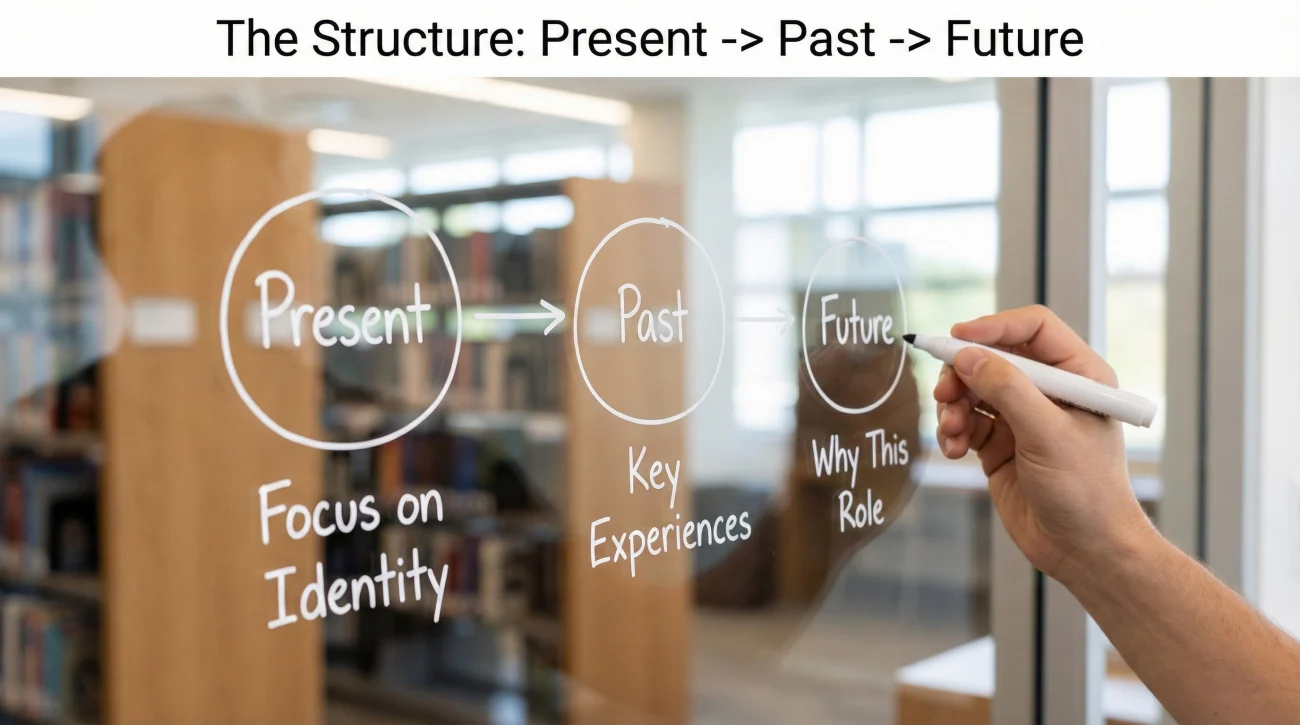
The classic Present-Past-Future framework works for students, but the content differs from experienced professionals.
Present: Your Current Identity
Start with who you are right now. Your year in school, your major, and what currently occupies your focus. This grounds the interviewer in your situation.
“I’m a junior at State University majoring in computer science with a concentration in machine learning.”
Past: What Shaped You
Share relevant experiences that built skills applicable to this role. Select experiences strategically based on the position you’re pursuing. Quantify impact when possible.
“I’ve spent two years as technology chair for our business fraternity, where I rebuilt our website and automated our membership tracking, reducing administrative work by about ten hours per month.”
Future: Why This Opportunity
Connect your background to why you’re genuinely interested in this specific role. Show you’ve thought about how this position fits your direction.
“I’m excited about this data analyst internship because it would let me apply my technical skills to real business problems while learning how analytics drives decisions in retail.”
Sample Answers by Situation
STEM Student
“I’m a senior at Tech University studying computer engineering. I chose this field because I’ve always been curious about how technology actually works at the hardware level, not just how to use it.
Over the past three years, I’ve focused on embedded systems. My senior project involves designing a low-power sensor network for agricultural monitoring. I’ve also worked part-time at the university IT help desk, which taught me how to explain technical concepts to non-technical users.
I’m drawn to your company because you’re solving real infrastructure problems with IoT technology. The work your team is doing on smart grid optimization aligns directly with what I want to build my career around.”
Liberal Arts Student
“I’m graduating this spring with a degree in English and a minor in business. That combination might seem unusual, but I’ve found that strong writing and analytical skills apply almost everywhere.
I’ve been editor of our campus literary magazine for two years, which means I manage a team of twelve reviewers, coordinate with our printer, and handle our budget. I also interned last summer at a small marketing agency where I wrote website copy and learned the basics of content strategy.
I’m interested in this content marketing role because I want to use my writing skills in a business context where I can see direct impact on company growth.”
Minimal Experience
“I’m a sophomore at Community College studying business administration. I’m the first person in my family to attend college, and I’m working about twenty-five hours a week at a grocery store while taking a full course load.
I haven’t had formal professional experience yet, but balancing work and school has taught me how to manage my time carefully and stay reliable even when things get overwhelming. At work, I’ve been promoted to shift supervisor, which means I handle scheduling and customer issues when managers aren’t available.
I’m applying for this administrative assistant internship because I want to learn how professional offices operate and develop skills I can build on after graduation.”
For more guidance on structuring your introduction, explore our comprehensive interview preparation guide.
Common Student Mistakes

Apologizing for Lack of Experience
“I don’t have much experience, but…”
This immediately undermines you. Everyone knows you’re a student. They’re not expecting ten years of corporate experience. Focus on what you bring rather than what you lack.
Leading With Personal Details
“I’m from a small town in Ohio and I have two brothers…”
Interviewers don’t need your biography. Lead with your academic and professional identity. Personal details can come later if relevant to building rapport.
Excessive Humility
Students often downplay genuine accomplishments because they seem small compared to professional achievements. Leading a club of fifty members is leadership. Maintaining a high GPA while working is impressive. State your accomplishments confidently without arrogance.
Generic Statements
“I’m a hard worker and a team player who’s eager to learn.”
Everyone says this. It means nothing. Replace generic claims with specific evidence. “I’ve worked twenty hours weekly throughout college while maintaining a 3.6 GPA” proves work ethic. “I coordinated a team of eight volunteers for our charity event” proves teamwork.
❓ FAQ
🎯 Should I mention my GPA?
Mention it if it’s strong (generally 3.5 or above) or if the employer specifically requests it. If your GPA is lower, focus on other achievements and don’t bring it up unless asked directly.
💼 How do I present unrelated work experience?
Focus on transferable skills rather than job duties. Retail work teaches customer service and problem-solving. Restaurant work teaches working under pressure and multitasking. Every job builds skills that transfer to professional environments.
⏰ How long should my answer be?
Aim for sixty to ninety seconds. Students often give answers that are too short because they don’t recognize what’s worth sharing, or too long because they include irrelevant personal details. Practice to find the right balance.
📋 Should I mention why I chose my major?
If the reason is compelling and relevant to the role, yes. Genuine passion for your field of study suggests you’ll bring that enthusiasm to work. Skip it if your major is unrelated to the position or if you chose it without strong reasons.
✨ What if I have no leadership experience?
Focus on other qualities: academic achievement, work ethic demonstrated through part-time jobs, personal projects, or initiative shown in other ways. Not every role requires leadership experience, especially at entry level.
Potential Over Experience
Answering tell me about yourself as a student effectively means showcasing potential rather than apologizing for limited experience. Lead with your academic identity, highlight experiences that demonstrate relevant skills, and connect genuinely to why you want this opportunity. Employers hiring students expect students, not seasoned professionals. What they want to see is someone curious, capable, and genuinely enthusiastic about starting their career with this role.
⚠️ Disclaimer: The interview strategies, sample answers, and negotiation tips provided in this guide are for educational purposes only. Hiring decisions are subjective and vary by company and industry. While these strategies are based on professional HR standards, they do not guarantee a specific job offer or result.