
What Internship Interviewers Actually Want
Internship interviews operate differently than full-time hiring. When employers ask tell me about yourself for an internship, they’re not expecting a polished professional narrative. They know you’re early in your journey. What they’re assessing is whether you’ll make the most of this learning opportunity and potentially become a future full-time hire.
Companies invest significantly in internship programs. Training interns takes time from full-time employees. The payoff comes when those interns contribute meaningfully during their term and return as capable new graduates. Interviewers are evaluating whether you’re the kind of person who will absorb knowledge quickly, contribute positively to team culture, and represent a good investment of their mentoring time.
This means your introduction should emphasize eagerness to learn, clarity about why you want this specific internship, and enough capability to suggest you won’t be a burden on the team.
What to Emphasize

Learning Orientation
Interns are expected to learn. Express genuine curiosity about the field and eagerness to develop skills. This isn’t about pretending you don’t know things. It’s about showing you’re genuinely excited to grow.
Specific learning goals are stronger than generic eagerness. “I want to understand how market research actually influences product decisions” is more compelling than “I want to learn about business.”
Career Direction
Explain how this internship fits your career exploration or development. Even if you’re uncertain about your exact path, you should have reasons for pursuing this particular opportunity.
“I’m exploring whether investment banking is the right fit for me, and this internship would give me direct exposure to the work and culture.”
Relevant Preparation
While experience expectations are lower for internships, relevant preparation still matters. Coursework, projects, campus activities, or even independent learning that relates to the role shows you’re already moving in this direction.
Potential Contribution
Interns shouldn’t only take. The best interns contribute value while they learn. Indicate what skills or qualities you bring that could benefit the team, even in small ways.
| Internship Emphasis | Why It Matters | How to Show It |
|---|---|---|
| Learning eagerness | Shows you’ll maximize the opportunity | Express specific things you want to learn |
| Career direction | Suggests you’re intentional, not random | Connect internship to your broader path |
| Relevant preparation | Demonstrates baseline capability | Mention coursework, projects, or activities |
| Contribution potential | Shows you won’t just absorb resources | Highlight skills that could help the team |
Structuring Your Internship Introduction
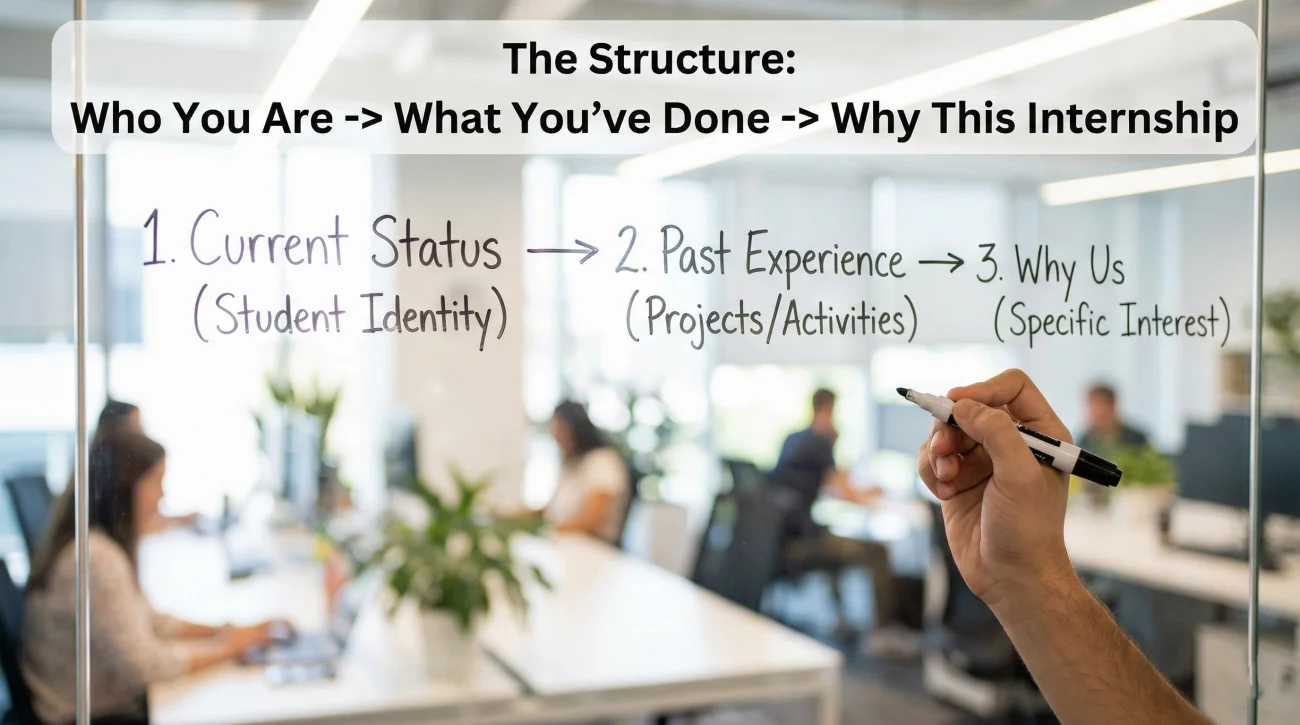
Who You Are Now
Ground the interviewer in your current situation. Your year in school, major, and relevant focus areas. Keep this brief but informative.
“I’m a junior at State University majoring in accounting with a minor in information systems.”
What You’ve Done
Select relevant experiences, even if limited. Academic projects, campus involvement, part-time work, or independent learning all count. Connect them to why you’re prepared for this internship.
Why This Internship
This is crucial for internship interviews. Companies want interns who specifically want them, not interns who applied everywhere and happened to get this interview. Research the company and articulate genuine reasons for your interest.
“I’m drawn to this internship specifically because your firm works with healthcare clients, and I’m interested in eventually specializing in healthcare consulting.”
Sample Answers
Consulting Internship
“I’m a junior at Business University studying economics with a concentration in strategy. I’ve been drawn to consulting since taking a case competition course last year where my team placed second analyzing a retail company’s expansion strategy.
That experience showed me I enjoy breaking down complex business problems and working collaboratively under pressure. I’ve since joined our consulting club and completed two more case competitions to build my skills.
I’m particularly interested in your firm because of your work in healthcare, which is a sector I want to understand better. I’m hoping to use this internship to learn how consultants actually work with clients and to figure out whether this path is right for me long-term.”
Engineering Internship
“I’m finishing my sophomore year in mechanical engineering at Tech University. My focus has been on robotics and automation, and I lead the controls team for our student robotics competition group.
Working on competition robots has taught me how to design systems that actually work, not just systems that look good on paper. I’ve debugged sensors, programmed motion sequences, and learned to work within tight material budgets.
I applied for this manufacturing internship because I want to see how automation works at industrial scale. Building competition robots is one thing. Understanding how factories actually implement robotic systems would help me figure out where I want to focus my career.”
Marketing Internship
“I’m a junior studying communications with a digital marketing certificate I’m completing alongside my degree. I run social media for our campus newspaper, which has grown from about two hundred followers to over three thousand since I took it over.
That experience taught me basics of content planning, analytics, and what actually gets engagement versus what just fills space. I’ve experimented with different posting times, content formats, and platform strategies.
I want this internship because I want to learn how marketing works at a professional level. Managing a student publication is great practice, but I know there’s a lot I can only learn from seeing how a real marketing team operates with actual budgets and business goals.”
For more introduction frameworks, see our comprehensive self-introduction guide.
Internship-Specific Pitfalls

Generic Company Interest
“I want to work at a big company to learn about business.”
This could apply to any company. Research specifically why this firm, this role, and this opportunity. Generic interest suggests you’re spraying applications everywhere.
Only Wanting Resume Credit
If your answer sounds like you mainly want the brand name on your resume, interviewers notice. Focus on genuine learning goals and fit rather than prestige collection.
Pretending to Be More Than You Are
Interns aren’t expected to be experts. Pretending you know more than you do will become obvious quickly and damage trust. It’s better to say “I’ve studied this in class and I’m eager to see how it works in practice” than to claim expertise you don’t have.
Being Too Passive
“I’ll do whatever you need me to do.”
While flexibility is good, complete passivity suggests you have no direction. Have opinions about what you want to learn and contribute, even as you remain open to guidance.
The intern mindset: Eager to learn but not empty. You have interests, goals, and some capability. You’re seeking guidance to develop further, not a blank slate waiting to be programmed.
❓ FAQ
🎯 How important is GPA for internships?
Many companies have GPA cutoffs for internship programs. If yours is strong, mention it. If it’s below typical cutoffs, focus on other strengths and be prepared to address it if asked. A lower GPA combined with strong relevant experience can still succeed.
💼 What if this is my first internship?
Focus on academic preparation, relevant activities, and genuine enthusiasm. Everyone’s first internship is their first. Companies expect to train interns with limited experience. What matters is showing you’re prepared to learn and contribute.
⏰ How much should I research the company?
Enough to articulate specific reasons for wanting this internship. Know what the company does, recent news or projects, and why it interests you. You don’t need to know everything, but complete ignorance signals you didn’t care enough to prepare.
📋 Should I mention wanting a full-time offer?
It’s fine to express interest in potentially returning full-time, but don’t make it sound transactional. “I’m hoping this could be the start of a longer relationship with the firm” is better than “I want you to hire me after graduation.”
✨ What if I’m unsure about my career direction?
Frame it as exploration. “I’m using this internship to test whether consulting is the right path for me” is honest and appropriate. Companies understand that internships serve exploratory purposes. Complete uncertainty is fine if you can explain why this specific exploration interests you.
Make the Learning Case
Answering tell me about yourself for an internship is about demonstrating you’re worth the investment. Show genuine curiosity and specific learning goals. Connect your background to why you’re prepared for this opportunity. Articulate clearly why this particular internship interests you. Companies want interns who will absorb everything they can, contribute positively, and potentially return as valuable full-time employees. Your introduction should convince them you’re that person.
⚠️ Disclaimer: The interview strategies, sample answers, and negotiation tips provided in this guide are for educational purposes only. Hiring decisions are subjective and vary by company and industry. While these strategies are based on professional HR standards, they do not guarantee a specific job offer or result.