More Than Just a Steering Wheel Holder
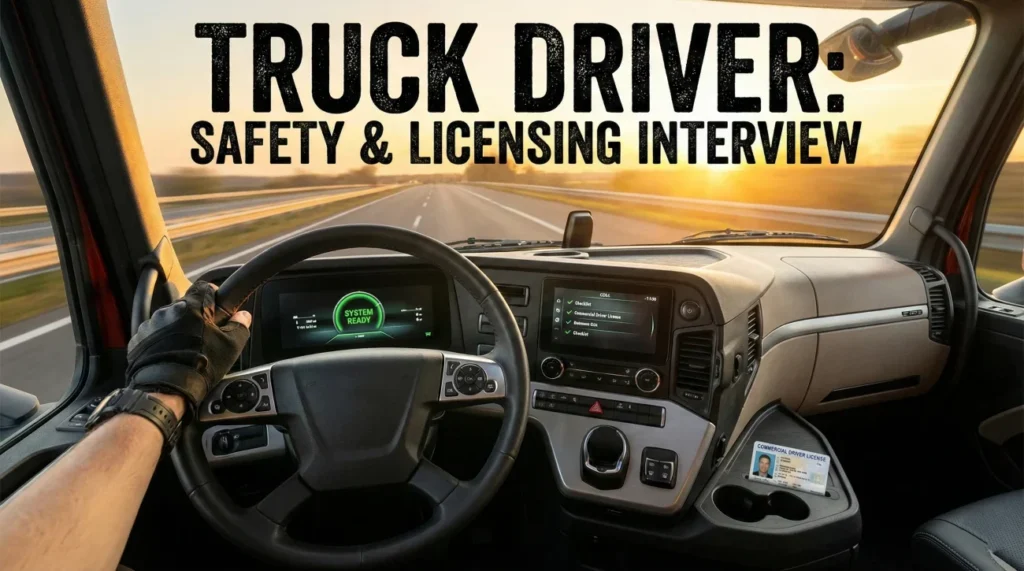
The trucking industry is under siege. With insurance premiums sky-rocketing and “Nuclear Verdicts” (lawsuits exceeding $10 million) becoming common, companies can no longer afford to hire average drivers. They are looking for “Risk Managers” who happen to have a Commercial Driver’s License (CDL). A clean driving record is just the entry ticket; the interview is where they determine if you are a liability or an asset.
Interviewers today will grill you on the specifics of the Federal Motor Carrier Safety Administration (FMCSA) regulations. They don’t just want to know if you do a pre-trip inspection; they want to know how you check a slack adjuster. They want to see if you understand that a logbook violation isn’t just a fine, but a strike against the company’s safety rating that could lose them contracts. This guide provides the hardcore technical truck driver interview questions designed to separate the professional operators from the steering wheel holders.
The Legal Side: DOT & Logs
Q: The “14-Hour Rule” vs. the “11-Hour Rule.” Explain the difference like I’m a rookie.
The 11-hour rule limits my actual driving time. I can only turn the wheels for 11 hours. The 14-hour rule is my “daily window” of opportunity. Once I punch in, that 14-hour clock ticks down relentlessly, regardless of whether I am driving, fueling, or eating a sandwich. I cannot stop it. If I spend 4 hours at a dock, I don’t get those back; they are burned. I must stop driving after the 14th hour, even if I only drove for 5 hours.
Q: How do you manage your “70-Hour Clock” to avoid a 34-hour restart?
I run on “Recap.” Instead of burning out by driving 11 hours every day and hitting my 70-hour limit in 6 days, I pace myself. I aim to work about 8.5 to 9 hours a day. This way, the hours I worked 8 days ago fall off (recap) and become available again tomorrow. It keeps me rolling continuously without being forced to sit parked for 34 hours, which keeps my paycheck steady.
Q: What is a “CSA Score” and how do YOU impact ours?
CSA is the government’s report card on the company. Every time I get a warning for a light out, a flat tire, or speeding, points are added to your score, not just my license. If that score gets too high, the DOT pulls all your trucks in for inspection, and brokers stop giving us loads. I protect your score by doing legitimate pre-trips so the DOT never finds a mechanical violation on my rig.
Q: A DOT officer pulls you over for a Level 1 Inspection. What do you do?
I turn off the engine, put the keys on the dash, and have my permit book, medical card, and license ready before he gets to the window. I am polite. “Yes sir, no sir.” I follow instructions perfectly. If he finds a violation, I own it. Arguing on the side of the road never deletes a ticket; it only guarantees a closer look at everything else. I treat the officer with respect to get us back on the road faster.
Technical Knowledge: The Rig
Q: Air Brake Check (LAB)
Leaks: Hold brake, max 4 PSI loss/min. Alarm: Fan brakes, warning light on at 60 PSI. Buttons: Fan down to 20-45 PSI, valves must pop out.
Q: Tire Inspection
Steers need 4/32 inch tread; Drives need 2/32. I verify no mismatched sizes on duals and ensure valve caps are present to hold pressure.
Q: Fifth Wheel Connection
I physically look under the trailer to ensure the locking jaws are fully closed around the kingpin shank, not the head. No daylight between apron and skid plate.
Q: Checking Slack Adjusters
With brakes released and wheels chocked, I pull the slack adjuster by hand. If it moves more than 1 inch, it is out of adjustment and unsafe.
Q: Fluid Levels
I check oil, coolant, and power steering fluid daily. A low coolant sensor can shut down the engine on the highway, causing a tow bill for a $10 gallon of fluid.
Q: Lights and Reflectors
I check every marker light. A burned-out clearance light is “probable cause” for a trooper to pull me over and start a full inspection.
Scenarios: Real World Problems
Scenario: You arrive at a shipper, and they overload your drive axles. The suspension gauge is maxed out.
I refuse to leave the yard. I slide my tandems (trailer wheels) to redistribute the weight if possible. I scale it immediately. If it is still illegal, I go back to the dock and demand a rework. I tell them: “I cannot legally haul this.” I call dispatch to back me up. I will not risk my license or a $5,000 fine for their mistake.
Scenario: You are tired. Your eyes are heavy. But you have 2 hours of legal drive time left and the load is hot.
I pull over. Legal does not mean safe. I send a macro message to dispatch: “Stopping for safety. Fatigue.” This protects me under the Coercion Rule. If I crash, the lawyer won’t care that I had legal hours; he will sue me for negligence. I protect the public first, the load second.
Scenario: You are backing into a blindingly tight dock. Traffic is blocking you, people are honking, and you are stressed.
I stop. I set the brakes. I get out and look (G.O.A.L). I ignore the honking; they can wait. I would rather make them wait 5 minutes than spend 5 hours filling out an accident report because I hit a wall. I take a deep breath, reset my angle, and back in at a snail’s pace.
Operational Smarts
Q: How do you plan your trip to avoid “Low Clearances”?
I never trust Google Maps. It is for cars. I use a Motor Carrier Atlas or a GPS specifically programmed for truck dimensions. I look at the route before I turn the key. If I see a non-truck route or a restriction, I plan around it. Hitting a bridge is a career-ending event.
Q: Driving in winter: When do you chain up?
If the chain law lights are on, I have a decision to make. If the road is pure ice, I park it. Chains help you go, but they don’t help you stop on ice. I communicate with dispatch: “Weather delay.” No load is worth dying for in a ditch.
Q: Fuel economy is huge for us. How do you drive for MPG?
I manage my momentum. I don’t race to a red light. I let the truck coast. On the highway, I keep it in the sweet spot (usually 62-65 MPH). Every mile per hour over 65 burns significantly more fuel. I minimize idling by using the bunk heater. I treat the fuel tank like it’s my own money.
Pro Driver Quiz
Test Your Road Knowledge (20 Questions)
1. What is “G.O.A.L”?
- Go On And Leave
- Get Out And Look
- Gas Oil And Lube
- Get Over All Lanes
2. When you double your speed, your stopping distance increases by:
- 2 times
- 4 times
- 3 times
- It stays the same
3. The “Service Line” (Blue) controls:
- Emergency Brakes
- Service Brakes (Foot Pedal)
- Trailer Lights
- ABS System
4. A “Bobtail” is:
- A short trailer
- A tractor without a trailer
- A broken tail light
- A type of engine
5. Minimum tread depth for Drive tires?
- 4/32 inch
- 2/32 inch
- 1/32 inch
- 6/32 inch
6. “Off-Tracking” means:
- The GPS is lost
- Rear wheels follow a different path than front wheels
- Driving off road
- The engine is misfiring
7. “Deadhead” refers to:
- A tired driver
- Pulling an empty trailer
- A broken engine
- Driving at night
8. At 60 PSI, the low air warning must:
- Stop buzzing
- Activate (Light/Buzzer)
- Pop the valves
- Shut off the engine
9. How often do you check load securement?
- Once a day
- First 50 miles, then every 3 hours/150 miles
- Only at fuel stops
- Never
10. “Jackknife” happens when:
- The driver eats too much
- The trailer swings around the tractor
- The brakes fail
- The engine stalls
11. A “Converter Dolly” is used for:
- Moving heavy boxes
- Connecting double trailers
- Changing tires
- Sleeping
12. “Gross Combination Weight Rating” (GCWR):
- Truck weight only
- Max weight of Truck + Trailer + Load
- Trailer weight only
- Axle weight only
13. The “Kingpin” is located:
- On the tractor
- Under the trailer nose
- In the engine
- On the dashboard
14. “Brake Fade” is caused by:
- Cold weather
- Excessive heat from overuse
- Old fluid
- Wet roads
15. “Rubbernecking” means:
- Checking tires
- Staring at an accident scene
- Sleeping in the cab
- Stretching before driving
16. “Black Ice” is:
- Dirty snow
- Thin, invisible ice on the road
- Oil on the road
- A type of coffee
17. A “Bill of Lading” goes:
- In the trailer
- Within driver’s reach or door pouch
- In the trash
- At the office
18. “Tandems” are:
- Two drivers
- Double axles
- Two trailers
- Two fuel tanks
19. To correct a trailer skid, you should:
- Brake hard
- Release brakes and steer into the skid
- Accelerate hard
- Jump out
20. “Defensive Driving” is:
- Blocking other cars
- Anticipating hazards to avoid accidents
- Driving slow
- Honking loud
❓ Frequently Asked Questions
💰 Is “Percentage Pay” better than CPM?
It depends on the market. Percentage Pay (e.g., 25% of load revenue) is great when freight rates are high. You earn more for the same work. CPM (Cents Per Mile) is safer when rates crash. It guarantees you get paid for the distance, even if the company booked a cheap load.
🖐️ What is “Touch Freight” vs. “No Touch”?
No Touch (Drop & Hook) means you stay in the cab; the shipper loads you. Touch Freight (Fingerprinting) means you have to unload the boxes yourself (common in food service). Touch freight destroys your knees but usually pays significantly more.
🛑 What is a “Nuclear Verdict”?
This is a lawsuit where a jury awards over $10 million against a trucking company for an accident. Companies are terrified of this. That is why they will fire you for texting and driving instantly. They are protecting themselves from bankruptcy.
📜 Manual vs. Automatic Restriction?
Most fleets are 90% Automatic now. However, having an “Unrestricted” license (can drive stick shift) makes you hired first. It means if the only spare truck on the lot is an old 10-speed, you can still work while the other guy waits.
🏠 Reality of “Home Time”?
Recruiters lie. If they say “home weekends,” ask “How many hours?” Often “weekend” means getting home Saturday night and leaving Sunday afternoon. Be specific: “I need 48 full hours off.” If you go OTR (Over the Road), expect to be out 3 weeks to get 3 days home.
The Last Mile
Truck driving is not a job; it is a lifestyle that demands total commitment. The freedom of the open road comes with the heavy weight of federal regulations and public safety. When you walk into that interview, do not just talk about miles. Talk about safety. Talk about protecting the equipment. By mastering these truck driver interview questions, you show the fleet manager that you are the professional who gets the load there without a scratch and without a violation. That is the driver every fleet manager is desperate to hire.
⚠️ Disclaimer: The interview strategies, sample answers, and negotiation tips provided in this guide are for educational purposes only. Hiring decisions are subjective and vary by company and industry. While these strategies are based on professional HR standards, they do not guarantee a specific job offer or result.