How Would Your Boss Describe You? (External Perspective)

How Would Your Boss Describe You

Borrowed Credibility The question how would your boss describe you is a third-person mirror. It is not about what you wish were true, it is about what your work caused other people to believe after watching you perform. It also tests whether you live in feedback. People who regularly ask for input can answer with … Read more

Describe Yourself in Three Words (Adjectives That Stand Out)

Describe Yourself In Three Words

Three Words, Zero Wiggle Room When you are asked to describe yourself in three words, it is a compression test. Anyone can talk for five minutes. The point is whether you can choose what matters, and resist the urge to cover everything just in case. Most people fail by picking generic traits and hoping confidence … Read more

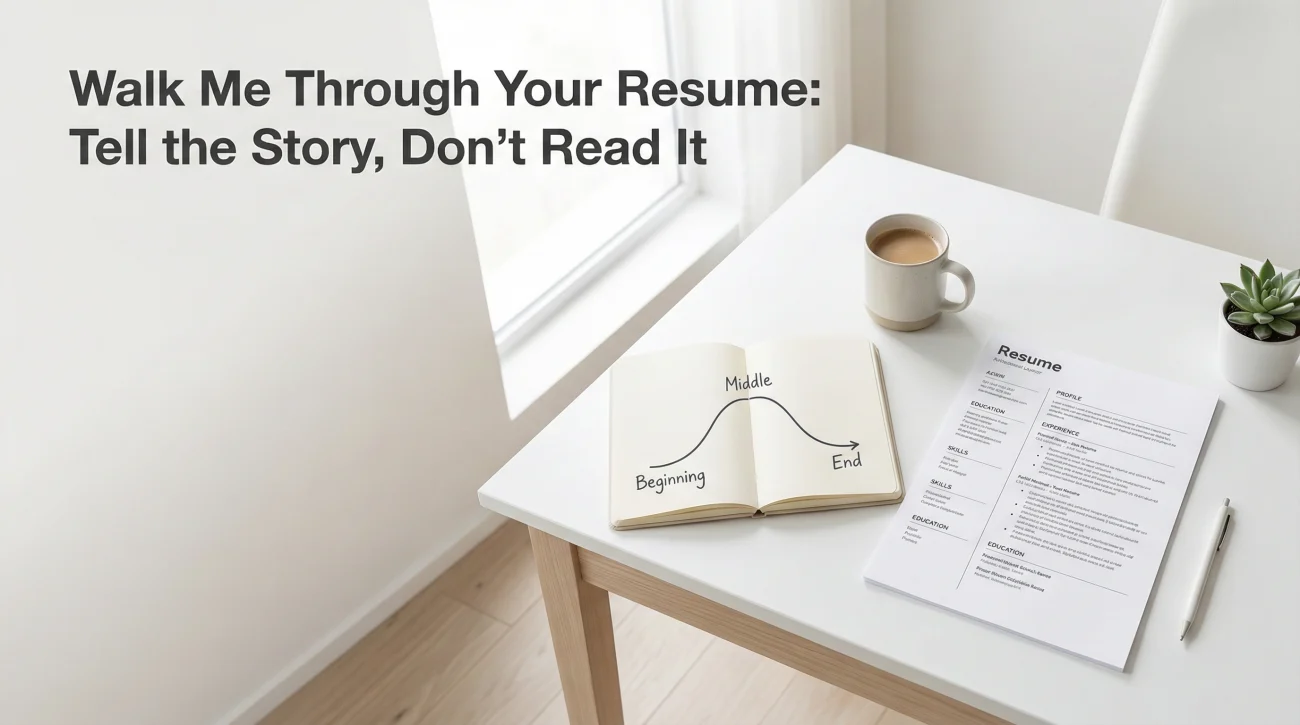
Walk Me Through Your Resume (Chronological vs Highlights)

Walk Me Through Your Resume

They Want the Plot, Not the PDF When someone asks walk me through your resume, they are not asking for a live audiobook. They already skimmed the dates and titles. What they want is the story behind the moves, and whether your judgment matches the role they are hiring for. Think of it as a … Read more

Tell Me About Yourself as a Freelancer (Transitioning to Full-Time)

Tell Me About Yourself As A Freelancer

Freelance, Not Flaky When you say tell me about yourself as a freelancer, the room is quietly translating. Are you a specialist or a drifter? Can you commit to one team, or will you disappear the moment the work gets boring? It is not personal, it is risk management. Here is the twist: freelancing can … Read more

Tell Me About Yourself for Career Changers (The Pivot)

Tell Me About Yourself For Career Changers

Connect the Dots Before They Try A career change is a story problem: the facts might be true, but the meaning is not obvious yet. In tell me about yourself for career changers, lead with the role you are moving toward, then immediately translate your past into skills that belong there. Pick one or two … Read more

Tell Me About Yourself for Executives (C-Suite & Strategy)

Tell Me About Yourself For Executives

Talk Like an Owner, Not a Candidate At the executive level, the room is doing risk math. With tell me about yourself for executives, start with your operating thesis, what you tend to build or fix, and the scale you have done it at. Then choose two proof points that show you can steer: a … Read more

Tell Me About Yourself for Managers (Team Lead & Leadership)

Tell Me About Yourself For Managers

Make Them See How You Lead, Fast Managers get judged on outcomes and on how they produce them. In tell me about yourself for managers, open with your management scope in plain words, then anchor it to one concrete result that happened because of your leadership. Choose moments that show your approach: how you set … Read more

Tell Me About Yourself for Experienced Professionals (Mid-Career)

Tell Me About Yourself For Experienced Professionals

Lead With Your Pattern, Not Your Timeline You are not trying to sound impressive here, you are trying to sound obvious. With tell me about yourself for experienced professionals, start by naming the professional you are today in one clean line, then give the listener a reason to trust that label. Pick two or three … Read more

Tell Me About Yourself for an Internship (Answer Examples)

Tell Me About Yourself For An Internship

What Internship Interviewers Actually Want Internship interviews operate differently than full-time hiring. When employers ask tell me about yourself for an internship, they’re not expecting a polished professional narrative. They know you’re early in your journey. What they’re assessing is whether you’ll make the most of this learning opportunity and potentially become a future full-time … Read more

Tell Me About Yourself as a Fresh Graduate (Entry Level)

Tell Me About Yourself As A Fresh Graduate

The Transition Moment You’ve spent years preparing for this moment. Coursework completed. Degree earned. And now someone asks tell me about yourself as a fresh graduate and you’re suddenly unsure what to say. You’re not a student anymore, but you’re not quite a professional yet either. You exist in the uncomfortable space between identities. This … Read more

Tell Me About Yourself as a Student (No Experience Answer)

Tell Me About Yourself As A Student

The Experience Gap That Isn’t Students freeze when asked tell me about yourself as a student because they believe they have nothing to say. No full-time jobs. No impressive titles. No years of experience to reference. The question feels designed for someone else, someone with a real career to describe. This perspective fundamentally misunderstands what … Read more

Interview Answer Length (Timing Guide)

Interview Answer Length

Core idea: Interview success depends on matching answer length to context, because the same content can feel confident or tone-deaf depending on timing. Context rules: Formal interviews reward 60 to 120 second answers, while networking and quick recruiter touchpoints demand a tight 30 to 45 second pitch. Two-minute structure: Use a clear time budget for … Read more

How to Use Interview Templates (Without Sounding Robotic)

How To Use Interview Templates

Why Templates Fail: People memorize scripts and sound wooden, the fix is treating templates as flexible frameworks that guide structure while keeping your voice. The 70/30 Rule: Keep 70% proven structure for flow and pacing, use 30% for real specifics like metrics, company context, and natural phrasing. Internalize Not Memorize: Practice the same framework multiple … Read more

Interview Introduction Scripts (The Copy-Paste Library)

Interview Introduction Scripts

Why scripts work: Prepared frameworks prevent awkward freezes and let you focus on confident delivery instead of scrambling for words. Framework over memorization: Learn the structure (what goes where), then speak it naturally, so you avoid sounding robotic. Use the right template: Keep one standard Present-Past-Future version and one situation-specific version for pivots, no experience, … Read more

Explaining Reasons for Leaving (The Right Way)

Explaining Reasons For Leaving

What Interviewers Are Really Testing: They use “why are you leaving” to predict professionalism, judgment, and whether you will repeat the same issues or blame patterns. The Moving Towards Framework: Briefly acknowledge the change, spend most of the answer on what you want next, then connect this role directly to that goal. Reframe Negatives Into … Read more

Transferable Skills Examples (The Bridge Strategy)

Transferable Skills Examples

Core idea: Transferable skills matter more than job titles because they show how you create outcomes across different settings. What counts: A skill transfers when the underlying problem, stakeholders, constraints, or decision-making pattern stays the same, even if the industry changes. Find yours: Work backward from real accomplishments, break down daily tasks into actions and … Read more